Thursday, October 27, 2011

The Sorrento Peninsular


Italian picturesque: Marina del Cantone


If you drive along the famous Amalfi Coast Road to Positano, then keep going, you will find yourself in the Sorrento Peninsular. Here, the towns are under the jurisdiction of Naples instead of Salerno, and you are technically no longer “on the Coast”. The landscape is subtly different, the lemon groves of Amalfi being replaced by old olive groves. Sadly, many are not neatly cultivated these days, but their blue-green foliage gives the hills here their special look.


A drive to the end of the Sorrento Peninsular has several rewards, one of which is the view of the Isle of Capri which you can have when you reach the end of the peninsular.

The divine Isle of Capri.

Another is the interesting view from a broad isthmus at Santa Agata sui due Golfi, where the land narrows so that you can see the Gulf of Sorrento on one side and the Gulf of Naples on the other - with Vesuvius brooding behind the city.

The Gulf of Naples and Vesuvio.

The fish are biting.


And a special reward is to stop for lunch at Marina del Cantone, a small fishing village on the sea, which must be thronged with holiday-makers in the summer, but is delightfully secluded in October. But the sun was still hot on my visit, an occasional local took a dip in the sea, and most of the beachside restaurants had not yet packed up for the season. Here at Restaurant Maria Grazie fresh fish - caught yesterday evening or early this morning - was on the menu. Maria Grazie is an icon of this little village, having been in business for generations, and was once very popular with visitors for its famous spaghetti and zucchini. Apparently people would come from Positano by boat just for Maria Grazie’s spaghetti and zucchini. But fish, crusty bread, and chilled white wine it was for me...


Maria Grazie in Marina del Cantone

October sunshine and a lazy lunch, at Marina del Cantone

Fresh as...!

Fish collection vehicles.


Then on with the drive, around the point of the peninsular and down to have a look at Sorrento, quite a big bustling city. Here we had an adventure with the local polizia, who took exception to a particular left turn...after quite  a bit of discussion, close examination of papers, and a longish wait, we were allowed on our way, that particular memory of Sorrento now passing into history and into this blog post, unbeknownst to the polizia involved...there’s nothing like an adventure, Italian-style. Ah, la dolce vita!


Map from: http://www.italytravelsguide.com/sorrento.php

Wednesday, October 26, 2011

Chestnuts


Chestnuts!


Of the multitude of produce grown in Australia, chestnuts seem to be a rarity. But in Italy they have been a welcome autumnal staple in the diet of the country people for hundreds, possibly thousands, of years. It is said that Pliny, and even Homer (of ‘The Odyssey’, not The Simpsons) mentioned chestnuts. They ripen in the autumn, and can be stored, roasted and eaten through the winter. They can also be made into a kind of flour and used to make sweet treats.

Chestnut-filled goodies.
Chestnuts - castagna in Italian - grow on steep slopes, so of course they are ideal for the Amalfi Coast, and in particular for the hills around the village of Scala, which perches high above the Coast. Scala is right next door to the more famous, chic and relatively elegant village of Ravello, famous for its music festival and for being the resort of choice for aristocrats over the decades. But Scala retains the atmosphere of a genuine traditional village, and it is also the location for one of the oldest traditional food festivals of the region: the Festa della Castagna, celebrated in October each year.

Party time in Scala.
Dancing along.

Venturing up to Scala on the second night of the two-day festa, finding parking was a challenge. But once found high up on one of the switchback roads which form the village, if was but a short toddle down several hundred steps direct to the village piazza, where all the action was. Centre stage - literally - were dozens of enthusiastic village children in traditional dress, the older ones singing and dancing and the younger ones crazily jigging along with their tambourines. Accompanied by a piano accordion and mandolin, they made a fine old din for the crowds of local who had rugged up for the pleasantly chilly autumn evening. This was another side to the Coast, which I’d enjoyed in the height of summer. Two months ago, coming up to Scala was an expedition to find a little shade and coolness under its trees. Possibly they are chestnut trees. I’ll have to check.


The cooks at work.


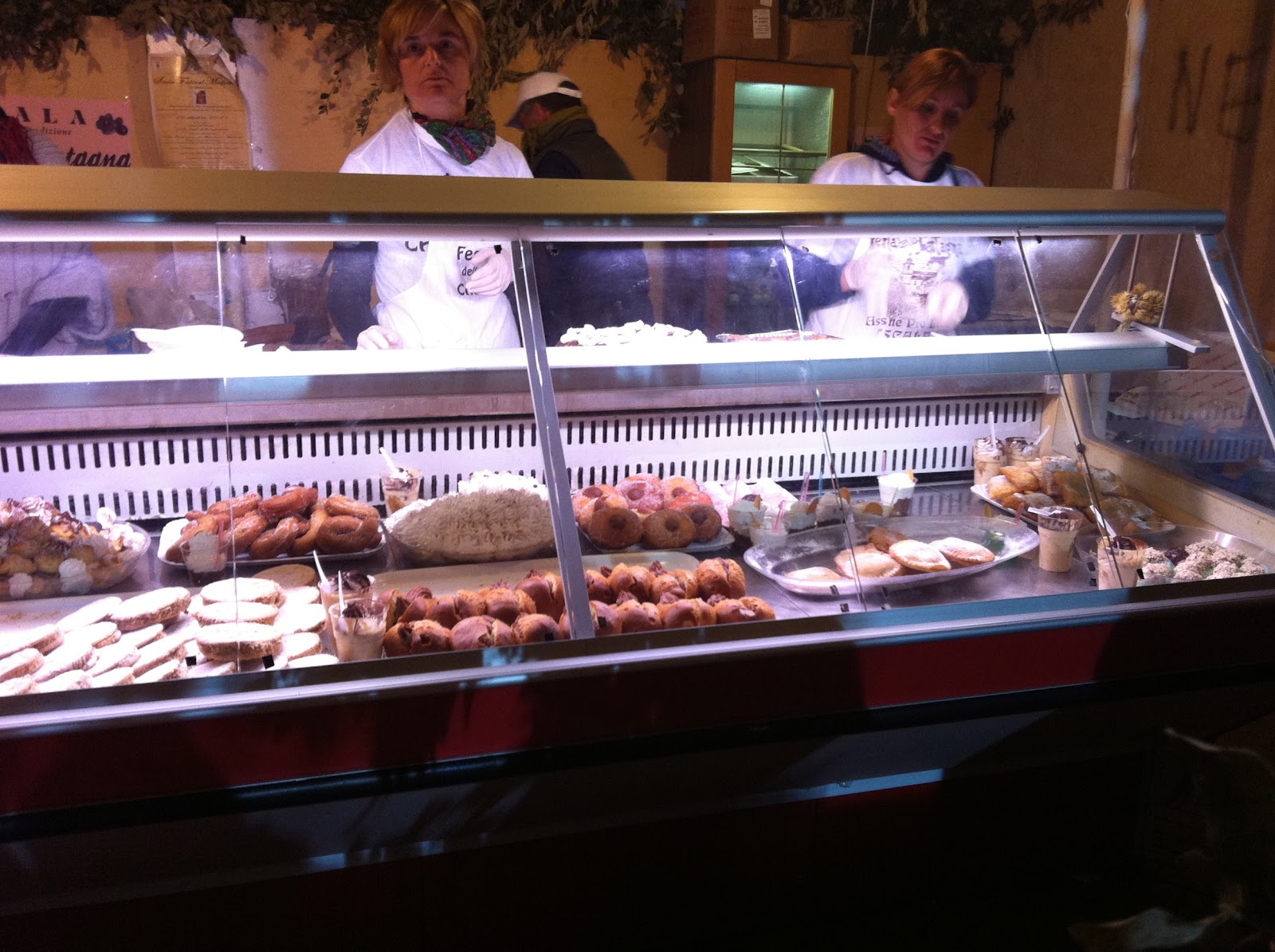
In the piazza several temporary food stalls were cooking up a storm, serving several versions of meat on a roll: spicy sausages, pork and spinach were featured. The pork was, rather unusually, cooked inside a big loaf of bread. But the pièce de résistance (if I can mix my languages here) was the stall selling a huge variety of chestnut-paste filled pastries. After all, this is a chestnut festa! Scala has a tradition of wonderful chestnut pastries. 


The pastry mother-lode.

Or, of course, you can collect the shiny, plump nuts direct from the tree and cook your own. According to this blog, this is how it is done:

Chestnuts can be eaten fresh, either roasted or boiled. Try the following recipe for boiled chestnuts: remove the outer hard skin and put them in a saucepan with enough water to cover, add a bay leaf and a sprig of green fennel and boil them for about forty minutes. Leave them to cool, peel off the soft skin and enjoy! If you omit the herbs you can then mash the boiled chestnuts to make chestnut purée to for desserts or to make gnocchi di castagne (chestnut dumplings).


It seems that Scala is not alone in celebrating the advent of chestnut season. All across Italy, towns come out for their own local versions of the festa della castagna.


Festa della Castagna


Monday, October 24, 2011

The festas of Southern Italy

The Madonna of the Church of St Elias, Furore, Amalfi Coast

Since I'm back in Italy on the Amalfi Coast this week, here's an appropriate post....

Southern Italy, that is, Sicily and all the boot up to Naples, has been occupied by foreigners on and off (mostly on) for 3,000 years, until 1860 and the advent of Garibaldi and his wild men. But Italian history is for another day. I point this out now merely to comment that one of the long term occupiers, Spain, has left the Southern Italians with at least one interesting cultural by-blow: a taste for parading their saints about and celebrating their Saints Days with local feasts and festivities.

Festa in Sacco, in the Cilento Hills

It's hard work for the band members.
A well-earned break 
The Madonna in the church at Sacco
Waiting for her outing.

Every small village has a special day when they carefully and reventially parade their special Madonna or Saint through the streets, and this must be accompanied by a band. The musicians of Puglia in Southern Italy have made such bands their speciality. For a really special festa, the village pools its funds and busses in a high-quality band from Puglia, preferably complete with an imposing maestro who will round off the parade with a set of operatic favourites (Italian opera, of course). Then there must be the lights put up all over the village to make the place sparkle on festa night; and the piece de resistance: the fireworks display. Village compete over the magnificence of their fireworks displays. The local comitato for the festa will receive congratulations all round if the band, the lights, the parade, the priests and the fireworks are all up to standard - and preferable better than those of the next-door village.

Atrani's Festa

The Comitato manning the office, Atrani

Ahhh...S. Maddelena! Atrani.

But it is not all about competing. The time of the festa is also a time for spotlighting the madonna or the saint of choice, showing some serious devotion; and of the community coming together. In some villages, it is the time when the diaspora of village people returns to visit from the far-flung corner of Italy - or Brooklyn.

Atrani parades its S. Maddelena

Atrani's fireworks rule!


Thursday, October 20, 2011

Would you travel without a camera?


Travel essential?

Whether you consider yourself a traveller or a tourist (and there’s a topic for another post), would you - could you - take a trip entirely without a camera? My camera (sometimes more than one) is with me on all my trips. Taking pictures and reliving the adventures through them afterwards gives me lots of pleasure, as does sharing my best shots on my blog, Facebook, in slideshows or even prints. I’m hardly Robinson Crusoe there.

But are reasons to leave the camera at home?


Duplication of effort:

Round and round and round...
If you are traveling in a couple (or more), and one person in the group is an avid or exceptionally good photographer, it may make sense for you to abandon any attempt to compete. My view is, if taking photos gives you your own special pleasure, go ahead and take your own too. Here’s a related point for that avid photographer: if you’re in a group, you can be really annoying if you make everyone wait while you get that one special shot. It’s only special to you. There are ways to avoid this problem, such as traveling alone or with other photographers. On an Antarctic cruise, I once joined a small group of photographers who were put into their own Zodiac (inflatable boat) with a photographic guide. The rest of the group was warned: “don’t join this boat unless you want to spend twenty minutes going round and round the same iceberg.” We did, and it was fantastic.


Too much effort:

On a grueling trek, a hike through sand and dust, or in hot humid conditions, where carrying a camera would be difficult or tough (on you and the camera), you might decide to forget that added hassle. On the other hand, if you are a keen photographer these extreme adventures may be just the sort of thing you want to record, but consider if the effort is really worth it. I carried my digital SLR and its heavy lens all the way to the top of Mt Kilimanjaro, then lay in my tent in the crater too exhausted by the climb and the altitude to have any wish at all to crawl out and set up a tripod to capture the full moon over the glaciers.

Crater camp on Kilimanjaro: a long way to drag a camera.

Photography not allowed:

You might be happily snapping away, recording your holiday memories, only to find that the interior of a special place is out of bounds to photography. Many churches, art galleries and museums do allow non-flash photographs, but certainly not all. How does that make you feel? I usually go through the gamut of momentary annoyance and maybe disappointment, to resignation, to actually enjoying the experience of a visit which doesn’t focus (excuse the pun) on lining up a great shot, or waiting for tourists to get out of my way. If the place is really special (think the Villa Borghese in Rome, as just one example), buy a book or a few postcards. A related situation: your camera breaks, or you forgot the charger, or the memory card is full or battery run down. Chill.

Photography could get you into trouble:

There are places you shouldn’t photograph: military installations are high on that list, and some parliament buildings. Put the camera away when you see one of those, or anything possibly related, such barbed wire and sandbag bunkers, or vague white domes in the desert, or an airport where there is no commercial airport. Yes, you might grab a Pulitzer winning clandestine picture, but you might also get arrested. Or shot. There are also culturally sensitive sites where photography might be inappropriate. (Aside: I would suggest that the elders of Uluru place that sign saying “no photographs” of certain sacred sites at the Rock a little more prominently - sorry!)

Uluru: Photography allowed from this viewpoint


What happens afterwards?

Get creative with your photos
In the old days, some holiday makers would return home, have their film developed, show the prints around, then put them in a drawer or box to be forgotten more or less for ever afterwards. Today the equivalent is a computer hard drive full of photos that haven’t been culled or edited or organised, and that no-one looks at anyway. I’ve known people who didn’t even download their pictures from their camera card. My motto is, if you enjoy your photos, keep them accessible. File them away on your computer in some kind of logical, named or at least dated order. And use them: put your favourite shots on your desktop, keep a blog or make Facebook albums, make some slideshows (really easy to do these days) even if only you will look at them. For very special “wow!” shot, you might consider prints; for once-in-a-lifetime trips a hard copy photo book is also easy to produce. Enter your best shots in photo competitions; make on-line albums and send the link to your friends.


The experiential approach

How many times have you seen - or been one of - a group of sightseers alighting from a bus at a viewpoint and hurriedly scattering en masse to take photographs? Now, as you can tell from my views above, I’m not averse to this. Photography gives a lot of people a lot of pleasure. But consider what the alternative experience might be like. I once sat next to a fellow traveller on a bus out to Yosemite National Park. The day was glorious, the waterfalls were in full spate, around every corner was a picture-postcard view. My companion simply got off the bus and gazed interestedly around him. No camera. In conversation, I learnt that he was taking a one year trip through various countries, learning languages and staying with local families. He had decided: no camera, and no souvenirs. There was no space in a backpack for souvenirs, and a year’s worth of photos was too daunting a prospect. With this philosophy, he was free to quietly absorb the places he visited, and fix them in his memory as experiences rather than carefully composed visual take-homes.

Bridal Veil Falls, Yosemite. Too beautiful not to snap....

A few tips for those of us who still want to take a camera:


Permission granted.
  • Carry a small compact which fits in your pocket for those times when a big SLR would be intrusive or crass, or when you’ll be walking for hours and don’t want to carry a load, or when you think you would like to go out without a camera but are still just a little too addicted to go cold turkey.
  • Seriously good photographs sometimes happen through luck; but more usually they do mean carrying good (heavy) gear, and getting up early to catch the best light. And having patience and the willingness to sacrifice most of your holiday to photography.
  • It is absolutely true that you should ask permission before sticking a camera lens in someone’s face. You might think that you are far enough away and they won’t notice...but you really don’t want an angry Maasai warrior dancing around in front of your African safari vehicle because someone inside it took a photo that shouldn’t have been taken (yep, actually happened to me). Also, it is just not civilised.
  • Do use long lenses to capture ‘people scenes’ without being obtrusive. And you will not - repeat, not - get any decent wildlife pictures with out some kind of telephoto. You will not get great ones with out the right equipment for the job. The same applies to itty-bitty subjects, such as insects, low-light situations and capturing movement. And as for trying to photograph inside an arena or theatre or cathedral with the little flash on your compact: it only lights up a few metres in front of you, you know. (I can’t believe that still needs to be said).
  • Do cull, discard, select when you get home. And do use editing software to at least straighten your wonky horizons and remove dust smudges. The diehards will work long and hard on their ‘post-production’, but even a happy-snapper has no excuse to show really bad photos now that digital is here.
  • If you take a camera on your trip, take it with you wherever you go, and use it. This may seem obvious, but cameras left in the hotel room are responsible for a lot of great missed shots.

Photo credit: Mike Holihan
Your blogger with long lens at the ready....

...for this shot.


And a final thought...

There are other ways to record and relive your trip. Try writing some stories, sketching, or making a scrapbook of ticket stubs, postcards and memorabilia. A camera isn’t compulsory. Enjoy!


Here are a few travel photographer blogs with some lovely shots: clearly these guys never leave their cameras behind!

David Lazar
The Travel Photographer
Mitchell K Photos


Tuesday, October 18, 2011

St Johns Wood


St Johns Wood Church Grounds
My new ‘hood, St Johns Wood, takes its name (obviously enough) from St Johns Wood Church and what was once a wood surrounding it. St Johns Wood Church Grounds is today a lovely park, presently picturesque with autumn leaves. The church and its grounds, originally a burial ground, date from 1814. The City of Westminster City looks after the park today, and the old gravestones and markers have been shifted to the edges of the park. They are set out so that any remaining inscriptions can be explored, but really the stones are very worn, and they sit quietly under the foliage of the park, evoking if not specifically commemorating the people of the 19th century parish who were buried here. If you want to poke around in the undergrowth, the City’s website suggests that you look for:

John Sell Cotman, watercolour painter, (1782-1842) This stone is on the west side of the grounds in the Glade.

Private Samuel Godley, (1781-1832), who fought at the battle of Waterloo This stone is close to the Cotman grave.


Joanna Southcott, religious fanatic, (1750-1814) There is a large marker stone against the west boundary wall which was erected in 1965. The grave itself is approximately twenty five feet due east of the marker stone.

London Central Mosque
Watercolour painter, Waterloo veteran, religious fanatic...hmmm...I wonder if the residents of St Johns Wood have changed much today?


Across the road from the church grounds in one direction is Regents Park, and London’s Central Mosque - a building with a lovely copper dome, but a minaret that looks something like a concrete water tower. I have yet to hear the call to prayer: not sure what the City of Westminster regulations are on that - perhaps more stringent than those in remote villages of Morocco’s Atlas Mountains, where the imam’s call wakes everybody at 4.45 am.

All over until next summer.


Across the road in the other direction is another cathedral to religion: Lord's Cricket Ground, official home of the MCC (Marylebone Cricket Club, for the non-afficionadoes out there). Surrounded by a high wall and with gateways patrolled by guards, this one is harder to visit. If, like me, you have often wondered why Lord’s is called Lord’s, here’s the answer: it was originally a private games ground owned by a chap named Thomas Lord. Like so many peculiar names in London, there’s a simple explanation. I have yet to nab a ticket to a cricket match, but according to a newsletter that came through my postbox yesterday, this autumn Lord’s is offering High Tea in The Long Room, usually the exclusive preserve of Members Only. You heard it hear first.


While we are on the subject of landmarks in St Johns Wood, possibly the most famous of all is Abbey Road, The Beatles’ studio and “the” pedestrian crossing that featured on the cover of their album of the same name. On any day, motorists are good-naturedly held up while tourists attempt to pose in mid-stride on the crossing just like John, Paul, George and Ringo. Paul McCartney still live in St Johns Wood, though I’m not sure where. There are many very well-to-do mansions around here, any one of which could potentially hide a celebrity. The Abbey Road studio itself is a white building set back from the road; I was surprised to find that its white-painted fence posts are covered in tiny graffiti - messages left by visiting fans over the years.

Buy your Beatles memorabilia here.


St Johns Wood makes a bit of a thing of its connection with The Fab Four (remember when they were called that?) There is a Beatles souvenir shop outside the tube station; and Beatles classics playing in the coffee shops of the High Street.


Apart from these monuments to god and mammon, St Johns Wood is a well-to-do, leafy suburb with lots of ex-pats (American and Australian, I’ve noticed), many young families, a Carluccio’s usually full of strollers and prams, at least five dry-cleaners and seven real estate agents, an organic food market, one pub and a variety of cafes and small restaurants. Apart from the Oxfam second hand shop, there is not, as far as I am aware, a bookshop. St Johns tube stop is on the Jubilee line, one stop from Baker Street and two from Bond Street, and - as the saying goes - a million miles from care.

My 'local": Carluccio's, St Johns Wood style.


"Home"

Beatles pic from http://www.popartuk.com/music/the-beatles/abbey-road-album-cover-lp0597-poster.asp

Saturday, October 15, 2011

Narita Stopover


Tea & cookies

12 hours in Japan - what would YOU do? I have visited Japan in the past, and so have seen the major “sights” of Tokyo, and with only 12 hours there is a limit on how far you can expect to travel. Indeed, I’ve been warned that it can take 2 -3 hours to get in to central Tokyo from the airport at Narita. Plus there’s the dreaded jet lag to consider. Here’s what I did after arriving at 9 am:

First: check into a day room at the Narita Rest House and take a shower. Good move. The Narita Rest House, despite it’s attractive traditional-sounding name, is in fact a cheap, run-down airport hotel. Never mind - it has a shower and a bed, and one of those amazing over-engineered Japanese toilets.

Red letter day at Naritasan

Watching the show.
Second: head off with pre-booked guide, Ms Kaoru Otani, and a cheerful driver. We made our way into the city of Narita, our object the local temple known as Naritasan. This, as it turns out, is a principal Shingon Budhist temple, founded in 940, and is a huge complex of buildings and gardens. Not only that, we have arrived on the day of the annual fire-walking ceremony. How lucky can we be? Naritasan, approached by several large gates and steep staircases, is dedicated to a deity named Fudōmyōō, who is associated with flames. Thus, the monks get to play with fire quite a lot. In fact, the main ceremony, which I witnessed, is performed several times a day and involves the lighting of a sacred fire. It seems that if you wave your belongings in the general direction of the flames, they absorb some spiritually potency, so the ceremony ends with the monks carrying armloads of cheap handbags and waving them in the flames before returning them to their pious and hopeful owners. Outside, since this was a special day, other monks were lighting a large bonfire and performing various rites of chanting, dancing and fierce-sounding invocations around it. Later, they would walk on the dying embers.

Beautiful pagoda

Kaoru grabs some spiritual incense smoke

Japanese tea house
Third: Leaving the temple after the ceremony, Kaoru and I wandered up a nearby street, where vendors were getting ready to quell the appetite of the faithful with a variety of unidentifiable foodstuffs, including a kind of jellied eel, the local speciality. Seeking refreshment, we walked down a small side alley and found a lovely little tea garden, complete with koi pond and red parasol umbrellas. Kaoru helpfully ordered some Japanese tea (strange sludgy stuff) and sweets (a red bean paste thingy), which I drank and ate, feeling very Japanese. Well, a tiny bit.

Fourth: After this interlude, we hooked up again with our cheerful driver and set off for a neighbouring city, Sakura City, about 30 minutes drive away. As in many parts of Japan, it was hard to tell where one city ended and the next started, since there is very little actual countryside still existing. But in the end we reached our goal: the National Museum of Japanese History. I had read on the web that this was a very good museum, but Kaoru sheepishly admitted that she had never been there. Once inside, she and I wandered through the galleries on the early Paleolithic age through to the Nara period (8th century); daily life from the 9th to the 16th centuries including the Heian court and everyday lives of samurai, and a wonderful model of 16th century Kyoto; and then the culture of the Edo period up to the 18th century. Kaoru kept exclaiming (in a refined Japanese kind of way): “This great treasure!”, “Look here! This very famous!” We found marvelous scrolls that had been preserved for centuries, buried in metal canisters; awesome and detailed painted screens showing life in ancient Kyoto and Tokyo; and some very well preserved ancient pottery and statuettes. 
National Museum of Japanese History

Aren't they cute?

Edo period Tokyo- "a treasure!"
It is indeed a great museum, though very rarely visited because of its distance from Tokyo. It was a busy Sunday at Naritasan, but there was hardly anyone in the museum. Not only is the Museum worth a visit for its contents, but it also sits in a beautiful botanical park known as Sakura Castle Park. Sakura Castle, of which some remains still exist in the park, was founded in the early 1600s. Sadly, a mere stopover did not give enough time to explore - maybe next time.

Fifth and final: back to the Narita Rest House for a few hours of shut-eye before the next long-haul flight leg. And another look at that amazing toilet.

Toilet instructions: contemplate and enjoy.

Er...maybe later.