Showing posts with label Hamburg. Show all posts

Monday, April 29, 2013

Hamburg in the snow

Hamburg in the snow


Spring seemed late arriving in Europe this year. Elegant Hamburg was still under a blanket of snowy drifts in late March.


Waking to a city blanketed

Interior of St Michael's Church: Lutheran simplicity

And this would be Dr Luther himself

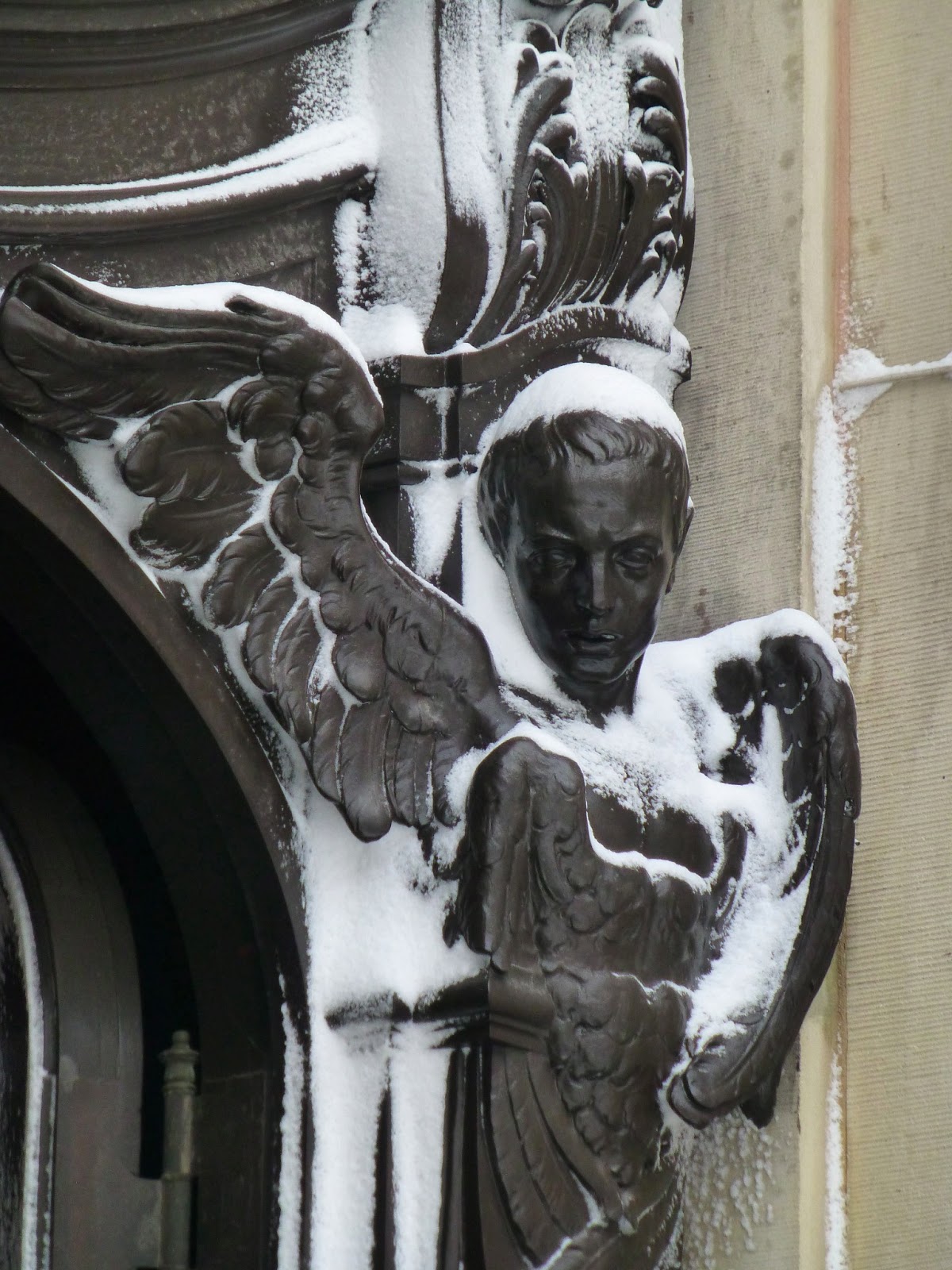
A fierce-looking angel on the portal of st Michael's


Snowy streets

Interior of the Rathaus hall

Brahms' House

Cafes on the canals

Rathaus (Town Hall)


Sunday, September 19, 2010

Containerland

Well I am glad I saw that – ‘Bliss’ in its German version.  It was very interesting indeed to see a different interpretation, and I am coming to love the music very much. However, I wouldn’t give the Hamburg version the honours. The production design and direction was unattractive, IMO. Some of the singers – particularly Betty (Hellen Kwon) and Alex (Viktor Rud) were improvements on the OA cast, but I can’t say that I preferred the Harry Joy or the Honey B. Certainly we like to hear the high notes hit strongly and accurately; but it is not so good to have to trade off delicate interpretation and good acting. Also, with all due respect, Harry looked decidedly unattractive, making the storyline even more unlikely than it already is.

Simone Young’s orchestra was marvellous. It was unusual to have the singing in English and the surtitles in German (but a useful change from the singing in Russian and the surtitles in Spanish, which was the case last weekend). I couldn’t say quite what era the production was supposed to be set in. It looked like the present day, except cheap and tacky – perhaps that what the designer and director think Australia is like. But then Harry Joy wore his white suit and shoes, and Mrs Dalton looked like Maggie Thatcher. The bedlam scene was set in a rubbish dump, with which we were then stuck for the whole of the second act. Instead of the Elysium of nature, the finale was therefore set in the rubbish dump, which by then had spouted bits of greenery. Honey B turned up dressed as a....bee, and the dump transmogrified into a hive. Or possibly a honey pot. Which was somewhat more disturbing than Neil Armfield’s peat moss and plantings. OA did the beautiful ending much better. And the explosion.

If you haven’t seen the opera, all this will either make you very curious, or bore you silly.


In other news, I made a local acquaintance today, and was introduced to Hamburg. Christian, the driver/guide from the hotel drove me around for a few hours in his nice Audi. We started with the local ‘willages’, and as I surmised yesterday, we are in millionaire territory around here. Hamburg vies only with Bremen for the highest number of millionaires per square inch. They are merchants, notaries, shipowners, and vote conservative en bloc, according to Christian.


Hamburg is actually an inland port – 70 kms from the North Sea. Yet it is the largest port in Europe – 75 square kilometres – and second only to Rotterdam in the number of containers it moves: 10 million per year. In fact, it is Containerland around here. I saw containers used as billboards and containers used as art installations. They worship containers. The Queen Mary can, and does, come into the Hamburg port, but it has to wait for the flood tide. Everyone gets excited and bands play along the riverbanks.


The other ubiquitous things in Hamburg are the container loading cranes. These are silhouetted on every horizon. There are pretty riverside walks, a lake with sailing boats, a sandy man-made beach, lush green parks and up-market cafes – and in the background of every view, the cranes.

John, Paul, Ringo and George. And me.


But there was one exciting spot where there are no cranes – the seedy laneway in Reeperbahn, the red light district, where the ‘Indigo’ Club stands. This was the site of The Beatles’ first German performance in August 1960, and the launch of their career. Moreover – just so you realise the significance of finding this spot – I am the proud owner of a copy of the LP record made in Hamburg that year, entitled, appropriately enough, ‘The Beatles In Hamburg’. This precious object I have left in Sydney in the safe and appreciative hands of Dan, who at least owns a turntable.


Christian & Carl's


Christian and I toured Hamburg’s districts in his car, walked around a little at the port and in the largest cathedral, St Michel (Lutheran of course), and had lunch at a bistro in the new Haffencity redevelopment area, opposite the partially-finished new concert hall (which is going to look fabulous when it’s done). The bistro in question, ‘Carl’s, is owned by the same person as owns my hotel, a rich shipowner. I speculated over lunch as to why a rich shipowner would want to get into the hospitality business. Christian replied: ‘but they need their hobbies’.


See? Canals.


I asked how Hamburg had fared in WWII. It seems that it was badly bombed, with 40,000 lives being lost in one night in 1943. Much of the city centre is thus reconstruction, although the Louis C Jacob, being further out, escaped. The blackened steeple of the St Nikolai church has been left looming over the modern buildings as a bleak reminder. Hamburg is, though, a pretty and liveable city. It has a lake in the centre, and 2500 canals (‘more than Venice’).


Finally, for those of you following my beer-drinking career, I sampled a local brew at lunchtime: Ratsherrn Bio-Pilsener vom Fass. I don’t know what that means; I took it on faith, trusting in Christian and ‘Carl’s’. It was quite nice.

Food


My tour of the Hotel Louis C Jacob was quite fascinating. The front of house manager was my guide. Her name is Annette. On the basis of this trivial co-incidence, she confided that she had allocated me to one her favourite rooms in the hotel. I have also just had a call to say that an opening has occurred in their famous restaurant, so either the name thing is way more important than I could have thought possible, or I showed suitable signs of being impressed by the tour. Or it could be pure chance, of course.

The famous terrace with lime trees - on a rainy afternoon.
The oldest part of the building dates from 1790; there is a marvellous huge cellar which was discovered when their earthmoving equipment fell into it during excavations for recent renovations; the artworks on the walls – 500 of them - are all originals, forming the collection of the private owner. They have a Max Lieberman painting of the terrace (although not that painting of the terrace – it is in the Hamburg Art Museum). There is a story about Lieberman staying in ‘the house’ (as they call the hotel), and they have a ‘Lieberman Room’ where they think he may have laid his head.


But the best bit was being allowed into the celeb chef’s kitchen – a huge affair with 60 chefs. It has its own escalator. Extraordinary. Well, my salmon and warm potato salad lunch, which I had this afternoon in the sitting room from the bar menu, was delicious, so I am hoping of great things from dinner tonight, now that I have been ‘allowed in’.

Thomas Martin's kitchen at the Louis C Jacob Hotel, Hamburg
I checked – this place is only costing 185 Euro a night – very inexpensive for the standard. Wow – a find. Of course, I haven’t seen Hamburg yet! But I do like a destination hotel. For the record, the chef’s name is Thomas Martin. He has one Michelin star, and catered Robert Redford’s wedding (here).

*****
Later.....

Well, dinner was more of a theatrical experience than a meal – very special. I regarded it as excellent training for el Bulli (which has three Michelin stars, the maximum possible). Dinner lasted only 2.5 hours, while el Bulli will be 5.5, but as with all marathon training, one needs to start slow. I recorded the progress of the meal on Facebook – a version of real-time reporting – which, due to the ephemeral nature of Facebook posts, I will repeat here:

Practicing for el Bulli. Although this Thomas Martin restaurant in Hamburg has 'only' one Michelin star. 60 chefs and an escalator in the kitchen (I had a tour).

The amuse bouche consisted of 5 things. All delicious, I'm pleased to report.

Wait - that wasn't the amuse bouche. It has now arrived: pumpkin done 4 ways. And house made rye bread with pumpkin seeds, German unpasteurised butter and salt flavoured with grapefruit.

Tuna, done 3 ways, all raw of course. And rooibos tea on the side.

Poussin with pea purée and lobster. What is poussin anyway? I've just eaten it and I'm still not sure.

Veal, two versions; and a cheese called 'Munster' eaten with a knife and fork.

Choice of about 4 dozen petit fours and chocolates with tea. 2.5 hours. Quite exhausted. Will I last 6 hrs at el Bulli?

Roger: We have great confidence in your stamina!

Anton: Glad to hear you weren't too .. er .. chicken to try the poussin. And loved the rooibos touch. What a feast!

Jocelyn: According to my French dictionary, poussin is, somewhat obscurely: (zool) chick: (terme affectueur) pet, poppet. But if you check chicken in the English section it tells you more helpfully that it is a very young poussin.

Me: Shouldn't it have been' das Hähnchen'? In any event, it was well disguised. But tasty.

Poussin?


*****
The next day...

And so we turn to breakfast.  I can report that a Michelin-starred restaurant does an excellent poached egg (and everything else), and that nothing was lost in translation. Jocelyn has taken up with vigour the question of why the Spanish don’t recognise poached eggs, and reported yesterday that a Spanish – or, I should say, Catalonian – friend had replied to her enquiries:

Dear Jocelyn:
Entre testamento y requerimiento judicial, y reunión con abogados, me detengo unos minutos a discutir si el huevo de tal manera es poché o escaldado.

En español el huevo sin cáscara cocido en agua hirviendo con vinagre y moldeado con dos cucharas es "ESCALDADO "
El huevo cocido en agua hirviendo con cáscara pocos minutos quedando muy crudo es "POCHÉ"

Supongo que en cada región lo llamarán de una manera diferente.

Querida Jocelyn, vuelvo a mis cotidianos temas, BYE.  Gloria.

I somewhat amazed myself by being able to work out the gist of this, with only a few recourses to Google Translate (which, as usual, baulked at a couple of fences):

Between 'testamento' and judicial requirements, and meetings with lawyers, she now has one minute to discuss the manner of the egg 'poché' or 'escaldado'.
In Spanish the egg without a shell cooked in hot water with vinegar and moulded with two spoons is called ESCALDADO ['scalded']. An egg cooked in hot water with its shell for a few minutes, being very crude (?) is "POCHÉ" ["poached']

She supposes that in each region it is called in a different way.

Dear Jocelyn, I return to my everyday issues, BYE. Gloria

This is quite revealing, and explains why I received a soft boiled egg when I used the term 'poached'.


It has been an interesting cross-lingua investigation. To which we can now add the more quickly solved mystery of ‘poussin’.

But wait....I’ve just had an SMS from Kyle which will neatly close this discussion:

Quote in today’s Sunday Times: “Other restaurants may aspire to theatre, while el Bulli is opera”


Saturday, September 18, 2010

Germany: Hamburg


I arrived in Hamburg today, a new city for me. It is of course the home of that famous Sydney girl, Simone Young, who is musical director at the Hamburg Opera, and – according to the guide book I picked up at the airport – she has ‘become firmly established in Hamburg’ and ‘a star of the local cultural scene.’ There is a photograph of her in the hotel’s brochure. Tomorrow night I go to hear her conduct the opera ‘Bliss’, which she originally commissioned from composer Brett Dean, back in the days when she and Opera Australia were still friends.  I read some reviews of the first performance, and it is said to be better than OA’s version – we’ll see!

Hotel Louis C Jacob
The hotel I have washed up at is called the Louis C Jacob http://www.hotel-jacob.de/ and is out of town a bit, on the banks of the River Elbe: at Elbchaussee. It is a divine old place, with an historic main building and a new wing (huge rooms). It is one of those places that gives new guests an aperitif and a tour of the building, a custom of which I am about to avail myself, once the cocktail hour arrives.  The guide book describes it as

‘Arguably the most beautiful, privately-run hotel in the city, with an idyllic view of the river from the Elbchaussee. Meticulously furnished right down to the last oil painting over the mantelpiece. Everyone who is anyone in Blankenese will have either had their wedding reception or at least a birthday celebration here. And dinner under the lime trees – immortalized by the artist Max Liebermann – is simply divine.’

Divine it may be, but I won’t be having dinner under the lime trees, because the restaurant is booked solid throughout my stay. Everyone who is anyone is having their wedding reception or at least a birthday celebration here. But they should let me in for breakfast.

Terrasse im Restaurant Jacob in Nienstedten an der Elbe
Max Liebermann 1902

The cab drove through the surrounding suburban neighbourhood on the way here, and I would confidently say that this must be one of the most beautiful and wealthy areas in all of Europe. I do not exaggerate. It is full of huge old villas, beautifully kept, set back in their grounds and surrounded by parklike gardens. I saw little girls in white satin with cerise umbrellas (it was raining lightly) skipping to church where the bells were ringing (possibly the wedding prior to the reception at the Louis C Jacob). Some houses were converted barns, with great steep roofs covered in thick thatch.  Everywhere looked green, damp, cool, immaculate, rich and well-run: kind of the opposite of Madrid last weekend.

Tonight I am stepping down the road to a restaurant recommended by the concierge, and tomorrow I’m taking a city tour with a guide – including collecting my opera ticket and getting the scoop on where to eat pre-theatre. There’s nothing like local information.

It has begun to rain lightly again. To quote the useful guidebook (written by a Hamburger):

‘Hamburg is one of the greenest cities in Germany – which is not really surprising considering there are two rivers, the Alster and the Elbe, that flow through the city under countless bridges. With the combination of water from below and water from above the city cannot be anything but green and luxuriant. Rain and fog do not deter the true northerner.’

Well, I am a true southerner, but I did think to bring my coat and umbrella, so this southerner will also be undeterred.

As far as I can make out, the main feature of Hamburg (apart from this lovely suburb) is it dock area, where beats the huge commercial heart of the city. I also discovered what the term ‘Hanseatic’ means. Any guesses? It refers to the merchant roots of Hamburg, in the 13th to 15th centuries, when it was part of the ‘Hanse’ guild of merchants, the most powerful league of cities in the world at that time (‘world’ in this context presumably meaning ‘Europe’). Hamburgers seem very keen on being ‘Hanseatic people’ (despite the 15th century being a very long time ago), and I read this about something termed ‘the Hanseatic mentality’:

‘A Hanseatic merchant has many virtues: he is proud of his tradition, is honest and direct, but never short-tempered. A true Hanseatic citizen doesn’t look back (‘what’s gone is gone’), but forward.’

Of course, others have reviewed the merchants of Hamburg in less favourable terms, such as the King of Denmark in the 17th century:

‘Arrogant skin-flints and pepper sacks [‘money grabbers’], slimy fish-mongers and lazybones...’

So far everyone I’ve met has been lovely, so I can’t endorse King Christian’s views at this point. However there seems no doubt that Hamburg today – having survived a Great Fire on 5th May 1842, bombing in WWII, and big floods in 1962 – remains an extraordinary vital commercial centre. In 2006 there were 22,684 new companies registered at Hamburg’s Chamber of Commerce, hitting a high point in the city’s history. This, with a population of around 1.75 million – less than half of Sydney’s population.

I have spent the afternoon relaxing in this lovely hotel (which I hasten to assure you was not especially expensive – its out-of-town location seems to keep the price down), which has been lovely after the crazy-busy week I had last week.

Annette Locator: Hamburg

I think I should at this point acknowledge the contribution to my knowledge of Hamburg – and yours – made by my little guide book, one in the ‘Marco Polo’ series and written mainly by a local named Dorothea Heintze. Thank you, Dorothea. Dorothea clearly loves her city, but doesn’t shy off giving her readers the bad news too:

‘Most locals are open and friendly towards visitors and are anything but arrogant or stand-offish. Traders from the Hanseatic city have been criss-crossing the world’s oceans, building up business, since time immemorial and their relationship with their British counterparts across the Channel has always been very close’ [I see she skips lightly over that bombing thing]...But everybody is expected to do one thing: keep a stiff upper lip. Hanseatic northerners faithfully uphold their local mentality – never to lose face and always to show a certain restraint. Those who are not from Hamburg would perhaps call this aloofness.’

Now I’m afraid to go out....