Showing posts with label Venice. Show all posts

Saturday, October 26, 2013

And more Contemporary Art.


Duane Hansen 'Bus Stop Lady' (1983) USA. Uncanny.
Some more highlights from the Venice Biennale, this time from the Arsenale site, where a few more countries were represented, including Italy and China. There was also room after room in the old industrial complex of individual artists - much higher-quality stuff (IMHO) than the Giardini Central Pavilion. See what you think...

Daniel Hesidence 'Untitled - Maritime Spring' (2012) - USA.
One of the rare 2D offerings. Rich marine colours.
Not entirely sure (forgot to take a note of the artist), but striking.
Walls and walls of comic book pages. I read few. Religious themes.
The artist might be saying something by putting comic pages on the wall. But they'd be much easier to peruse in comic book format.
Shinichi Sawada 'Untitled - Spiked Face'. (2000 - 2007) Japan.
One of a cabinet of similar figures. Highly textured clay, and strangely Japanese.
Pawel Althamer 'Venetians' (2013) Polish, I think.
There was a whole room full of these people, carefully made. Spooky. 
John DeAndrea 'Ariel II' (2011) USA.
This is painted bronze. An uncanny texture.
Charles Ray, 'Fall '91' (1992).
This is blurry because the guy with the fan was yelling "no photo!" Ironically, it was him
standing beside the work that attracted me to take a photo, because you could see the odd scale.
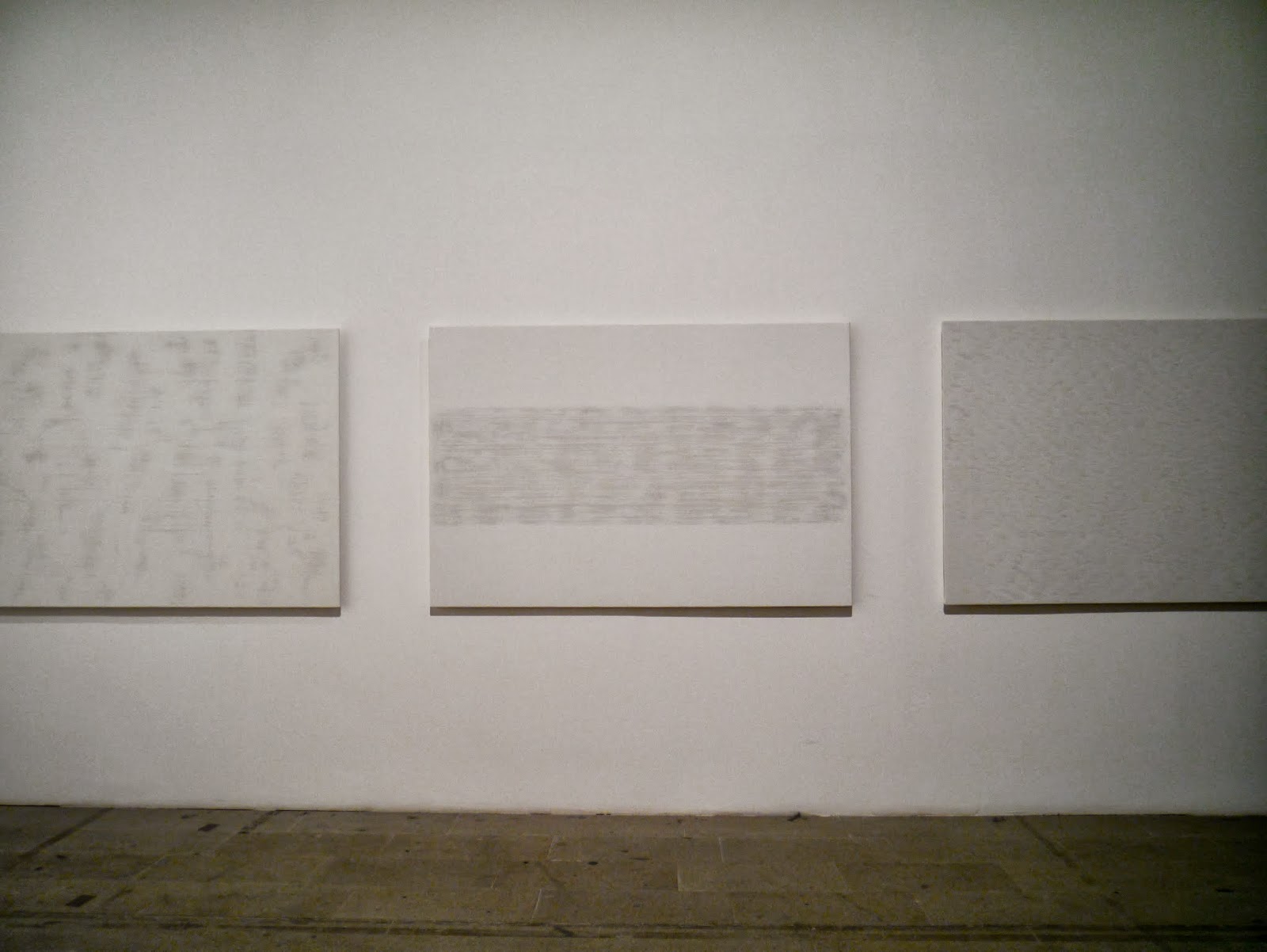
Prabhavathi Meppayil 'Untitled' (2011) India.
Copper wire embedded in gesso. The artist, a woman, works with Indian jewellery craftsmen.
Minimalist, quiet, deep.
Walter De Maria 'Apollo's Ecstasy' (1990)
This artist is big in "Land Art" - kilometres of concrete walls, metal rods in the desert, that sort of thing.
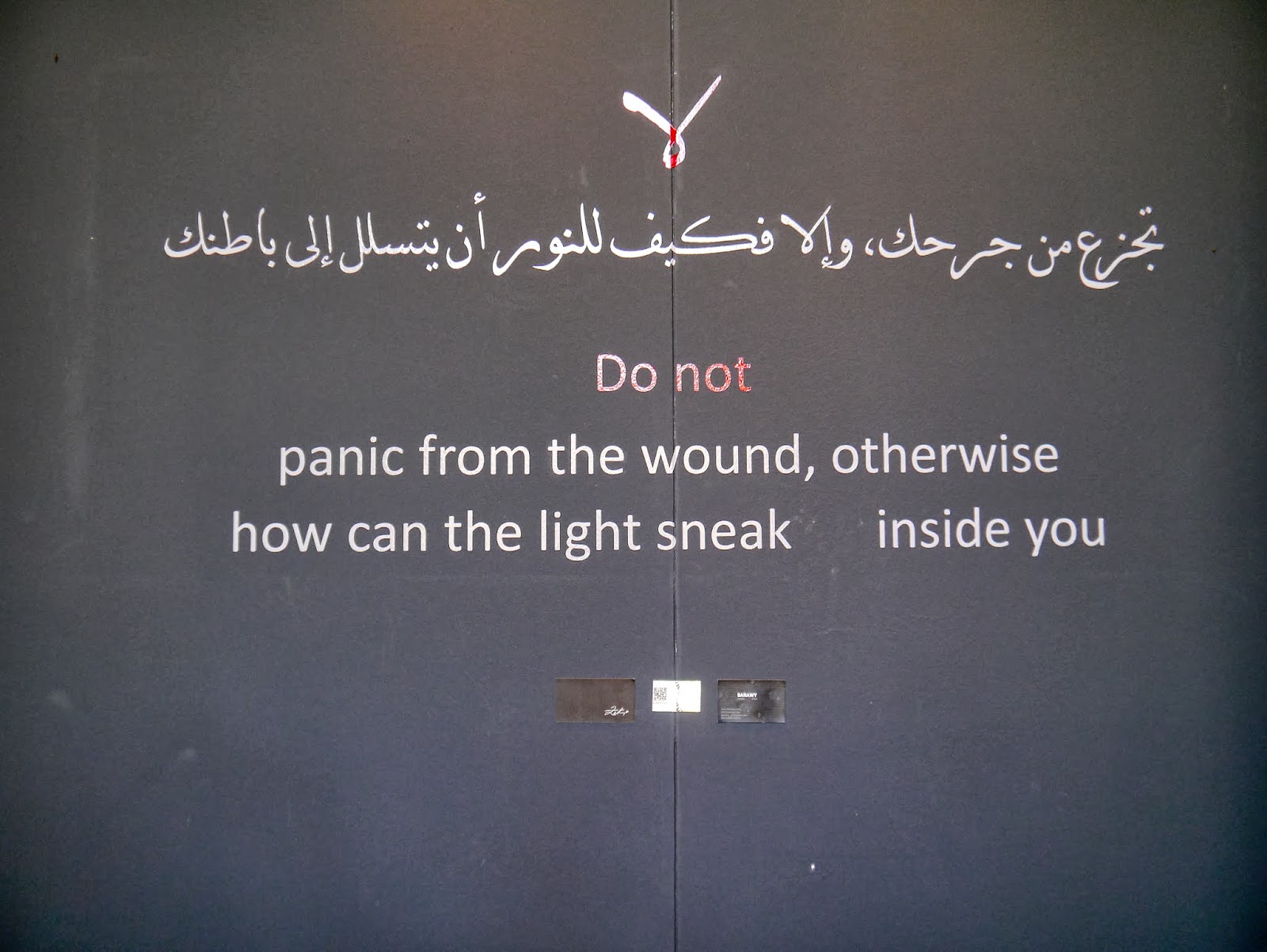
Akram Zaatari 'Letter to a Refusing Pilot' (Lebanon Pavilion)
A video work I actually liked. Highly political, makes a clear an important statement, and uses 'The Little Prince'.
And not in a darkened room.
Yup. Kosovo.
This was followed by a large installation made of tree branches that you could walk into. It had peepholes that showed you women's clothing on hangers in a white room. *more information needed*
This was in the Kosovo pavilion too, Masterful draughtsmanship and precise and elegant lighting.
I don't know what's going on, but clearly something very dramatic. Life-sized. The Indonesian Pavilion.
An olfactory - and colourful - piece in a combined South American space.
From the Pavilion of the Bahamas, which was - I thought ironically - concerned entirely with Polar themes.
Artist Tavares Strachan. This piece - one of many different ones - is an example of the fairly popular (and clever) technique of using of tiny images to make a bigger one (in this case, the big image os a polar bear.) 
Yes, a piece of Polar ice. Pavilion of the Bahamas.
There was also a companion piece - 'fake Polar ice'.
Elisabetta Benassi 'The Dry Salvages' (2013). Italian Pavilion.
An uneven floor (you can walk on it) of 10,000 bricks made of clay from a flood plain and stamped
with the codes of the largest pieces of space debris still in orbit. And a T S Eliot poem referenced in there, too.
Monumental, carefully made, and thought-provoking. All the best qualities. Though you do need the explanation.
Shu Yong 'Guge Bricks 1500' (2013) China.
The artist took 1,500 slogans, words, maxims and quotations from Chinese and translated them into English
with Google Translate. Then he printed the results on paper and stuck them to these bricks. As above.
Li Wei 'Floating over Venice' (2013) - a performance.
In the Republic of Kenya Pavilion (in a Venetian office building).
This photo is a result, presumably, of the performance.


Friday, October 25, 2013

Contemporary Art


Venezuela. Urban Art (aka graffiti)
Some more highlights from the Venice Biennale - so much contemporary art, so little blog space...an eclectic selection of things that caught my eye at the Giardini site.

What I love about contemporary art: ideas made concrete; solidity; provocation; well-made things; thought-provoking; monumentality; connection with contemporary culture.

What I dislike about contemporary art: shoddily made things; penis fixations (particularly of the large and bloated kind); violence (go to the movies if you want this); video installations. And if you're going to do the "found objects" thing, you better be good, very good.

Themes I noticed in the Venice Biennale: destruction/deconstruction; digital/video anything; miniatures; collections of myriads of things - found objects, multiples works or sketches clumped together.

And - the "hard to find entrance". The Danish pavilion had eschewed its usual front door and taped rough little paper signs pointing the way to "Entry" along the back wall and around a few corners, and you entered via a broken bit of wall. You exited through a cluttered storeroom. The Finnish Pavilion's entrance was behind a flap of black canvas. And even finding the entrance to the USA Pavilion was a bit of a challenge.When I mentioned to the door attendant that they needed a sign, she replied "I know. Unfortunately, that's the point."

Ah, contemporary art. Ideas made solid. Though not always prettily.

The USA Pavilion.

The Swiss Pavilion. 

Entrance this way. 

The UK Pavilion. Something about Prince Harry probably shooting an endangered species.

The Australian Pavilion. I don't know. But I liked it.

The Uruguay Pavilion.

The Hungarian Pavilion. Started strong with a theme about unexploded shells, but lost me when it
devolved into a video-and-earphones thing.

A very good performance piece going on in the Central Pavilion. There was chanting.

Swiss artist Jean-Frédéric Schnyder. I think this is the devil. In a Tyrolean hat.
Central Pavilion, Giardini.

Brazilian Pavilion.

Brazilian Pavilion. It's called "Soft Books". 
This was a sound exhibit. Unfortunately the local authorities had insisted on
reduced decibels and limited "sounding" times. About which the artiist was miffed.

This was the Romanian Pavilion. There was nothing in it. 

The Venice Pavilion (the city has its own). A 'Silk Map' theme. This is inside a large silk egg. Really.

Egypt. Yup.

Egypt. Beautiful and golden.

Serbia. Vladimir Perić. "3D Wallpaper of Children's Room" (2007)
Composed of Mickey Mouse figures collected personally by the artist from flea markets.
(You should see his razor-blade bathroom wallpaper).


Thursday, October 24, 2013

Favourites from the Venice Biennale

'Danaë' by artist Vadim Zakharov: Russian Pavilion
I'd been at the Giardini site of the Venice Biennale for about half a day, and I'd decided on the 'winners' from amongst the 29 Country Pavilions - in my humble opinion (such as it is), the best three were: Russia, Spain and The Netherlands.

Honourable mentions: Greece, Venice, Austria, Serbia, Egypt. And maybe Australia. And maybe the UK. Oh, I forgot: Venezuela was pretty good too, and Switzerland was OK. And the Ai Wei Wei installation...

And I hadn't even got to the Arsenale yet...

But let me share a little from the three that impressed me the most, in that first half-day.

Russian Pavilion
'Danaë' by artist Vadim Zakharov.

I'm not usually into "audience participation" art works, but I liked this one because of its re-imagining of a myth. Myths are so unexpectedly powerful. Golden coins rained down upon female visitors - referencing Danaë and no doubt lots of other themes. My golden moment: watching a chagrined male visitor trying to insist that he should be allowed into the "female only" rain room. He just didn't get it.

This is the official description of this work:

Ladies only....
"The mythological theme of Danaë, as a constantly recurring motif in art from antiquity to the modern period, is given a new, updated interpretation through Vadim Zakharov’s transformation of the Russian Pavilion.

The divine myth about the impregnating of the Greek figure of Danaë is subject to numerous readings: in this case, golden rain falling is a reference to the seduction of Danaë as a symbol of human lust and greed, as also of the corrupting influence of money.

...Philosophical, sexual, psychological, and cultural fragments are condensed into a stage like composition that extends through all the rooms of the Pavilion. Sculptural and pictorial elements, as well as performative interventions, demand active participation - also by visitors - in order to ensure the material flow of goods (coins, peanuts, rose petals, people) as an ongoing process. In his “Performance in Five Acts” Zakharov demonstrates to a society that no longer believes in myths, the importance of its mythological personifications."

"But why can't I go in? Discrimination!"

Reality check?

I never did figure out what this participant in the art work was meant to represent.
He's sitting on a saddle.

Spanish Pavilion
Artist Lara Almarcegui. 

The idea is that the installation is composed of the 'ingredients' of the pavilion itself. Although others have comented that it just looks like a bit heap of rubble, I see themes of deconstruction, understanding where buildings come from, where they go/look like when before and after: issues that are eco-thought provoking (I just made up that term). Separating out the elements. Plus the rubble was very monumental and artfully dumped. The shifting ideas made concrete, in a strangely beautiful way. Perhaps you had to be there.


Dutch Pavilion
Artist Mark Manders 

'Room with Broken Sentence'

MM: "I covered all the windows of the entrance with fake newspapers. Like a thin layer of skin, the outside world is separated from an inner world....I cannot use real newspapers, because my work would then be linked to a certain date and place in the world. All of my works appear as if they have just been made and were left behind by the person who made them. There is no difference between a work made twenty-four years ago or just a single day ago. Like the words in an encyclopedia, they are linked together in one big super-moment that is always attached to the here and now. The newspapers consist of all the existing words in the English language. Each word is used only once....The photos in the fake newspapers are taken in my studio and are mostly of studio dust. I try to avoid including language in the pictures."

Sometimes the explanations are as good as the art.


'Composition with Blue'

MM: "I made this work in 2013. It really should have been made in the 1920s, but I simply was not alive at that time. It is a composition with verticals that form one harmonious musical chord, and it covers a small gap in art history." Yup.


'Fox / Mouse / Belt'

"This work originated from a series of three separate words. The word 'fox' consists of a jumping fox that I froze in the middle of a leap. I caught it at that moment in time. I then used my belt to tie a mouse to the fox's stomach, into which the mouse would normally disappear. With a simple gesture, I took this 'unit', which took place in mid-air, and set it down on the ground, whereby the sculpture sank even deeper into motionlessness. Consequently, the moment seems to occur in a continuous present or outside of time. The stylisation creates an unbelievable standstill without a 'before' or 'after'.

"During this period [1992] I was also fascinated by the fact that living creatures can disappear into other creatures as food, sometimes even when they're still alive. At the same time, I wanted to create a sculpture in which a human act could be clearly distinguished. I ended up painting the sculpture to look like it was made of wet clay. For this reason, it exhibits an extreme, vulnerable nakedness, and it seems as if you could just press your fingers into it at any time. This is the only future moment that the sculpture seems to capture."

Three versions of this work are being exhibited during the Venice Biennial; one inside the [Dutch] pavilion, one at the MoMA, New York, and one at a small supermarket in Via Garibaldi in Venice."

And why not?


And the Ai Wei Wei installation? Three-legged stools. Traditional Chinese item. Multiplied.
Very Ai Wei-Wei. And interesting to walk through.