Showing posts with label Abruzzo. Show all posts

Tuesday, September 3, 2013

Hermits

Abbey of Sant’ Eutizio, Umbria
When Pope Benedict XVI resigned there were news reports that he had spent some time contemplating at the tomb of the only other Pope ever to have resigned on his own initiative, Celestine V in 1294. Celestine’s remains are in the Basilica Santa Maria di Collemaggio in L’Aquila in Abruzzo, central Italy, a city which was seriously damaged by an earthquake in 2009. Wiki reports that:
Celestine's remains survived the 2009 L'Aquila earthquake with one Italian spokesman saying it was "another great miracle by the pope". They were then recovered from the basilica shortly after the earthquake. While inspecting the earthquake damage during a 28 April 2009 visit to the Aquila, Pope Benedict XVI visited Celestine's remains in the badly damaged Santa Maria di Collemaggio and left the woolen pallium he wore during his papal inauguration in April 2005 on his glass casket as a gift. (source)
Mount Morrone from Sulmona
Celestine was born Pietro Angelerio, and became a Benedictine monk when he was 17. He turned out to be a dedicated ascetic, and went to live as a solitary hermit on Mount Morrone, outside of Sulmona in Abruzzo. He thus acquired the nickname ‘Peter of Morrone’. These mountains may be contemplated by today’s visitor to Sulmona - they’re visible from Piazza Garibaldi downtown. We’ll leave Celestine there -- except to say that he found even Mount Morrone too comfortable, and went to live in an yet more remote cave on the Mountain of Maiella in central Abruzzi, from which he was somehow able to found the Celestine Order of monks, and to become Pope for a few months, from July to December 1294, before that historic resignation.

The Abruzzi mountains are part of the earthquake-prone Appenines, and include the highest mountains in Italy. The Corno Grande of the Gran Sasso tops out at 2912 m ASL. While today the mountains attract mountain climbers and skiiers, in medieval times they attracted hermit monks. The region is scattered with the remains of small eremos, or hermitages, where ascetic religious types chose to spend their physically difficult but presumably spiritually soothing days.


In the hidden Valle di Sagitario near the village of Villalago is a small building housing a now-decrepit chapel. It marks the site of a limestone cave where, according to tradition, the monk San Domenico lived in about the year 1000. This source gives this interesting information (which may have suffered a little in the Google translation):

In the main church of Villalago there is a rest of the wooden bed where it is believed St. Dominic mused in his hermitage. Here there is also preserved a molar that the saint gave to the inhabitants of Villalago as a sign of its passage.

Today the eremo site provides a quiet welcome to a small reserve and grotto on beautiful Lago San Domenico. It’s also the final destination of an 80 km pilgrimage of the faithful, up to 300 of whom walk from Fornelli in the province of Isernia each August.

Lago San Domenico
Abbey of Sant'Eutizio

On a somewhat grander scale, in the mountains of Umbria near the village of Piedivalle, there is the Abbey of Sant’ Eutizio. Both St Benedict and St Francis are connected with this site, and it's considered one of the most important for western monasticism. It has its beginnings in the fifth century, when hermits took up residence in caves which they dug out of the hillside. St Benedict was born nearby, in the town of Norcia. One of the founders of the monastic community, Santo Spes, was his teacher and spiritual father, and he visited the hermitage frequently. Saint Francis (of Assisi fame) is said to have stopped by the monastery to investigate the surgical skills of the monks. S. Spes was succeeded by Sant'Eutizio who built the fifth century community. The church was built in his honor. He died on 23 May 540 and his remains were laid in the church. He was a very important figure for the community, called “the evangelizer of the valley”, and the complex is named after him.


Ancient remains.
Quiet contemplation.
After centuries of history, the Abbey was abandoned in the 1950s and its moveable treasures taken to Rome for safe-keeping. But there’s an inspirational story that follows:
Fundamental to the return to life of this abbey was the work and dedication of a priest of the diocese of Spoleto-Norcia, Don Fabrizio Proietti, who in the mid-80s, not yet thirty years old, asked and obtained permission to settle in the structure, cleaning with the power of his hands most of the complex. He attracted the attention of the surrounding community and institutions, attracted investments and private donations, also involving Catholic associations from all parts of Italy. He offered the Abbey as a destination for labor camps, offering hospitality in exchange for help to restructure the settlement, and empty the immense underground space which in the last two centuries had been used as a dump. 
He founded a small monastic community of inspiration, bringing to life the daily liturgy according to the Benedictine rule, and in a few years he was able to "resurrect" the abbey, getting from the Library of Rome Vallicelliana the return of part of the artistic treasures, including the chalice and the breviary of St. Carlo Borromeo, and creating the Museum and the Library of the Surgical School of Preci, allowing thousands of people to learn about the abbey. 
Despite his untimely death, at the age of 42, in 1998, the Abbey has been throbbing with life. In September 2012, there was finally reinsertion of a new small community of Benedictine monks.(source - edited)
When you visit these sleepy spots today, they are quiet and often deserted. Perhaps they’ve always been that way. The ascetic hermits of the past found something peaceful and spiritually renewing in the eremos of the mountains.

Church doorway at Sant'Eutizio.

Still a quiet place.


Monday, September 2, 2013

Confetti

Confetti as you never knew it...
Where I come from, 'confetti' means small pieces of coloured paper or streamers that are thrown during a wedding or celebration. In Italy, it means almonds, or maybe chocolate or hazelnuts, coated in bright sugar confectionary, often done up into flowers or bouquets or other elaborate presentations -- compulsory at Italian weddings, and all other celebrations of any significance. My 'Rough Guide' guide book to Italy says:
Through ingenious marketing the Sulmonese confetti barons have made gifts of their intricate sculptures de rigeur at christenings, confirmations and weddings throughout Catholic Europe.
A 'confetti baron'! The phrase conjures quite a vision - a portly gent draped in confectionary? A smoke-filled room with senior businessmen clustered around a table full of...confetti?

Confetti barons...?
Sulmona's Roman aqueduct and the facade of San Francesco della Scarpa.
Garlic in the market in Piazza Garibaldi.
At the heart of it all is the small city of Sulmona, in Abrruzzo in Central Italy. Apart from confetti, which is everywhere in the town, Sulmona is also famous for being the birthplace of the Roman poet Ovid, and for being frequently destroyed by earthquakes, which are a serious threat throughout Abruzzo. It's only a few years (April 2009) since the main town of the province, L'Aquila, suffered a very serious quake.  Sulmona does still have a broad Piazza Garibaldi, where you can buy the local garlic (a speciality) on market days, and a quite well preserved Roman aqueduct. But if all that's left of the beautiful church of San Francesco della Scarpa, after earthquake damage, is a weighty portal, why not devote the town's attention to something lighter - and more profitable - like confetti?

Ovid contemplates his birthplace.
Ovid still looks down on it all, from a statue in a small piazza; and inside a palazzo now put to use as a museum (though usually closed) there's a terrific sculpture of Ovid masquerading as a Christian friar. From pagan love poetry to clutching the Bible. He lived from 43 BC to AD 17 or 18, and is considered one of the greatest writers of Latin love poetry; he was a great influence on later poets and writers. His famous 'Amores' tell in three books of poems of his grand affair with Corinna. Here's a sample of what you can find if you read ancient Latin - or find a translation:
...the opening poem [in Book 2] tells of Ovid's abandonment of a Gigantomachy in favour of elegy. 2 and 3 are entreaties to a guardian to let the poet see Corinna, poem 6 is a lament for Corinna's dead parrot, 7 and 8 deal with Ovid's affair with Corinna's servant and her discovery of it, and 11 and 12 try to prevent Corinna from going on vacation. 13 a prayer to Isis for Corinna's illness, 14 a poem against abortion, and 19 a warning to unwary husbands. (source)
I'm particularly drawn to the ode to a dead parrot (inspiration for Monty Python perhaps?) and will now need to seek out Ovid's poems in modern English. But meanwhile, I like to think that the small boy Ovid looked upon the same Roman aqueduct that still crosses Sulmona, and perhaps walked the same Corso Ovidio street that now bears his name. But I'm very sure that he never posed as a monk holding aloft a Christian Bible.

Ovid re-interpreted.
Having been led astray by consideration of Ovid, I should return to Sulmona's current claim to fame - the ubiquitous confetti. Claims as to the origin of the confetti recipe vary from "since Roman times" to 300 years ago. The confetti factories of Sulmona are still often family affairs, with the sweets being made in the traditional way, by hand in a four-day process. It's true that the sweets taste much better when you can eat them fresh in Sulmona, unlike packaged ones which may have spent some time in transportation or on the shelf -- the confetti of Sulmona is exported widely.

Dazzling confetti displays...
...trying to out-do each other.
As to why the English word 'confetti' came to mean paper rather than sweets, Wiki says:
The English word confetti (to denote Jordan almonds) is related to the Italian confectionery of the same name, which was a small sweet traditionally thrown during carnivals. Also known as dragée, Italian confetti are almonds with a hard sugar coating; their name can be translated from Italian to mean confit, as in confiture. The Italian word for paper confetti is coriandoli which refers to the coriander seeds originally contained within the sweet. By tradition, the Italian confetti (sugar coated almonds) are given out at weddings and baptisms (white coating), or graduations (red coating), often wrapped in a small tulle bag to give as a favour to the guests. For a wedding, they are said to represent the hope that the new couple will have a fertile marriage. The British adapted the missiles to weddings (displacing the traditional rice) at the end of the 19th century, using symbolic shreds of coloured paper rather than real sweets.
Di Carlo & Figlio carries on the tradition.


These days, thanks presumably to those 'confetti barons', confetti comes in wild and varied guises, and cellophane, ribbons, bows and wires are manipulated to produce fantastical concoctions of confetti.

Perhaps Ovid would have presented a bouquet to Corinna. To soothe her about the loss of her parrot.


A basket of confetti.
Confetti under the aqueduct.

Sunday, September 1, 2013

The Real Italy


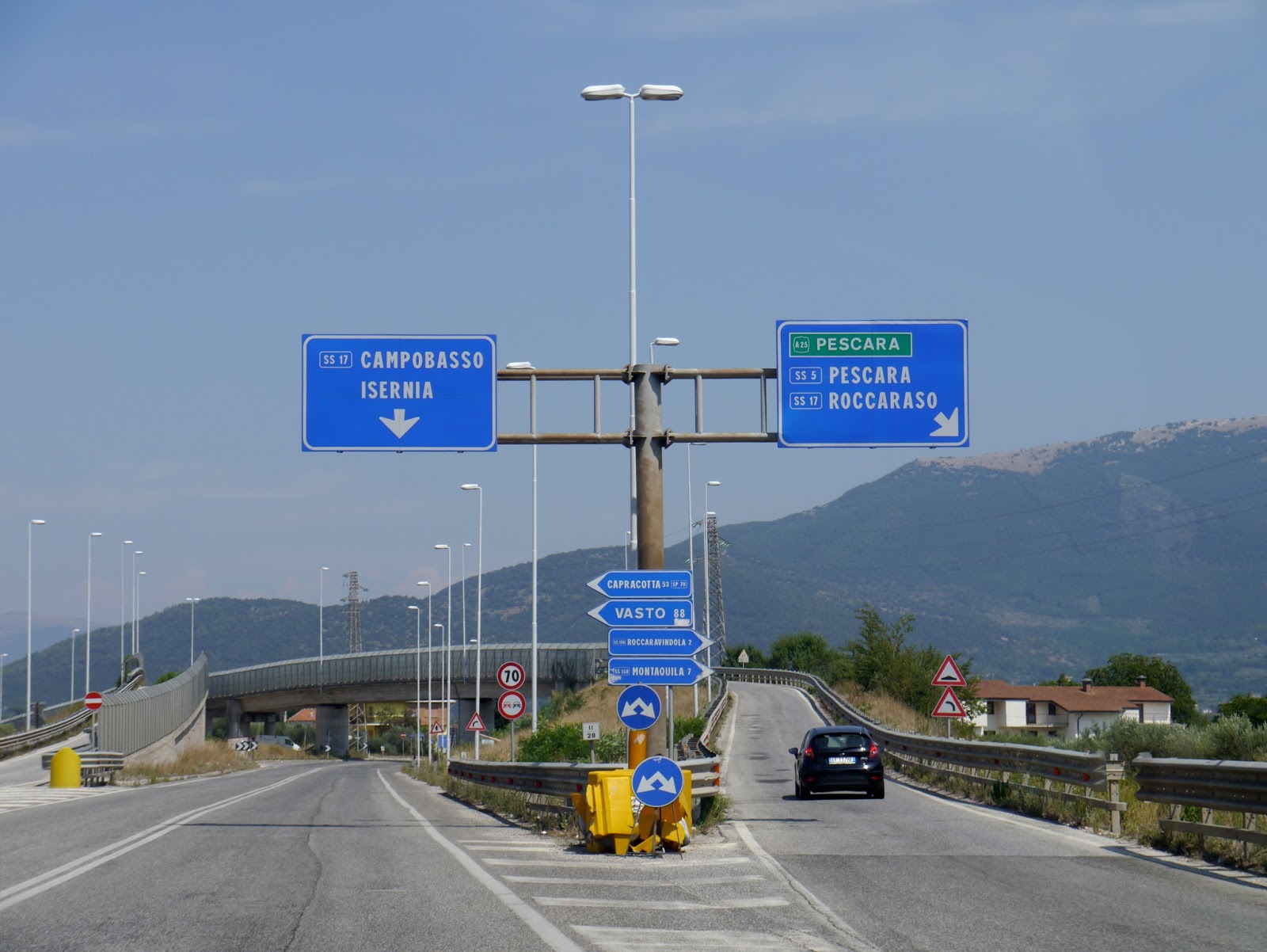
Which way to Pescina?
Before departing on a road trip through Central Italy, I got hold of a guide book to the Abruzzo region by an author named Rock DiLisio: 'Abruzzo Travel Guide - The True Italia.' Rock and his family hail from the Abruzzo, and after conceding that there is a lot on offer in Rome, Florence, Venice, Milan, Naples, Tuscany and Lombardia, he asks: "But where can I go to see the true Italy?" and concludes: "The typical answer to the question would be the Province of Abruzzo."

Actually, it's not uncommon for most Italians from small towns to assert that their town shows you the true Italy - la vera Italia. I was sure that we would indeed encounter la vera Italia on a road trip through the mountains of Abruzzo, past Italy's tallest peak, the Corno Grande (2912 m).

Like any road trip on secondary roads, we had our share of great scenery, changes in weather, small towns and the occasional interesting traffic. Stopping in the small towns, meeting the locals, surveying the many crops - corn, tobacco, olives, walnuts, sunflowers, vegetables of all kinds, hazelnuts, almonds - si, abbiamo scoperto la vera Italia. (Yes, we found the real Italy).

Here's a photo journal of the road trip through Abruzzo, as seen through the windscreen from the passenger seat. Buon viaggio.


Headed North on the A1, Napoli to Roma.
It was some help, but generally we relied on the Italian Way - asking directions.
Our first hill town.
In the province of Molise, looking for Abruzzo -- which way?
Ah, mountains!
"Scanno 44" - our destination appears at last!
We're in Abruzzo!
Beautiful Lake Barea.
The medieval village of Barea.
Into a pine forest.
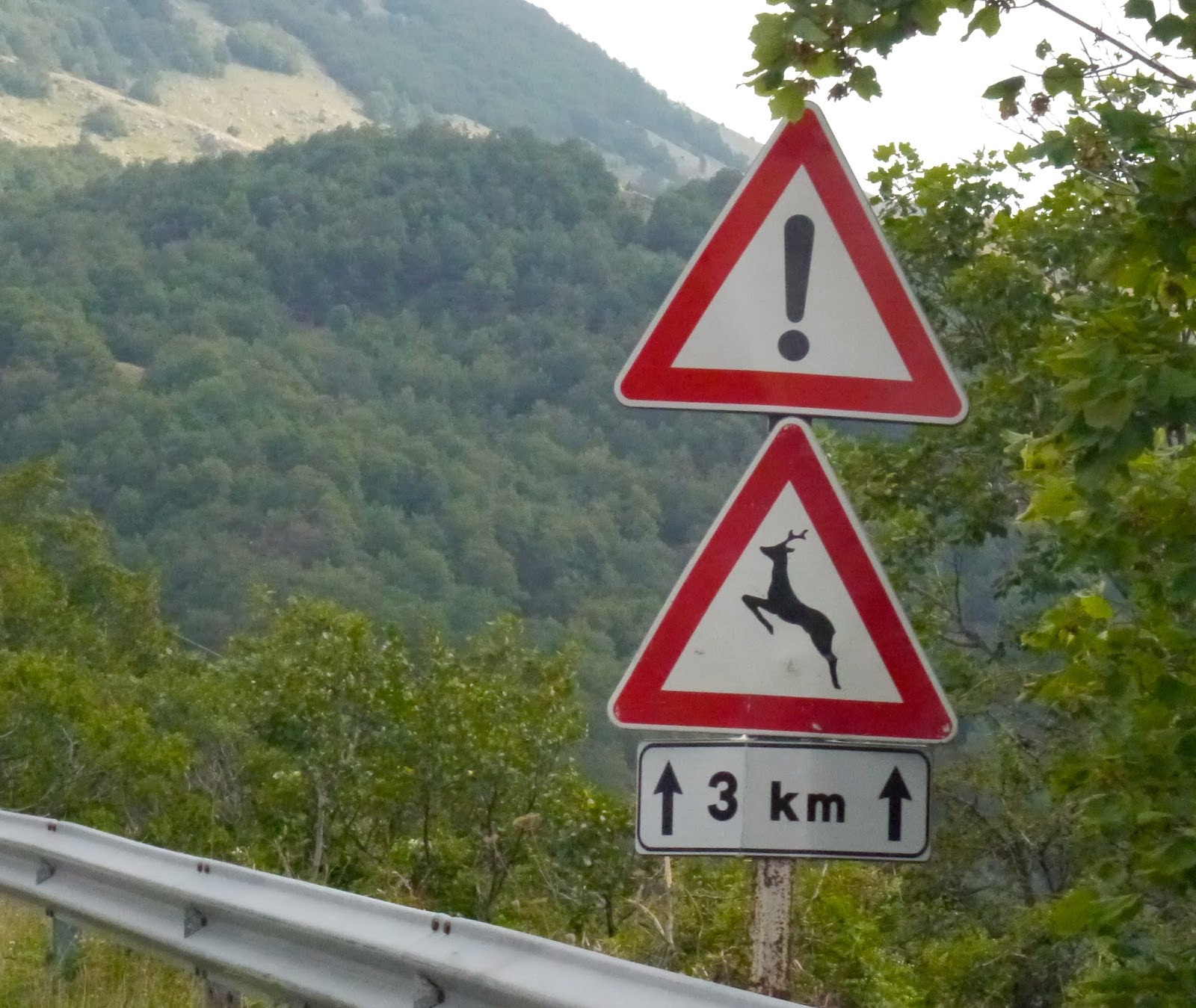
Watching out for deer - and chamoix!
The Valle dei Scannese.
Traffic hazards.
Beautiful Scanno - 1050 m ASL.
Lago di Scanno. Like Lake Louise, only Italian.
The lovely hidden Valle di Sagitario
Another hill town appears.
Tunnel through the rocks.
Coffee stop in the heart of the Real Italy.
Anversa di Abruzzi.
No, not a Roman aqueduct, a rail bridge.
Local harvest. Near Sulmona.
Fields and mountains.
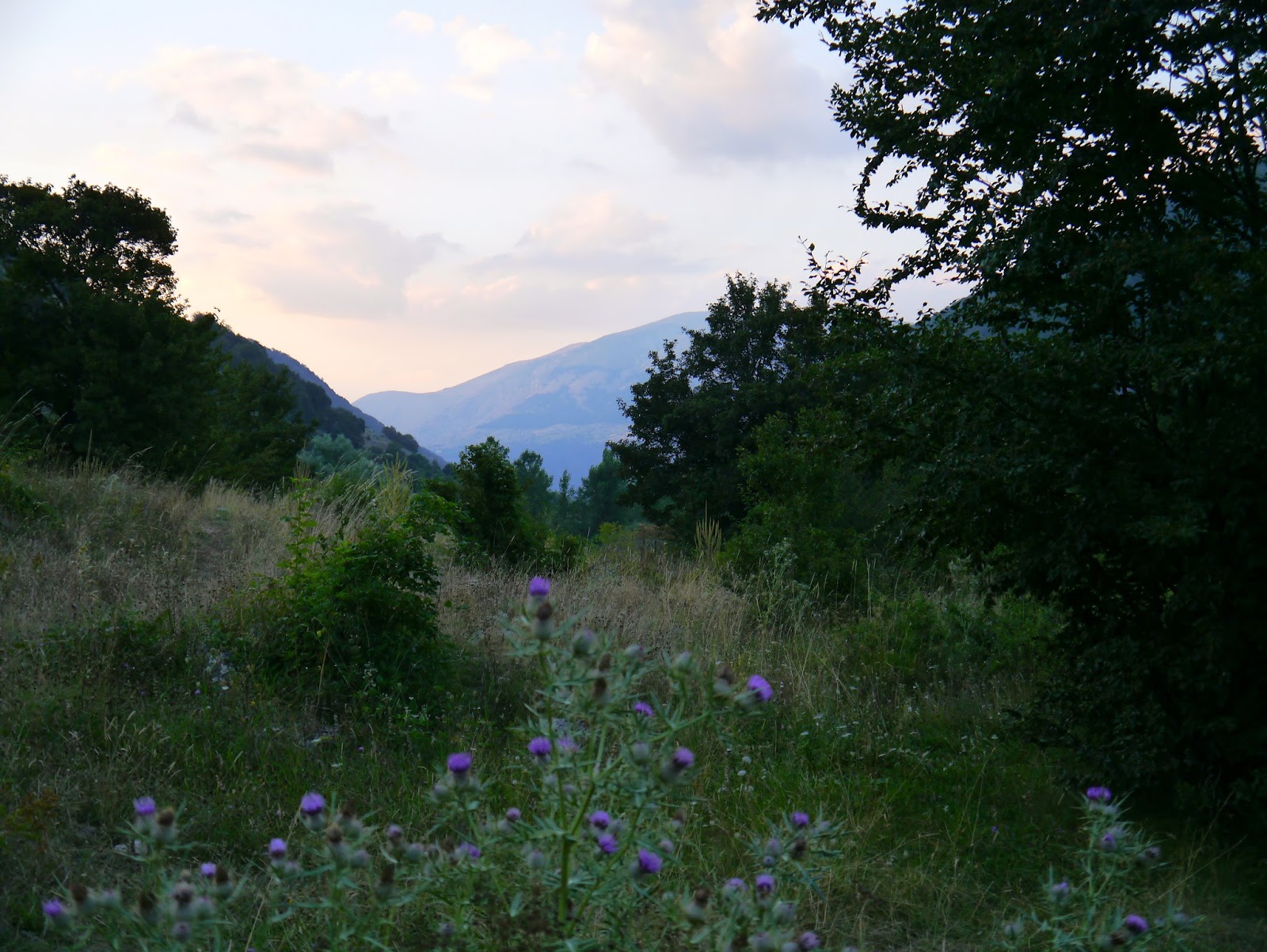
Dusk in Abruzzo.
Parco Nazionale d'Abruzzo.
Passo Godi, 1540m ASL. 
Giro d'Italia!
It wouldn't be Italy with a traffic snarl. Pecasseroli.
Close to our highest point, near Pecasseroli.
A patriotic town on the plain.
This is definitely a Roman road - in the Piana del Fucino.
Colour in Celano.
Towards L'Aquila, the capital of Abruzzo.
Clouds coming in.
Sheep and hay. Le pecore e il fieno.
Into each road trip a little rain must fall.
Pine forests as we climb higher.
Another traffic hazard.
A local resident.
Mountain scenery above the farmland.
Near the highest area of Abruzzo. Mist in the valleys.
Impressive road tunnels.
Rainy view.
Yes, that's what the sign says.
Back to farmland.
And a misty rainbow to end our drive.