Showing posts with label Exhibitions. Show all posts

Wednesday, July 24, 2013

London Arts Again

London.
Visiting London, so theatre, opera, galleries are a must. The British capital is an overwhelming cornucopia for an arts lover. Here's the round up from a recent week:

* 'Relatively Speaking' - Alan Ayckbourne
* 'Gloriana' - Benjamin Britten
* Vermeer: The Art & Love of Leisure - The National Gallery
* Lowry and the Painting of Modern Life - Tate Britain 
* Life and Death in Pompeii and Herculaneum - British Museum
* Summer Exhibition - Royal Academy

Felicity Kendall, Jonathan Coy, Kara Tointon
in 'Relatively Speaking' by Alan Ayckbourne

'Relatively Speaking' - Alan Ayckbourne

Who wouldn't want to see the lovely Felicity Kendall on stage? And she surely do not disappoint in the clever comedy from the 1960s. Her co-stars were Jonathan Coy, Kara Tointon and Max Bennett, all excellent. It was directed by Lindsay Posner, and delightfully designed by Peter McKintosh.

While I'm a little wary of 'yet another' Alan Ayckbourne play, this one is very cleverly plotted. Check this link for information and this short synopsis:
Ginny goes to the house of her older lover in order to end a relationship and retrieve some compromising letters. Matters are complicated when her current partner also turns up and meets the wife of the lover, believing her to be Ginny's mother, leading to misunderstanding and confusion.

Guardian Review
Telegraph Review

Felicity Kendall

'Gloriana' - Benjamin Britten

My visits to Covent Garden have been fewer and more carefully chosen this year, but there was never any doubt that Britten's 'Gloriana' would make the cut. This rarely-performed Britten opera has been staged for his centenary year, and despite some hard-to-please reviewers, I found it gorgeous. 

It has a somewhat curious history, having been commissioned to commemorate the coronation of Queen Elizabeth II in 1953. face with this invitation, Britten chose a story of Queen Elizabeth I, in the dying years of her reign - the elderly Queen enarmored of the dashing younger Essex, whose death warrant she eventually has to sign. The exquisite production at ROH places the performance - in Elizabethan costuming - as an amateur drama play in a village hall in 1953 -- with a young Queen Elizabeth II in the audience.

The moment at the end when the young Queen faces the old Queen, though an addition to Britten, is a great moment of theatre.

In a village hall somewhere in England, 1953

Toby Spence and Susan Bullock
Richard Jones directs a production of Britten's Gloriana for our time. Commissioned by the Royal Opera House to mark the coronation of Elizabeth II in 1953, the opera explores tensions between affairs of state and affairs of the heart.
Benjamin Britten's Gloriana was commissioned by the Royal Opera House to mark the coronation of Elizabeth II in 1953. William Plomer drew on Lytton Strachey's Elizabeth and Essex to create the libretto, which artfully combines modern and archaic forms of English. Britten's score is similarly diverse: it mixes the sounds and manners of Tudor England -- from lute songs to courtly dances -- with the composer's own distinctive style.
Moving from the pomp of state ceremony to the intimacy of the Queen's private rooms, Gloriana depicts the public and private faces of the Virgin Queen, and the deterioration of her relationship with the impulsive Earl of Essex. [ROH]


The Guardian review This reviewer seems rather disappointed - or hard to please? I certainly agree with one of his comments: Brindley Sherratt's Blind Ballad Singer is a superb cameo.
Brindley Sherrat - the blind balland singer

As the reviewer describes it:
...an exercise in post-second world war nostalgia. This opera about the first queen Elizabeth is presented as a historical pageant put on in a municipal hall somewhere in England (Aldeburgh's Jubilee Hall perhaps?) to mark the coronation of Elizabeth II, where it's performed in front of the newly crowned queen herself. Throughout the performance, the trappings of am-dram are ever present: producer, prompter and St John Ambulance man hover in the wings, a local musical teacher conducts the choir; there's some suitably naff dancing, while in the Norwich scene (a pageant within a pageant within an opera as it becomes here) the royal monogram is spelt out in vegetables, as if at a harvest festival.

Vermeer: The Art & Love of Leisure - The National Gallery

This blog has already waxed lyrical over Vermeer, and the exhibition at The National Gallery was cleverly curated around the music of the time, with some lovely original musical instruments on display, alongside the paintings. In the Sainsbury Wing.

See the paintings here.


Put sound to picture as curator Betsy Wieseman explores the fascinating role of music in 17th century Dutch painting and society in this accompaniment to 'Vermeer and Music: The Art of Love and Leisure' which runs from 26 June - 8 September 2013.
'Vermeer and Music: The Art of Love and Leisure' offers an opportunity to enjoy a selection of 17th century Dutch masterpieces alongside period musical instruments, with accompaniment from the Academy of Ancient Music. Featuring five rare works from Johannes Vermeer, including three paintings of women with musical instruments from 1670 - 1672, which forms the culmination of the exhibition and offers a unique opportunity to view these works as a trio. [source]

Lowry and the Painting of Modern Life - Tate Britain 


Over at Tate Britain I queued to see a very popular exhibition of a British painter I'd never come across before: L S Lowry (1887 - 1976). His paintings seemed at first to be a version of naive art, but on closer inspection are very much more. For me the most interesting aspect of the exhibition was the incredible documentation of Britain's industrial north in the early twentieth century. Those 'dark satanic mills' you hear mentioned - Lowry lived amongst them (as a tax collector, of all things) and documented them not only with visual accuracy but a deep and moving connection to what he was seeing.
I saw the industrial scene and I was affected by it. I tried to paint it all the time. I tried to paint the industrial scene as best I could. It wasn’t easy. - L.S.Lowry

For Lowry modern painting needed to represent the remaining rituals of public life: football matches and protest marches, evictions and fist-fights, workers going to and from the mill. Without his pictures, Britain would arguably lack an account in paint of the experiences of the 20th-century working class. [source]

Lowry at Tate Britain.

Life and Death in Pompeii and Herculaneum: British Museum

Portrait of baker Terentius Neo and his wife. Pompeii, AD 55–79. 
The special exhibitions at the BM rarely fail to please, and the current one on Pompeii and Herculaneum is proving incredibly popular. Tickets need to be booked days ahead. I was very keen to see this one, as the artefacts would presumably come from my part of Italy -- I have visited the sites of Pompeii and Herculaneum, and the Archeological Museum of Naples. The exhibition and the catalogue were not very forthcoming on exactly where the exhibits usually reside, but apart from a few which 'belong' to theBM itself, they seemed to be from the Naples Museum or from something called the
La Soprintendenza Speciale per i Beni Archeologici di Napoli e Pompei. All I can say is that the Soprintendenza has some real treasures.

At the BM.
Compared to what the Italians manage in the treasure-filled but cash-strapped Archeological Museum of Naples and at the sites themselves, the BM has done it's usual marvellous job of curation. The Exhibition traces the events of the eruption of Vesuvio, but also focusses on what the remains, preserved by volcanic ash, teach about the everyday life of Roman people in AD 79. Brava, BM.

BM's Exhibition Website
In Spring 2013 the British Museum will present a major exhibition on the Roman cities of Pompeii and Herculaneum, sponsored by Goldman Sachs. This exhibition will be the first ever held on these important cities at the British Museum, and the first such major exhibition in London for almost 40 years. It is the result of close collaboration with the Archaeological Superintendency of Naples and Pompeii, will bring together over 250 fascinating objects, both recent discoveries and celebrated finds from earlier excavations. Many of these objects have never before been seen outside Italy. The exhibition will have a unique focus, looking at the Roman home and the people who lived in these ill-fated cities. [BM press release] 

A fresco showing a garden scene, AD 30-50

Plaster cast of a dog, from an ash cavity in Pompeii.

Guardian review of the BM Exhibition.

Summer Exhibition - Royal Academy

Installation view of Gallery I with Marilène Oliver's 'Dreamcatcher' (detail).
Summer Exhibition 2013. [source]
Each year the Royal Academy holds a 'Summer Exhibition' - everything is for sale. There were some things this year I'd love to hang on my walls, but sadly my selections (two lovely paintings by Academician Anthony Eyton) were somewhere north of the £20,000 mark. Ah, well. It was fun to imagine which I'd choose to take home from the more than 1,000 works displayed.

Royal Academy website
Now in its 245th year, the Summer Exhibition remains a much anticipated highlight of the arts calendar, serving as a unique window on to all areas of the contemporary art world. It is the world’s largest open-submission exhibition, displaying more than 1,000 works in all styles and media, including painting, printmaking, photography, sculpture, architectural models and film.
All works are fastidiously selected by a panel of celebrated artists and architects from across the disciplines, and it is their task to narrow down more than 10,000 entries to those that go before the public. The majority of the works are also available to buy, offering an unrivalled opportunity to own work by high profile and emerging artists.
On the facade of the Royal Academy building:


El Anatsui's work on the facade of the RA.

El Anatsui has garnered much international acclaim for a range of spectacular site-based installations. This large-scale bespoke piece, created for the Royal Academy, measures 15m x 23m and is entitled TSIATSIA - searching for connection. It will hang from the balustrade of Burlington House for the duration of the Summer Exhibition. The sculpture is an intricate, shimmering, metallic ‘wall-hanging’ created from aluminium bottle-tops, printing plates and roofing sheets, amongst other materials.

And inside:
Grayson Perry RA is showing his series of six tapestries entitled The Vanity of Small Differences, telling the story of the rise and demise of Tim Rakewell, inspired by Hogarth’s A Rake’s Progress. See the tapestries on the Victoria Miro website. 


Thursday, September 13, 2012

Palace Hopping

Kensington Palace: Queen Vic


I’ve been palace-hopping lately, and Britain is not a bad place to do that. A couple of palaces I visited were royal; the other was ducal, which is almost as good. Well, if you can’t be royal...

Kensington Palace is - now - in the centre of busy London, off the Kensington High Street and not far from the Royal Albert Hall. It is surrounded by ornate gateways, trimmed gardens (literally - a gardener was making sure the trees were an even cone-shape the day I was there), and a very big park with a duck-and-swan pond and bicycle paths. In front is a large white statue of Queen Victoria, who was born in the palace and lived there for some time.

Inside, however, is a series of rather tacky and badly curated displays. I won’t say I didn’t enjoy the room showing several of Lady Diana’s gowns, but the “Lady Di” wallpaper was a bit naff. She lived in KensingtonPalace too during one period of her short, sad life.

Gallery at Kensington Palace
In the wing devoted to the arrival in England of the Hanovers - George I and onwards - I thought we might get a nice sense of the state rooms. There was a long gallery set up well, including whispered conversations between men of state of the Georgian days which activated when you sat on the cushions of the window seats. The rooms devoted to Queen Victoria were also interesting: her first meeting with parliament at the age of seventeen, all those children, the happy days with Albert round the spinet, then the long years of mourning after his death (which produced quite a bit of sniping and some resentful comments from the citizens) - these were revealing. It’s just a pity that most of the displays were marred by bad modern mobiles and caricatures, or silly attempts at light and sound shows, or poor lighting, or objects placed inside boxes with peep holes, and so on...


Blenheim - a country pile.


At Blenheim Palace, the ducal seat of the Duke of Marlborough, we had no such shenanigans. Well, actually we did have a walk-through animated show about the building of Blenheim and the various Dukes, but it was quite well done and only one little bit, so I forgive them. Blenheim was built in the 18th century on land given by and with money given by Queen Anne to the first Duke - who was also given the dukedom by said Queen. It seems she was very grateful indeed to him for leading the troops to victory at the Battle of Blenheim, defeating an upstart Catholic French king. The friendship between Marlborough’s wife Sarah and Queen Anne is also said to have played a part...

Gardens at Blenheim - a small sample
The public rooms at Blenheim, particularly the lovely ornate dining room (red, of course) and the long library/gallery, which boasts its own pipe organ, are certainly impressive. On my visit there was also an exhibition about Winston Churchill, who was born at Blenheim - you can view the actual bed - when his mother (who was, interestingly, American) was caught short with labour pains during a visit. Winston’s father, Randolph Churchill, was a younger brother of the Duke, and so Winston and what we might call the subsequent Duke were cousins. It is said that he visited Blenheim often and enjoyed it there. This subsequent Duke, Winston’s cousin, also married an American - for her money, she was Consuelo Vanderbilt. They divorced after 11 years and Consuelo became a suffragette. You can take the girl out of America and all that...

The gardens, lake and park at Blenheim are all extensive and famous. The estate is situated just outside of Oxford, near a village named Woodstock. On the day of my visit it was raining rather heavily (the car got bogged in the car park) so my stroll in the grounds was brief. But I could see in the distance, on a grassy knoll covered with grazing sheep, the victory column of the first Duke, erected presumably to celebrate himself. The current Duke gave us a video welcome, and he seemed a nice man. He and his Duchess still live at Blenheim. It must cost an awful lot for upkeep, and I hope my twenty quid helped. It was a nice visit. They have a champagne bar out the back.


Buckingham Palace

For sheer luxury and sumptuousness Buckingham Palace, present London home of Queen Elizabeth II, can’t be beaten. For the past twenty years the Palace has been open to visitors in the summer months. You buy a timed entry ticket in advance, and then you are corralled with what seems like thousands of other hopefuls and sent off on a one-way tour through the State Rooms. It is a crowded, hot and sometimes annoying experience but still I highly recommend it. The wealth, treasures and  display are awe-inspiring. The red throne room, where the Royal Wedding photos are taken; John Nash’s lovely bowed music room looking over the enormous park out the back; Queen Victoria’s ballroom (another pipe organ - she brought this one up from Brighton Pavilion, a place she couldn’t stand)....and the picture gallery! Amongst some very large and triumphant Van Dyke portraits, they have a Vermeer. Amazing. French furniture, Sevres porcelain, beautiful upholstery...and this summer they also had an exhibition showing the Queen’s diamonds (Diamond Jubilee - geddit?) I have to tell you, those are SOME jewels. I had to go back and take a second look at the enormous pink, and the drop earrings, and the state diadem...*smelling salts please*

Buckingham Palace - the back door.

At the end of the tour you are debouched into the back garden, a great quiet park in the centre of London. Except of course for the Palace Cafe, which was full to the gills with tourists, foiling my plan to have a cuppa tea “with the Queen”. But I did manage a Buckingham Palace ice cream further down the garden path where things were quieter.


And around the corner you can - as I did, for the second time - visit the Royal Mews and gawp at the Royal Coaches and the Royal Limousines, and - best of all - a couple of the Royal coach horses, doing stoic duty on display for the summer tourists.

Could you say that the Tower of London is a palace? Certainly it was once, though it has also been a fortress and a gaol. Today it houses the real Crown Jewels - these make the diamonds in the Buckingham Palace display look like a few trinkets. The present Crown of State includes the enormous “Black Prince’s Ruby”, and the Cullinan Diamonds, 1 and 2, mined in South Africa. The spooky Korinoor Diamond from India is in the crown which was worn by the Queen Mother. The display is beautifully organised and the crowd control exemplary. The information about the coronations is excellent - did you know that Handel’s “Zadok the Priest” has been played at every English coronation since George III’s (for whom it was composed), with the words, which come from the Bible, having been used at every coronation since medieval times? Me neither.

The White Tower, Tower of London.
"Jane was here"?

The Tower also has darker stories to tell. You can view the spot where Anne Boleyn (and others) lost their heads; the Beachamp Tower where Lady Jane Grey (and others) were imprisoned, with the prisoners’ graffiti etched in the stone walls; the ‘Bloody Tower’ where Sir Walter Raleigh lived his life in captivity (though relative comfort); and where the two young Princes are said to have been last seen. Did Richard III do them in, or has he been slandered by Shakespeare? And how about his brother Clarence, who was drowned in a vat of malmsey in the Tower?

What with ravens, and Beefeaters, and the Traitor’s Gate leading straight out into the Thames, the fortress palace built by William the Conquer has plenty to intrigue.


Visiting with the locals, Tower of London


Tuesday, July 24, 2012

The name’s Bond. James Bond.

Bond...James Bond


British style icon, man of action and drinker of martinis - shaken, not stirred: that is of course Bond, James Bond. The Barbican is hosting an exhibition this summer celebrating all things Bond, especially his Englishness. As one quote in the exhibition puts it, women leave a Bond movie admiring James Bond, and men leave it “standing tall”. I’m not entirely sure I agree with that, or even understand it, but the exhibition turned out to be a lot of fun.

In the foyer of the Barbican, Bond (in his Sean Connery iteration) leans stylishly in his stylish Saville Row suit against his stylish Aston Martin sports car. It’s all about style. Inside on view are many of the costumes from the movies, including the sumptuous evening gowns from ‘Casino Royale’. Of particular interest to exhibition-goers are Bond’s teeny swimming trunks, and the bikinis-with-knife-belts worn by his glamourous co-stars. There are jewels, diamonds (of course), golden guns, white dinner jackets, furs and ski-suits - including a memorable yellow and red number worn by Bond as he leaves the latest blond, clad only in a white fur, in the mountain hut and goes out to ski right off a mountain side:

“But James, I need you.”
“So does England”.


There’s M’s office re-imagined with it’s buttoned leather doors, and Q’s laboratory with its clever gadgets for beating bad guys. I particularly liked the “Re-breather”, a simple device to be inserted between the teeth, enabling Bond not only to swim underwater without his SCUBA gear, but to do so in his Saville Row suit, emerging merely a little (handsomely) disheveled. 

There are snippets of the movies playing throughout the exhibition, reminding us of such classic moments as the shower scene when Bond and his lady are spied upon by a robot (“What’s he doing?”; “Oh, just cleaning up a few things”). The body of Pussy Galore, asphyxiated by being painted all over with gold paint, is recreated in full life-like splendour. Bond, strapped down and with a laser beam headed for his crotch: “You don’t expect me to talk, do you?” Bond at the casino tables of Monte Carlo (“shaken, not stirred”); Bond piloting a gondola not only along the canals of Venice but also through it’s streets; Bond tobogganing down a mountain with the girl de jour, in her cello case (the case is on display) holding her priceless Stradivarius over his head. 


Shaken, not stirred...


Ah, yes. The adventures and the contraptions become more and more ridiculous as expensive stunts (a 1977 ski stunt was in its day the most expensive movie sequence ever produced, at half a million dollars) give way to the era of digital technology (Bond’s ski-do thing hooked to a glacier, which calves off into the ocean, melting on the way, allowing him to convert his machine to a windsurfer and windsurf off into the ocean -- really??) The story boards and sketches used to imagine these ridiculous escapades were endlessly fascinating.

But in the end, and despite my skepticism, the sheer amusing campness of it all converted me to a Bond fan. So naturally I had to visit the martini bar to imbibe a ‘Vesper’, Bond’s preference in ‘Casino Royale’: gin, vodka and Lillet Blanc - shaken not stirred, of course.


Sunday, January 23, 2011

Regency England: great hair


Who?

In the post about The Wellington Arch, we touched briefly on that period of British History known as ‘The Regency’. This was the period during which poor old George III (he who was on the throne – 1760 to 1820 -when England lost America in the War of Independence but gained Australia with the First Fleet). It was a crazy turbulent time, with the French Revolution having put everyone into a spin, and then years and years of wars between France and England culminating at last in Wellington’s great defeat of Napoleon at Waterloo (with the not inconsiderable help of Field Marshall von Blucher and everyone else in Europe).


Kew Palace, where poor George III spent his last days
Some say the poor George III wasn’t really mad, but suffering from a dreadful blood disease called porphyria which also manifests as a bad skin complaint. Nevertheless, by 1810 he was so non compos mentis that it was necessary to appoint his eldest son George, the Prince of Wales and heir to the throne, Prince Regent. The Regency began in February 1811 and lasted for ten years, until Papa George died in 1820, whereupon the Regent became king, George IV. The new king reigned only ten years himself, passing away in 1830. He was followed to the throne by that favourite of this blog, Queen Victoria (who was the daughter of the fourth son of George III, no-one else having produced any surviving children. I know you were just about to ask.)

Regency days...
The Regency years were a fine old time, from all accounts. George commissioned the architect John Nash to build the fantastical ‘Indian Gothic’ Pavilion at Brighton [*adds to travel list*], and to remodel Buckingham Palace (his ‘pied a terre’ in the city – I mentioned that in another post. You remember, don’t you? There might be a test one day.) He spent scads of money, dashed about a lot, secretly married a commoner (and, worse, a Catholic) named Maria Fitzherbert when he was 21 (and she was 27). Before we condemn him too much for this, it is rumoured that his father did a similar thing when he was in his teens, secretly marrying a Quakeress named Hannah Lightfoot, from Wapping-in-the-East.

George plunged extravagantly into so much debt that he had to go live with his secret wife at one point. George’s father had insisted on him marrying his cousin, Caroline of Brunswick, but they detested each other and lived apart (having first produced one daughter, Charlotte, who later died in childbirth at 21).  George was a great dandy, and good friends with Beau Brummell. He was instrumental in establishing the Royal Academy, and Kings College London. The art, style, fashions and architecture of the period are known as ‘Regency Style’. The Times once wrote of George that he would always prefer "a girl and a bottle to politics and a sermon."

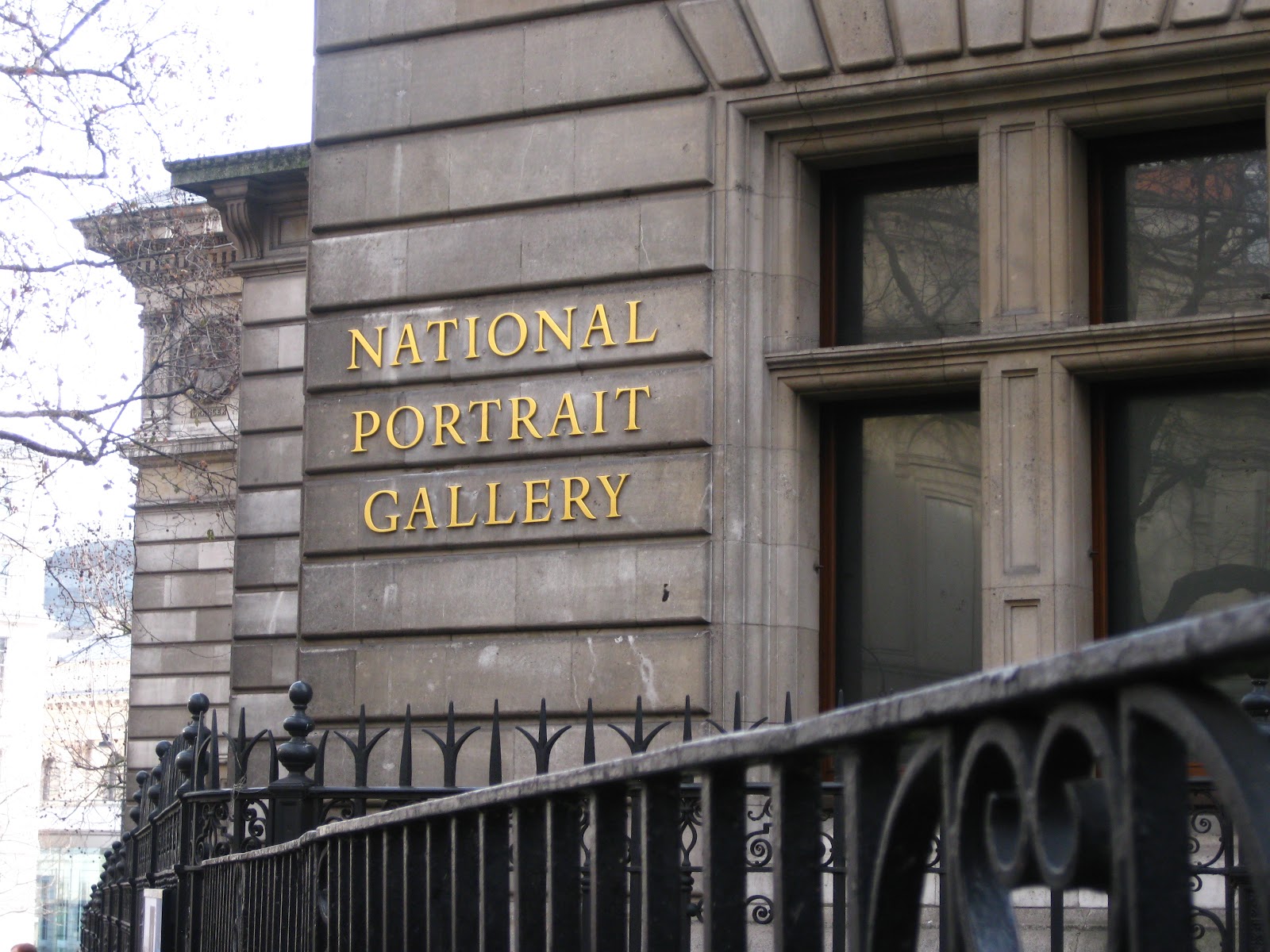
Sadly, the Regent’s dissolute lifestyle left him severely obese and possibly addicted to laudanum (we’d call him a heroin addict today). He also had very bad skin. He did, however, apparently have great hair. I deduce this from portraits of him by the premiere portrait painter of the Regency, Thomas Lawrence: a collection of whose paintings I visited today at the National Portrait Gallery. I popped into the exhibition to kill some time, but was immediately blown away by the pictures – so strong and vivid. Lawrence was said to be a great draughtsman, and the drawing skill is instantly evident. He also painted life-sized, full-length portraits in lively and sumptuous style.

Young Thomas was a prodigy from a humble background who took London by storm when only 21 years old. One of his early full length portraits that impressed the Academy and London society was a gorgeous one on display in the exhibition, of Queen Charlotte, the Regent’s mother, wife of George III and mother of his 15 children (the royal couple were said to be close. I think we can believe this).  The Queen only gave Lawrence one sitting herself, but she allowed one of her ladies-in-waiting to model the Royal jewellery for him on a later occasion.

Lawrence soon acquired influential patrons and went on from strength to strength. He painted the actor Kemble, dressed in a toga playing Cato. After ‘The Big Win’ at Waterloo, the Regent sent Lawrence on a tour of Europe, painting all the famous and powerful who had collaborated to defeat the dreaded Napoleon, culminating in a very gentle portrait of Pope Pius VII, also in the exhibition.

The National Portrait Gallery on a grey Saturday in January
Lawrence painted the Regent himself several times, and seems to have generally rendered him with the ‘High Romantic’ tousled hair-do I so admire.  The Regent first consented to sit for Lawrence in 1814, when he had been Regent for three years. As a result of this introduction, Lawrence was knighted and became ‘Sir Thomas’, and was sent off on his continental foray. The painter was often criticised for overdoing it in his portraits of George, making them rather, er, complimentary and perhaps not quite faithful to life. The Regent was severely overweight and wore cosmetics to disguise his bad complexion.

I was quite thrilled at my introduction to Thomas Lawrence, of whom I was previously only dimly aware. The portraits in this exhibition are sumptuous and exciting. They, and their artist’s story, are also a fascinating snapshot of the Regency period, when Napoleon was defeated and The Prince Regent was doing his best to bankrupt the public purse. And here’s another interesting factoid: Lawrence’s home and studio was in Russell Square, Bloomsbury, and it was to his house on the Square that his famous sitters came for their portraits to be done. Clearly all the best artistic types favour Bloomsbury!

But to return to the Regent, who became George IV, it seems he was sadly unlamented when he died.  The Times seems to have gone right off him by the end:

"There never was an individual less regretted by his fellow-creatures than this deceased king. What eye has wept for him? What heart has heaved one throb of unmercenary sorrow? ... If he ever had a friend — a devoted friend in any rank of life — we protest that the name of him or her never reached us."

If you are interested in more details about this larger-than-life character, here's an odd website that refers to him as 'Prinny'. Wikipedia has some good information. As it says:

The Regency period saw a shift in fashion that was largely determined by George. After political opponents put a tax on wig powder, he abandoned wearing a powdered wig in favour of natural hair. He wore darker colours than had been previously fashionable as they helped to disguise his size, favoured pantaloons and trousers over knee breeches because they were looser, and popularised a high collar with neck cloth because it hid his double chin. By 1797 his weight had reached 17 stone 7 pounds (111 kg), and by 1824 his corset was made for a waist of 50 inches (127 cm). His visit to Scotland in 1822 led to the revival, if not the creation, of Scottish tartan dress as it is known today.

But personally, I like the hair.


Some images from:
http://www.royalcollection.org.uk/egallery/collector.asp?collector=12762porphyria

Wednesday, January 5, 2011

The First Emperor

Terracotta Warriors

Over 2000 years ago, around 246 BC, a thirteen year old boy came to the throne of a small state called Qin (pronounced ‘Chin’), in what is now Western China. Shortly afterwards, he began building himself a tomb of massive proportions, which eventually covered 56 square kilometres. Throughout his short reign – about 25 years – he spent a lot of energy looking for an elixir which would give him eternal life. On one such expedition irony caught up with him and he died, and was interred in the massive tomb.

Emperor Qin Shihuang also spent his reign doing other important things, such as conquering many neighbouring states and pulling together the nation that eventually became modern China (from 'Qin'), developing a very detailed and specific rule of law (known as 'Legalism'), reputedly burning books and a few scholars as well, fathering about 20 sons, and - just by the way - building The Great Wall of China.The Qin Dynasty which he founded lasted only 15 years, but created a new political and cultural order that endured for the next 2000 years, more or less creating the China we knew up until the 20th century. Some say he was a fearsome, cruel and ruthless tyrant; others credit him with far-reaching reforms and the basis for stability and unity.

But he seems to have had rather a complex about immortality. The tomb he had built re-created the emperor's entire known world in an 'Eternal City', including quarters for servants, and even a private zoo - all made from terracotta and bronze, life-sized - everything the Emperor could possibly need in the afterlife. To protect this mausoleum palace, he also had created a vast army of terracotta warriors, estimated to number 8,000, complete with horses and carriages.

Your blogger on The Great Wall (ages ago - 1994)
The mausoleum itself was described in ancient texts, but nobody knew that the warrior army existed until, in 1974, a small village near Xi'an in Western China needed a new well dug. The villagers were startled to find heads, and then bodies, and then the hundreds of warriors. To date more than 1900 warriors have been unearthed, but it is estimated than in the pits are 8,000 soldiers, 140 chariots, 560 chariot horses and 116 cavalry horses - all life sized. They are all armed, moreover, with thousands of weapons, all real and all sharp. Over 40,000 weapons and arrowheads have already been recovered. The pits contain the army arranged in typical combat formation, defended with archers armed with crossbows. Some pits contain formations of cross bow units, some standing, some kneeling, all ready for action, frozen in the same stances given to them by their sculptors over 2000 years ago.

There are ten main figure types making up the First Emperor's terracotta army, and a single example of each is presently on display in the Art Gallery of NSW, a long way from their dark pit home in Western China, but lit evocatively in an inner room of the gallery. The exhibition lasts until 13 March 2011. One of the figures is an Armoured General, larger than the others and wearing a winged cap, armour and ribbons. Only nine generals have been discovered so far, so this is 'the big man'.

An Armoured General leads the exhibition
The other figures include an armoured military officer, a light infantryman, and armoured infantryman, a standing archer (facing sideways to fix the observer with an uncanny stare, though now missing his crossbow), an armoured kneeling archer, a cavalryman and his cavalry horse, a charioteer and a chariot horse. Not only are the figures life sized, they are curiously expressive, each one a gifted work of art. And to think that there are 8,000 of them - each different.


The tomb and the warriors are built at the base of Mt Li, as recorded in 'The Grand Scribe's Records', 89 BC:
'As soon as the First Emperor became king of Qin, excavations and building had been started at Mt Li, while after he won the empire more than 700,000 conscripts from all parts of the country worked there.'
The tomb proper is a rammed earth construction, a four-sided pyramid with three stepped levels, and forms a massive artificial hill lying between the Wei River and Mt Li. It once stood 120 metres high but is now somewhat eroded. The tomb mound itself has not yet been excavated, although it is described in detail in 'The Grand Scribe's Records'. It is said that all concubines of the Emperor who had no sons were buried with him; and that the workmen who knew the contents of the tomb were also sealed up in it. Such stories produce in us an exciting frisson, but may possibly be exaggerated. The mound has always been obvious, but it was not until the local farmers digging the well in 1974 discovered the entombed terracotta warriors that the incredible extent of the complex was realised.

In 206 BC an invading horde of Hans desecrated the tomb and pits, burnt some of the warriors and made off with some of the armoury buried with them. Originally all the figures were armed, and the horses and soldiers were painted. 

A Kneeling Archer at the rear
But even more fascinating than the creation of this incredible palace and army to guard it are the beliefs about immortality which prompted the whole enterprise. Ideas about immortality at the time were dualist (as we'd say, after Descartes): it was thought that there were two spiritual elements associated with the body - po, the life force that kept the body active, and hun, the expressive, emotional soul. It was believed that the two elements separated at death, with the hun going off to paradise or, if unlucky, to the gloomy 'Yellow Springs' (not as bad as Hell, but dismal nevertheless). As to the po, it would stay with the body provided that the burial arrangements were properly taken care of. If not, a ghost spirit might emerge to haunt and cause harm. 

There was a great emphasis on immortality. In some cases, it was thought that if the body was well enough preserved, this was a form of immortality. This led to some bizarre attempts to preserve the body, including in one extreme case of encasing it in a sheath of jade. There was also a belief in another form of immortality, somewhat closer to that in the Christian canon: the person left the world to to live as an immortal, 'transcending' or 'ascending' this life. These people might still be seen inhabiting the earth. There are references to the 'Eight Immortals' in Chinese mythology. My pick is the story of an Immortal who rode thousands of miles every day on a white mule, and at the end of the journey would fold the mule up like a piece of paper and keep it in his pocket.

But I digress. The First Emperor did not, it seems seek to become one of these Immortals, but rather to prolong his life on earth. Keeping the body alive forever was said to be possible through drinking magic elixirs, sometimes mixed from gold and pearls. During the First Emperor's time the necessary elixirs were thought to be located on islands in the East China Sea, and he sent a big expedition - consisting of thousands of young boys and girls - off to find them. They never came back. The islands don't exist (unless they are Japan) and a second group of 'Recipe Gentlemen' (magicians) sent to continue the search were presumed eaten by savage whales.

Painting of The Great Wall of China

We're not sure exactly what the First Emperor may have ingested in his quest for immortality, but the favoured ingredients of the day were those which were considered incorruptible - gold, mercury, jade, sulphur, cinnabar, orpiment, quartz and lead: distinctly poisonous, I would have thought. The herbal remedies, called 'herbs of deathlessness' in the literature, were equally varied: mushrooms and fungi, ferns, tree fruits such as pine nuts, onions and garlic, asparagus, lilies, ginger, lotuses, white-flowered peonies, magnolia, bamboo, cassia, citrus, ginger, ginseng, chrysanthemum and about a hundred others. My favourite story of the successful use of the 'herbs of deathlessness' concerns one sage who ate nothing but pine kernels. He grew hairs 'seven digits long' all over his body, his eyes took on a square shape, and he could overtake galloping horses. Sounds like some of the claims made today by herbal remedy salesmen.

Since he lived so long ago, it is impossible to know what The First Emperor was really like, although the stories have it that he was terrified of death and searched incessantly for immortality. It appears he may have been a workaholic: it is said that he would not sleep until he had read a daily quota of 30 kilos of official documents (I know a few people like that). In a modern novel (1985) author Jean Devi depicts the Emperor trying every available remedy and still complaining: 
'Since I gave up eating grain and chose only dried meat and jujubes instead of juicy roast meat, I have had terrible stomach pains. Breathing exercises make me dizzy and give me ringing in the ears. And despite my diet my bowels don't function'.
This bears a remarkable resemblance to me on a Weight Watchers diet. 

Terracotta Warriors, walking out of the mists of time


Information from the Art Gallery of NSW exhibition info sheet; and 'China's First Emperor and his Terracotta Warriors' by Frances Wood.


Monday, December 13, 2010

Evolving English


 Popped next door the other day, as one does occasionally. In my case, 'next door' is The British Library. Two minutes from St Pancras, and sharing its red brick but no other architectural features at all, the massive 1990s British Library building fronts Euston Road.

The spires of St Pancras from the British Library courtyard
It is open every day to the curious and the information-seekers, although if you want to actually use it like a regular library, you need to apply for a 'readers' pass', which are not given out to just any-old-body, according to their website. But even without a magic pass, the Library is worth a visit.


Their bookshop is excellent - I found it to be one of those relatively rare treasures, a bookshop where I would have liked to take home nearly every volume, so fraught with interest was its stock. Then there are several casual eating places, looking out on a (now decidedly wintery) terrace, or up into the heights of the venerable tomes of The King's Library. Scattered about various seating areas is a cross-section of London life, including many representatives of the student class, some asleep on their laptops.

'The King's Library'
I will have to return to my next door neighbour again, because there is much to see that I missed on this visit. For example, they have on display the Magna Carta, Shakespeare's First Folio, the manuscript of Handel's Messiah, Gutenberg's Bible and a notebook of Leonardo da Vinci. Oh, and 150 million collection items! Life is too short for this. The Library also, somewhat peculiarly, is a charity and solicits pubic donations. I don't think the Australian National Library does such a thing. Perhaps - if there is an Australian national Librarian amongst the blog readers - we could have a comment?

British Library courtyard

And there are also temporary exhibitions. At present the Library is featuring one such entitled 'Evolving English'. An entire exhibition on the English language? Whatever could they display? Well, er, books. And not just any old books. The carefully curated items in the glass cases here included some of the most fabulous treasures of book-dom. Just a few small things plucked from the Library's stores, I suppose. Here's small sampling:

Examples of Anglo-Saxon runes on bits of carved bone and metal - about 5th century.

'Beowolf', c. 1000, the longest epic poem in Old English. This would usually have been recited from memory by court minstrels. 'Lo! We spear-Danes in days of old heard the glory of the tribal kinds, how the princes did courageous deeds...'

The first book ever printed in English - Caxton's 'Recuyell of the Hoistoryes of Troy' 1471 - printed in Bruges or Ghent, since the Wars of the Roses was going on at the time at home.

William Tyndale's Bible, 1525. The first printed version of the Bible in English. For this project Tyndale suffered religious persecution. This 1525 fragment is the only surviving bit of his first attempt.

A play manuscript from 1593 'The Booke of Sir Thomas More', which fell foul of the Elizabethan censor and was never performed. However, revisions were made on the hand-written manuscript by various people. 'Hand D' - 147 lines - is thought to be Shakespeare. Shakespeare's hand writing!

A Folio Text of 'Richard III' by William Shakespeare, 1623 - from the first collection of Shakespeare's plays, collated and edited by members of his company. Without the First Folio we may never have known 17 of Shakespeare's plays, including Macbeth, Antony & Cleopatra and Measure for Measure.

Index cards used by the compliers of the Oxford English Dictionary in pre-computer days to record citations of meanings for words collected via circulars sent out to 'riends of the Dictionary'. 19th - 20th centuries.


A page from George Bernard Shaw's 'Pygmalion' (1913) showing red emendations; along with the official letter granting it a license to be performed, issued by the Lord Chamberlain's Office on 23rd February 1914. The letter says "The play is entirely without offence, except perhaps to the opinions of old-fashioned people who must be accustomed to having their opinions offended in modern dialogue." On 11th April 1914 the Daily Sketch tabloid carried this headline:
TONIGHT'S "PYGMALION", IN WHICH MRS. PATRICK CAMPBELL IS EXPECTED TO CAUSE THE GREATEST THEATRICAL SENSATION FOR YEARS." Mr. Shaw Introduces a Forbidden Word. WILL "MRS. PAT" SPEAK IT? Has The Censor Stepped In, Or Will The Phrase Spread?
The fuss was Eliza Dolittle's line: "not bloody likely". She did indeed say it, and the rest is history. The audience gasped, roared with laughter, and took up saying 'not pygmailion likely!' (That one hasn't lasted.)

A manuscript in the hand of Harold Pinter, on yellow foolscap, recording a telephone conversation with his wife, and the corrected typescript which he later used in a play (where the dialogue was transferred to two patients in a hospital.) It dates from around 2006. Pinter died in 2008, and this is one of his last pieces of writing. It was included in Pinter's People in 2007. Here's a bit:
A: How are you?
B: Very well. And you? Are you well?
A: I'm terribly well. How about you?
B: Really well. I'm really well.
A: I'm so glad.
B: Apart from...oh you know...
A: I know.
B: Apart from...oh you know...
A: I do know. But apart from that...?
B: How about you?
A: Oh, you know...all things considered...
B: I know. But apart from that...?
Silence.
A: Sorry, I've lost you.
B: What do you mean?
A: I lost you.
B: No you didn't. I'm right here. Where was I.
A: Anyway where were we?
B: Sorry?
Pause.
A. I mean apart from all that, how are you really?

I could go on and on. The exhibition includes examples of everyday English, English used in jokes and puns, used at work, accents and dialects (yes, those strange English variations explained), and English around the world. There is an 1898 dictionary by Edward E Morris called 'Austral English' which lumps Australian and New Zealand English together, Maori and Koori imported words all mixed up together. The display helpfully reminds exhibition-goers that words like kiwi and koala were originally indigenous words.

There's so much more as well: I haven't even mentioned Charles Dickens and Lewis Carroll and the interesting factoid that Dr Suess wrote 'The Cat In The Hat' in response to a call for simplified children's books, and it has only 156 different words, most of only one syllable. Plus there is audio material (Margaret Thatcher, Muhamed Ali...) and to round off your afternoon you are invited to record your own voice for the archives. I wonder if they already have a 1950s Tasmanian accent on file?


The excellent book of the exhibition, to which I owe much of this material (having not a good enough memory, folks, to bring all this back to you on my own) is by David Crystal. It appropriately ends with a 1985 poem by Guyanese writer John Agard (1949 - ) called 'Listen Mr Oxford Don'. I too will leave you with a few representative lines:

I ent have no gun
I ent have no knife
but mugging de Queen's English
is the story of my life...

Dem accuse me of assault
on de Oxford dictionary/
imagine a concise peaceful man like me/
dem want me serve time
for inciting rhyme to riot
but I tekking  it quiet
down here in Clapham Common


I could do with a cup of tea after all that...