Showing posts with label Dance. Show all posts

Wednesday, July 4, 2012

Cross-genre

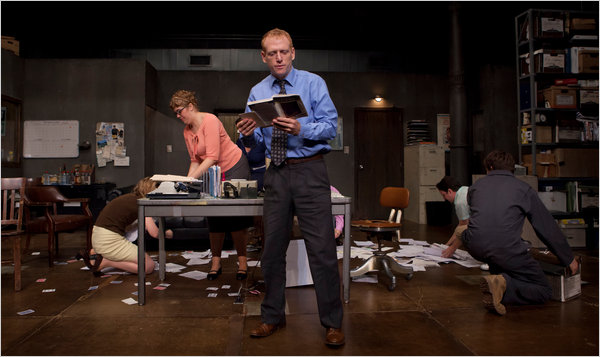
What is he doing? Reading a novel or dramatizing it?


When new and interesting things go on in the arts, it’s often about crossing genres - mixing music with poetry or painting, dance with drama, film with just about anything. recently I experienced a couple of amazing collisions: music and architecture, drama and the novel.


Grande Messe des Morts, Berlioz, the LSO


Assembling under the dome in St Paul's.


The LSO unpacks at St Paul's.
In St Paul’s Cathedral the London Symphony Orchestra assembled along with a choir of about 200 voices and performed Berlioz’ Requiem - Grande Messe des Morts, composed in 1837. Well! Wow! And...wow! Berlioz apparently composed the piece intending for it to be played in a large cathedral, and there can be few more appropriate venues than Wren’s magnificent church. The piece famously involves the placing of ensembles of brass and percussion in four remote locations, and on this night they were in the transept and above us on balconies. When it came their turn to contribute, the sound effects were nothing short of heart-stopping. Even a little terrifying.
Apparently this piece is performed every few years in St Paul’s, to kick off the City of London Festival. I quote from Guy Dammann’s review in the Guardian:
If your sense of aw lacks an existential dimension, Berlioz’ great Requiem will restore it. Being enveloped by the omnidirectional swell of sound at the onset of the Tuba Mirum, or dangled on the yo-yo of hope and despair that the Lacrimosa spins with such masterful theatricality, are not experiences one forgets.
One of the wonders of hearing this piece in this space, is how the quieter sections emerge with the greatest impact. While the tumults of the four brass bands of the apocalypse are still raging, the subdued desperation of the soprano’ cry of “salva me” just manages to escape, its quiet insistence intensified precisely because it reverberates in our minds rather than in the further reaches of Wren’s great dome.
The conductor was the venerable an fragile old Sir Colin Davis, and the lone soloist was tenor Barry Banks.


“Gatz” - F. Scott Fitzgerald performed by Elevator Repair Service


Now playing at the Noel Coward Theatre is an 8.5 hours theatrical marathon that is receiving rave reviews. It is a performance visiting fro New York, and performed by a theatre group called Elevator repair Service. And yes, they really do this: they read every line of F. Scott Fitzgerald’s novel “The Great Gatsby”, every “he said” and “she said”. Every word.
At first I wasn’t sure it worked. After the first couple of hours I felt that I was reading a novel in a less comfortable way, unable to put it down or take a tea break: force fed, as it were. Then after a long dinner interval, I settled down and started to see what the company was adding to the novel: comic lines where I hadn’t noticed them, subtle characterisations, some visual admixture...kind of like reading a novel via someone else’s head. A strange and extremely interesting experience.
And the company did manage to build up to the tense and dramatic climax of the story - and this even though the whole thing was set in a very dreary office, the central character starting as a bored office worker reading the novel, but soon assuming the character of the narrator Nick. His office co-workers assumed the other character roles as the story progressed, and the whole thing was remarkably convincing. A success.
Huge kudos to the whole company for the marathon effort. But a very special bouquet must go to Scott Shepherd, playing “Nick”, whole read the whole novel. Every word. 
And on the subject of cross-genre, let me repeat an apposite quotation from the program:
“[Nick Carraway] is both stage manager and chorus, recreating situations in all their actuality, and at the same time commenting upon them. Sometimes he even devises the action - contrives the circumstances by which the actors are brought together on the stage: it is he who arranges the reunion of Gatsby and Daisy.” - Brian Way. 
Read some comments here.
And a great review from the NYT.

Nick reads on, through the party scene.


And Aurora take it further.....
And now in my in-box comes an invitation to the Aurora Orchestra’s latest gig - Aurora are past masters of cross genre collaboration, commissioning paintings to accompany their music, adding a bluegrass band into their classical music mix. But this time they look likely to excel themselves. Here’s the description:
maxamorphosis maksemawfesis/ noun [zoology; musicology; choreography] rare process of transformation involving endangered species of violus-saltator(viola-dancer). Reaction commonly initiated by contact with simultaneous varying tempi and whispering strings, with resultant flutters in the piccolo and marimba. Also reliant on gradual release of enzymes (C+G+D+A) by specimen. Process discovered July 2012 by Julian Philips and Mickaël 'Marso' Rivière. A collaboration between composer Julian Philips and choreographer Mickaël 'Marso' Rivière, Maxamorphosis features Max Baillie as viola soloist alongside Aurora Orchestra and dancers from Company Decalage and Bboy's Attic.

Read all about it here.

Break dance meets classical music.


Images from:
http://www.gatzlondon.com/
http://www.maltbury.com/blog/tag/gatz/
http://theater.nytimes.com/2010/10/07/theater/reviews/07gatz.html
http://www.bbc.co.uk/programmes/galleries/p00vbwxs
http://www.auroraorchestra.com/event/battle/

Tuesday, April 24, 2012

Pet Shop Boys meet ballet

"The Most Incredible Thing"

I’m not a huge dance fan, but I enjoyed my second visit to Sadlers’ Wells just as much as the first - so perhaps I’d better re-think my anti-dance stance.

"The Most Incredible Thing" is a Hans Christian Anderson fairy tale with modern choreography by Javier de Frutos and music by the Pet Ship Boys. Does that sound like a recipe for disaster or what? An unkind reviewer in the Guardian did say that the result “sounds like the 1980s, looks like the 1920s, acts like the 1890s and feels as flat as the present.” he or she must have been having a bad day, because even if all that is true, the result is highly enjoyable.


Aaron Sillis and Clemmie Sveaas

Now, despite the Pet Shop Boys (Neil Tennant and Chris Lowe) having apparently sold 12 top ten studio albums and 40 top twenty singles since the 1980s, they were a closed book to me. One of those popular culture things that passed me right by while I was busy having babies and a career, I suppose. But I must confess to being very impressed with the score of ‘The Most Incredible Thing”, which was performed by a live orchestra and electronica. At times it might have been a bit cacophonous, but there was no doubt it was music to dance to, and dance gracefully, too.

And dance they did: the company and soloists were superb. I know nothing about dance, but I know what I like (as they say) - and I liked this.  The story is a bit inane, but then so is the story of The Nutcracker. It was a pleasure to see a fully-realised production with a clever set - though one nit-pick might be that there was too much reliance on video screens and signs being held up: we get it, we get it - we don’t need the sign!

The central part of the story features a magical clock which displays twelve marvelous scenes - a terrific plot line for a choreographer, and Javier de Frutos made the most of it, producing twelve fantastical vignettes. 

I just might go to see some dance again....


See a little for yourself.
Read a review.


Images from:
http://www.timeout.com/london/dance/event/247042/the-most-incredible-thing
http://www.guardian.co.uk/music/2011/mar/27/the-most-incredible-thing-review

Thursday, March 3, 2011

Horizonte, Soutine, Pollock and Le Tintoret

Le Tintoret & Bartabas
Horizonte, Soutine, Pollock and Le Tintoret are dancing horses. But that description will certainly not give you the true flavour of the dance performance I saw at Sadler's Wells. I don't go to dance performances very often (I keep waiting for everyone to start singing) but this one looked interesting. I was certainly right about that.

Ko Murobushi
The show is entitled "The Centaur & The Animal". There are two performers, six if we count the horses, and we probably should. The performers are a Frenchman with one of those single word names, Bartabas; and an elderly Japanese man named Ko Murobushi. The Frenchman trains and rides the horses and does various other set pieces; the Japanese man I doubt I will ever forget. His dance style is called Butoh, which is described in the program as a combination of dance, theatre and improvisation with influences from Japanese traditional performing arts and German Expressionist dance. I can tell you that his chiropractor would not like what he spent the evening doing.'Contortionist' comes close, but doesn't convey the extreme angst and violence and tension the little performer managed to create from the very first moment - and much of it by staying still. My own back began to ache and I wondered if it was just in sympathy, but then realised that I had been holding myself very taut because of what I was watching. I couldn't take my eyes off those little silver painted hands clawing about. And when he began writing about naked, with sand pouring all over him...

Impressive
In a way, the horses, lovely though they were, were a bit superfluous. It was all very controlled and beautiful. One section involved a lovely white horse (Horizonte, or Soutine, or Pollock or possibly Le Tintoret) performing some fairly amazing dressage steps. Horses doing dainty little dressage steps always seem strange and amazing - that such a large and obviously strong and lively beast would be bothered! In other set pieces, one of the horses 'died' repeatedly (only spoiling the effect on the last repeat by raising its head for a bit of a look around). Another white one, with its legs wrapped in blood red cloth, dashed back and forth with a rider in swathes of red, menacing a sand coloured figure trying to escape.

The horses sometimes performed without reins, and once without a rider. The rider (Bartabas) was on the floor, performing a very dramatic 'arising from the earth' sort of dance. The horse came over and began licking his arms and hands, and nuzzling him. No one was sure if this was part of the show, or just the horse being sweet. Or perhaps these sort of equine improvs are meant to be part of the show. It looked good, just a little distracting, perhaps.

There was a particularly dramatic bit where Bartabas stood in front of the dark horse (if you'll excuse the phrase) to create the impression that he was a man with a horse's head (a Centaur - geddit?). That was very well done - visually arresting.

Dark. Revolting. In a poetic kind of way. You had to be there.
The show doesn't actually have a storyline as such (as dance so rarely does) but it does have a voice over (exceptionally well-performed by William Nadylam), reciting excerpts (in English) from a poem by Lautreamont called Chants de Maldoror. I was a little uneasy when I read the program notes, which described the words as "some of the most barbaric and revolted writing"; "incredibly raw and wild"; "a general feeling of rage". I was right to be concerned. The stuff was shocking, and I worried about the small boy sitting in front of me, probably brought along by his mother to "see the horses". As the program also put it, "The abrupt Chants de Maldoror perfectly accompanies Ko Murobushi's body in mutation". In mutation? Is that what was happening? I must keep up (or read the program more closely). I understand that the Surrealists and Dadists were very keen on the  Maldoror. I wouldn't recommend that you look up the words of it in English, unless you are feeling too euphoric and want a real come-down. The first sentence contains a "warning" to the reader:

God grant that the reader, emboldened and having become at present as fierce as what he is reading, find, without loss of bearings, his way, his wild and treacherous passage through the desolate swamps of these sombre, poison-soaked pages; for, unless he should bring to his reading a rigorous logic and a sustained mental effort at least as strong as his distrust, the lethal fumes of this book shall dissolve his soul as water does sugar.
Having spent an evening listening to a bit of it, I'd say that's a pretty fair warning.

Bartabas in full flight.

There's not much more to tell you about the performance, except that I'm glad I overcame my prejudices and went to see some dance. The Butoh stuff was enthralling and visceral, and the horses were darling. The lighting designer needs to get a mention - thank you Francoise Michel - because with one of those plain dance sets the lighting was needed, and superb. The audience was fairly appalling. I have never heard so much coughing in my life (might be the time of year - colds about, but still); and why is that dance audiences discuss things while the performance is still in progress? They actually chat - they'd be thrown out of the Opera House for that.

Here's a clip of Bartabas talking about his "dance company but with horses" - very interesting.


Oh, and Sadler's Wells - you'll be wanting to know my impressions. Lovely. The theatre is new (1998) and modern and swish, and easy to get to from Angel tube station (one stop for me). However, there has been a theatre continuously on that site in Islington since 1683! And the odd name? The first entrepreneur was a Mr Dick Sadler, and he found an ancient 'medicinal' well in the backyard, which he promptly turned to a profit by selling the 'spa waters'. Thus: Sadler's Wells. That's one for the trivia parties.

The theatre has, as you can imagine, an interesting and varied history, my favourite part of which is that in 1804 it opened its doors as an aquatic theatre - with a vast tank under the stage, and a channel out to the river for the water supply. The shows had huge ships in full sail, sea creatures, fireworks and special effects like burning castles and volcanoes. Bring it back, I say! In the 20th century Sadler's Wells launched several companies that became (and still are) amongst the top performing companies in the country, including the Royal Ballet (formerly Sadler's Wells Ballet) and English National Opera (formerly Sadler's Wells Opera). These days, Sadler's Wells is one of London's main dance theatres. Not bad for over 300 years of continuous theatre history.

Auditorium at Sadler's Wells
Sadler's Wells, Islington


Horizonte, Soutine, Pollock and Le Tintoret are the latest in a very long line of performers. The night I attended was opening night, so the reviewers will be having their say in the papers tomorrow, I expect.

******
Postscript:

The Guardian's review did indeed appear today. Judith Mackrell gave the show three stars (out of five) and appeared to have a diametrically opposite reaction to me - she wanted more horses and less Japanese butoh. She complains that the horses don't even appear on stage for the first ten minutes - I was so entranced and tensed with watching Ko Murobushi that this never occurred to me. According to Judith, "It's one of the toughest openings to any piece of dance theatre I've seen. And you can sense the beginnings of mutinous restiveness in the theatre". Not where I was sitting, Judith...perhaps it was different in the free press seats. She clearly belongs to the 'want to see the pretty horses' crowd -- but hey, I'm a dance novice and Judith is presumably paid to see lots of it. I just think she was a bit snide about Ko Murobushi after he almost broke his back in an absorbing, if excruciating, performance. 


Images from:
http://eveseyes.blogs.france24.com/article/2010/12/17/horse-theatre-0
http://www.komurobushi.com/
http://www.e-architect.co.uk/london/sadlers_wells_theatre.htm
http://en.wikipedia.org/wiki/Sadler's_Wells_Theatre