Showing posts with label Olympics. Show all posts

Saturday, September 15, 2012

Dismantling Olympic park


The Olympic Stadium. Architects Populous


One feature of attending the various venues at the London 2012 Olympic Games - and they were, mostly, excellent - was that they were obviously very temporary. Indeed, if I'd had enough forethought, I would have sunk some investment money into companies that provide temporary scaffold seating. They certainly had a lot of business for The Games. Many were the almost-but-not-quite rickety metal stairs I ascended and descended to watch Hockey or Swimming or Volleyball or Archery; or worried about the crowds getting too enthusiastic with their stomping and stamping.

In the case of Archery, the temporary arena was plonked in the middle of the hallowed turf of Lord's Cricket Ground. In the case of Volleyball, it was erected inside the cavernous exhibition space of Earl's  Court. The massive banks of seating in Hyde Park for Beach Volleyball and in Greenwich for the Equestrian events featured often in the news. These temporary billets supplemented the more permanent O2 arena - sorry, 'North Greenwich Arena' - which hosted basketball and Gymnastics; and the excellent Excel, and mile-long (it seemed) exhibition space where they managed to squash a record seven sports. It was, in fact, a terrific feature of this Olympics that the venues were spread all over London, some in iconic spots with great views.

But it was at out at Olympic Park, that massive space carved out of the wastelands of East London, that  I was a bit surprised to find so much temporary-ness. Sydney's own Olympic Park stands pretty much today as it was in 2000; but London's is being demolished as we speak, now that the Games are done and dusted. This is of course not necessarily a bad thing. Building many permanent venues is possibly far more expensive than supplementing a few with all these temporary shelters. And as far as I know, none of them fell down.

A strange view of the Swimming Centre
- that great lit white bit is temporary.

While no-one is likely to miss the intrusion on Hyde Park, and Lord's needs its ground back for the cricket, there are those missing Olympic Park already. Apparently it is to undergo a makeover. There was some talk of demolishing even the large stadium, but it seems this is not going to happen. The hocket pitch - 'Riverside Arena' - will remain (though in my opinion is a very temporary sort of place). The Swimming Centre and the Velodrome, both rather nice pieces of architecture, were always intended to be permanent, though the Swimming Centre was scarred with ugly banks of temporary seating to increase its capacity during The Games. This will no go, and good riddance. The tow massive McDonald's outlets will also be put into the recycling bin; but the Orbit, that red intestinal tower, will apparently re-open to its expectant public after some time.

The swooping roof of the Swimming Centre. Architects Zaha Hadid.

The Park was surprisingly attractive, once you got yourself through the security tents and across the acreage of concrete. It had water features, and pretty wildflower gardens. It also necessarily has huge expanses of space, and perhaps there are plans to fill those up with something or other.

Nevertheless, I thought I would record a few views of Olympic Park during its few weeks of glory, as it is "remodelled" for life after The Games.

The equally-swooping roof of the Velodrome, dubbed 'The Pringle'.
Hopkins Architects.

To supplement my bad photos - I didn't get ticket to the cycling! - here's a video of Chris Hoy and the architects talking about 'The Pringle", which is one of the permanent buildings which will survive:

Velodrome video

The Water Polo arena - one of the nice ones, and soon to go.

The Water Polo Arena is one of the buildings which will be completely demolished. It was made out of recycled materials, including inflated PVC cushions covering it. It was actually one of the greta venues, being quite small and getting the crowd up close to the action. It was also rather lovely to look at.


A media centre constructed of shipping containers - cool.

One of the temporary McDonald's, amongst the wildflowers.

'The Pringle' and a temporary Basketball Arena.

Here's  a great article recording what a bunch of architects thought of the Olympic Park buildings when they first saw them. They loved the Velodrome and Swimming Centre, and where underwhelmed by the Stadium. It has, however, been recently reported that the Stadium has been shortlisted for a prestigious architectural prize: partly because of its ability to be dismantled, reduced, recycled -- in other words, for its temporariness.


Olympic Park, with its Stadium and crowds, Summer 2012.

A map of the park during the Olympics 2012.


Wednesday, September 12, 2012

Into Orbit


The Orbit dominates Olympic Park


Anish Kapoor is an Indian-born British sculptor, and his work best-known to me until recently was the big reflective jelly-bean in Chicago known as Cloud Gate. I've now also learnt that he has exhibited in the massive Turbine Hall at the Tate Modern and made a lovely-looking thing called Sky Mirror. Although I have been up close and personal with Cloud Gate, my most recent experience of an Anish Kapoor sculpture was - along with thousands of other Olympic Games goers - of 'The Orbit' in the London 2012 Olympic Park at Stratford in East London.


The Orbit has been widely derided as intensely ugly, and its reputation wasn't exactly enhanced by the London Mayor Boris Johnson ridiculously saying it would would have “dwarfed” the aspirations of Gustave Eiffel and “boggled the minds” of the ancient Romans. Architect Cecil Balmond was also involved in its construction, and presumably a slew of clever engineers. Having investigated The Orbit, I have to say that it is indeed very ugly. It seems to exist just because it can. The Eiffel Tower makes iron and steel look lacy and light. The Orbit just looks intestinal and off balance.


However, I must also say that climbing the thing (well, taking the elevator to the top and walking back down the ramp) is not an ugly experience, but on the contrary a rather beautiful one. This is partly because it takes you so high in the sky, and because you can look down on and across lovely views not before seen. Perhaps that makes me a little generous, but I'd give the Orbit 5 out of 10.


Here's the official description from the London 2012 website:

Standing 115 metres high, the Orbit is the tallest art structure in Britain – offering stunning views over the Olympic Stadium, Olympic Park and the whole of London.
Located in Orbit Circus in the south of the Olympic Park, the Orbit is London’s major new visitor destination – both during the Games and beyond.
The design and construction
The search for a permanent artwork on the Olympic Park was instigated by the Mayor of London’s Office, which invited more than 30 international artists to submit their ideas for a sculpture of up to 180 metres tall.
Following a lengthy selection process, the Orbit – designed by internationally acclaimed artist Anish Kapoor – was chosen.  As well as promising a unique moment and experience for visitors, the spiralling red structure successfully represented both London and the UK, and was reflective of the five Olympic rings.
Construction of the Orbit started in November 2010, and was completed by April 2012.
The Orbit experience
The Orbit is more than a work of art – it’s an entire experience. After going through the small, intimate entrance to the Orbit, visitors make their way into an elevator with viewing portholes, which takes just 30 seconds to pass through the Orbit’s twisting form and reach the viewing platform 85 metres high.
Once it’s reached the platform, visitors can step outside the lift and experience the Olympic Park in a whole new light – as well as enjoying stunning views of London’s cityscape. It’s also possible to look straight down the centre of the Orbit to the ground below – though this isn’t recommended for the fainthearted!
To conclude the experience, visitors are encouraged to stroll down the spiral staircase that twists through the Orbit, enjoying even more amazing sights.
After the Games, the Orbit will close and re-open in late 2013, when it will give even more visitors the opportunity to experience it.


Tuesday, September 11, 2012

The Closing Ceremony


Let the, er, Ceremony begin....


Olympic ceremonies are known for a number of traditional elements. They have to be garish, cacophonous, feature lots of parochial and patriotic symbols of the host city and country, use as many performers as humanly possible, and include bad music. There must also be surprise(s), and fire.

The London 2012 Opening Ceremony ticked all the boxes - its content was so successfully local that there are parts of it that the rest of the world will never figure out. The Closing Ceremony was a little clearer: we had the London Eye, Battersea Power Station, Big Ben, St Paul's, London buses, black cabs...yep, and really bad music. Well, some of the performers, such as John Lennon and Freddie Mercury, are dead, so perhaps that can be forgiven. Others were, I thought, dead, but apparently The Who still lives. The Spice Girls reunited (again) for the occasion, jiggling in evening dresses on top of black cabs being driven around the arena.

Evening falls, anticipation rises...


The ground of the Olympic Stadium was a covered, not in athletes (they came in later in reduced numbers - many gone home already, I guess), but in a great spread-out Union Jack. The sun rose over London, an actor dressed like Winston Churchill (let's not forget he was half-American -- sorry, I couldn't resist) popped out of the top of Big Ben. I think he read something from 'The Tempest' again, but I'm not sure, because stadium sound quality is a difficult thing for all concerned.


The athletes (or what's left of them) join us.

Actually, although all of the above is true, I will confess to enjoying myself. If we skim lightly over that rapper person, and the girl in the bad body suit, and the weird sequence with the inflatable octopus (what was that about?)... Eric Idle sang "Always Look on the Bright Side of Life", which is always good. Small children in white joined the deceased Mr Lennon to sing "Imagine", which was, if nothing else, appropriate for the Olympic Games. And - highlight of the night, folks! - the Stomp guys and gals battered and, well, stomped, through the London icons with not only precision timing but also a great deal of panache AND acrobatics. And through my binoculars I think I spied the charming Mr Dan from the gym! Stomping with the best of them, his feet in boots attached to a couple of 40 gallon drums. Don't try that at home.

I liked the straightforward London imagery. I liked the dousing of the flame (accompanied by a chorus of "awww" from 80,000 throats. I liked my seat close to Mayor Boris determinedly waving the Olympic flag one more time before he handed it on to the Mayor of Rio de Janeiro. In fact, in summary, I liked the 2012 Games. It was a privilege to be there.

Awww...sad to see it go.


Monday, September 10, 2012

Sports Photography


The pros in action.

If you followed the London 2012 Olympic Games at all, you surely could not help but be impressed by some of the extraordinary images produced both on video and by still photographers. Check out some of them here.

At the various sports venues, the authorised photography contingent could be seen huddled along their special court-side benches, cradling lenses as long as their arms, dressed in the ubiquitous beige multi-pocketed photographer's jackets. They each sported a four-digit number on their  jackets. Some had laptops with them - they could be seen downloading their digital pics and sending them off to wherever they were sending them, before the matches had even climaxed.


Looong lenses.

In our seats, not always very close to the action, and with a small compact digital camera, we couldn't be expected to compete with the pros. We were at least three feet of lens too short. However, that didn't stop us trying. Some sports leant themselves to pretty good shots - Weightlifting and Archery, for instance, where the competitor stands still, except for a bit of straining and trembling. Others, such as gymnastics, tempt the photographer with the balletic grace of the moves but foil with the speed and movement.

Peering over the judge's shoulder - Table Tennis.

Seat location matters, of course. Row five at the Water Polo provided unsurpassed views of the butts...er, musculature...of the athletes. Row fourteen for Athletics in the big stadium, though far from the finish line, was right on the relay start lines. The Hockey was hot, the Swimming was too far away, the Fencing was dimly lit. The Table Tennis was nigh on impossible to photograph, so incredibly fast do they pelt that tiny light ball around. Volleyball and Basketball look great through the camera lens, but all too often the great shot is over before you can click the shutter.

So it is with just a little preening that I present here an album of some of our amateur efforts at Olympic sports photography.

Swimmers on their marks.

en garde in the fencing

Men's Floor Exercises in the Gymnastics


Men's Pommel Horse - "hello boys"

Elegant...Men's Gynmastics


Volleyball


Table Tennis - concentration


Italian Water Polo players
(they model for Armani, I'm told)


Water Polo action.


Eyeing the ball - Table Tennis


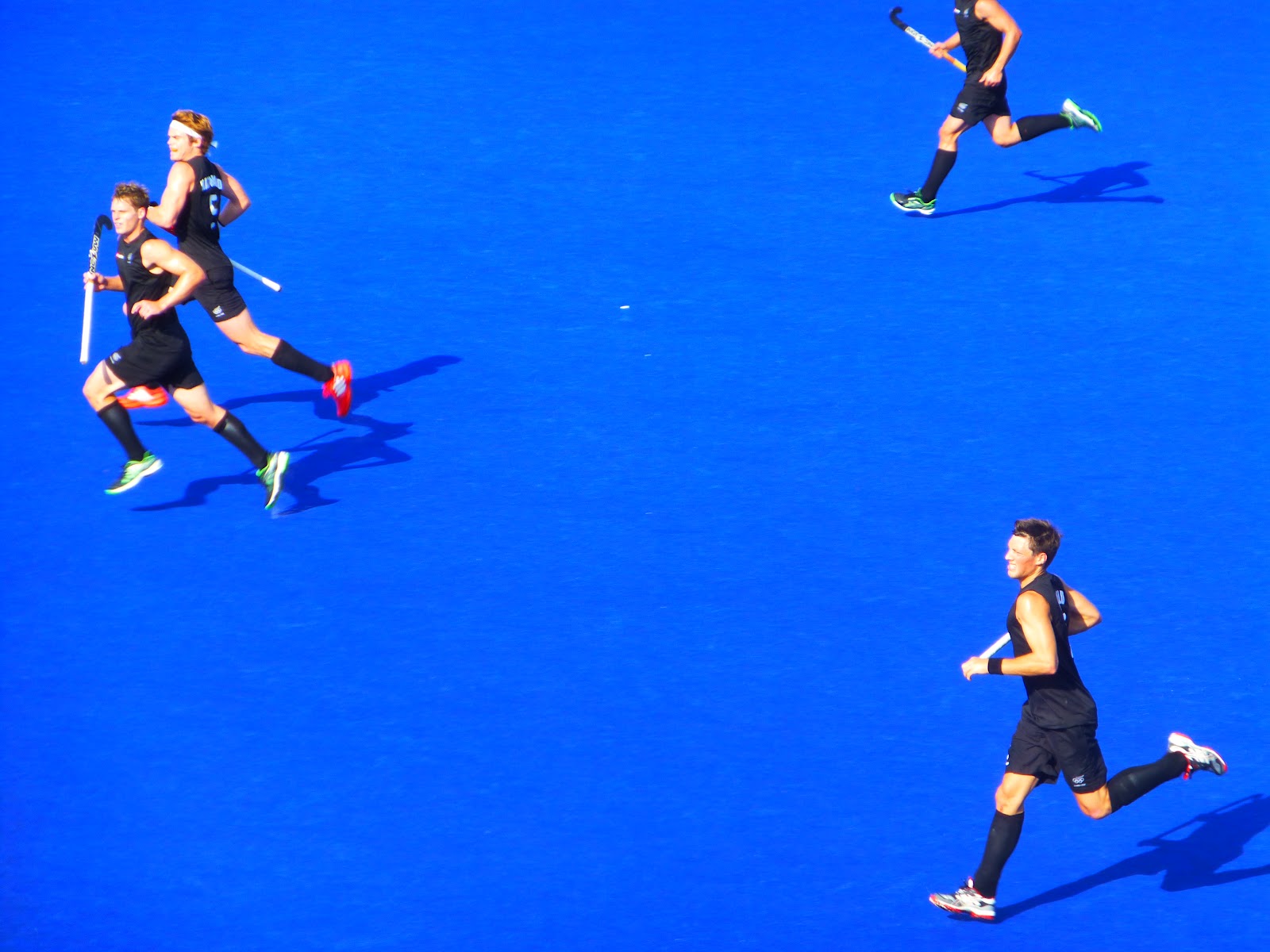
New Zealand in the Men's Hockey

Women's Basketball (France v Russia)

Ready in the relay.

Victory lap.

Women's Hammerthrow.

Lined up for the Women's 1500m


Oscar Pistorius, the South African 'blade runner'.

Victorious Bahamians.

Women's Basketball:
finally managed to snap the ball in flight.


Sunday, September 9, 2012

Medal Ceremonials

Weightlifting medal recipients.


At the Olympic Games there's the Opening Ceremony and there's the Closing Ceremony, but never a day goes by without dozens of those other ceremonies - the Medal Ceremonies. Sometimes they are the most dramatic moments of all. After a tense or exciting bout, the tensions of the victors relax and all their emotions are allowed to surface. Relief, patriotism, joy, euphoria - sometimes even unbridled religious fervour. The medal ceremonies are the unsung ceremony stars of the Games.

Aussie women win Basketball bronze.


The flower guy brings out his tray.
Lauren Jackson examines her bronze medal.  

For the spectator, watching your own country's sportsmen or women up on the medal dias is of course a great moment, but there wasn't so much of that going for Australia in this Games. Well, we did finish in the top ten, after trailing at 24th at one time. And there was plenty of Silver! This spectator enjoyed the Australian Women's Basketball team on the dias for Bronze (if only they hadn't lost to France earlier, they would have been the final against the USA, and they deserved to be, on form - arghh!)

When a medal winner is from a tiny nation, or one which hasn't won a medal for many long years, the jubilation from competitors and spectators alike is fervent. When the Venezuelan men's fencer won that country's first medal - a Gold, to boot - since 1968, well, we were all Venezuelan for a moment. When Ugandan Stephen Kiprotich won the Men's Marathon on the final day, we could feel for the Kenyans, but...hey, Uganda!

Venezuela - Fencing gold.

And of course there is the Home Crowd -- after a tense first day or two, Team GB swept all before it and gave their home supporters something to wave their Union Jacks about. And they did. Loudly. Often. Congratulations Team GB - and all the others who stood hand on heart, heart in mouth, sometimes weeping, on the winners' dias at the Medal Ceremonies.

A military operation (and that's the correct Korean flag this time).

Young ladies, young men, officials, photographers - oh, and athletes. Gymnastics.

Preparing to mount the winners' dias. Table Tennis.

A fetching purple colour.

In 2012 the dias for the Medal Ceremony was a charming purple, which went so well with hot pink, that other London 2012 signature colour. The flags were raised by military personal from various branches of the services. We will skim lightly over that unfortunate mix-up of flags on day one at the football - of all the flags to mix-up, it would have to be North and South Korea. Still, we moved on from that. Out marched the military in fine formation at each and every Medal Ceremony, treating the flags as carefully as new born babes, raising them and lowering them, and marching them back to storage with all due solemnity.

The anthem of the winning country is played as the three flags are raised. Like sorting out the flags, this too must be a mammoth and delicate task. The anthems used at the 2012 Games were specially recorded by an orchestra commissioned to do so - some had to be shortened, and some lengthened. There was quite a bit of low-key grumbling about the version of 'God Save The Queen' which we heard so often following Team GB's victories. Some didn't like the somewhat truncated version, which missed out the little rising trill in the middle. Still, needs must, and flags have to be raised and the next matches played.

THE moment. Table Tennis.

The flags are raised. Basketball. (Aussie!)

The medals are presented by an official from the relevant sporting federation, and a little bunch of flowers by an IOC bigwig. They come out dressed in their special uniforms, neat jackets and jaunty hats. Various lithe young ladies attend the proceedings, moving everyone to where they should be on the dias; and several handsome young men solemnly carry out the medals and flowers on little trays, while suitable music plays. It is very ritualistic, and probably is the moment in the modern Olympics which most recalls the ancient Games - somehow you feel that when the laurel wreath was placed on the ancient winner, things were solemn, and lithe young people were involved.


Yay! Happy medal holders.