Showing posts with label Churches. Show all posts

Saturday, December 28, 2013

Mosque Visit


In Abu Dhabi there's one major tourist attraction - and local attraction, too. The Sheikh Zayed Grand Mosque. My guide (an Indian) just knew I'd be impressed - "40,000 worshippers! Third-largest in the world! Biggest carpet in the world!" I thought I remembered being given similar statistics when I visited the Sultan Qaboos Grand Mosque in Muscat, Oman. But modern mosque stats are like that - big, bigger, biggest. It turned out that, wherever it falls in the rankings, the Sheikh Zayed Grand Mosque of Abu Dhabi is a very beautiful thing.


The building of the mosque was initiated by the late President of the United Arab Emirates (UAE), HH Sheikh Zayed bin Sultan Al Nahyan. His final resting place is located in the grounds of the mosque. It was constructed between 1996 and 2007, and Wiki claims that it's the largest mosque in the United Arab Emirates and the eighth largest in the world.

I looked up the design and building details. To me, there seemed a very strong Persian and even Mughal influence. The entire place is draped in spectacular marble. Here's what Wiki told me:
The Sheikh Zayed Grand Mosque's design and construction 'unites the world', using artisans and materials from many countries including Italy, Germany, Morocco, Pakistan, India, Turkey, Malaysia, Iran, China, United Kingdom, New Zealand, Greece and United Arab Emirates. More than 3,000 workers and 38 renowned contracting companies took part in the construction of the mosque.  
Natural materials were chosen for much of its design and construction due to their long-lasting qualities, including marble stone, gold, semi-precious stones, crystals and ceramics. It was built by the Italian company Impregilo. 
The design of the Sheikh Zayed Mosque has been inspired by Persian, Mughal and Moorish mosque architecture, particularly the Badshahi Mosque in Lahore, Pakistan and the Hassan II Mosque in Casablanca, Morocco being direct influences. The dome layout and floorplan of the mosque was inspired by the Badshahi Mosque and the architecture was inspired by Persian, Mughal and Moorish design. Its archways are quintessentially Moorish and its minarets classically Arab. The design of the mosque can be best described as a fusion of Arab, Persian, Mughal and Moorish architecture.


The marble used includes Sivec from Prilep, Macedonia on the external cladding. 115,119 m2 (1,239,130 sq ft) of cladding has been used on the mosque, including the minarets. Lasa from Laas, South Tyrol, Italy was used in the internal elevations. Makrana from Makrana, India was used in the annexes and offices; Aquabiana and Biano from Italy in the East White and Ming Green from China.
Wow.


The stats (all from Wiki): The mosque is large enough to accommodate over 40,000 worshipers. The main prayer hall can accommodate over 7,000 worshipers. There are two smaller prayer halls, with a 1,500-capacity each, one of which is the female prayer hall. There are four minarets on the four corners of the courtyard which rise about 107 m (351 ft) in height. The courtyard, with its floral design, measures about 17,000 m2(180,000 sq ft),and is considered to be the largest example of marble mosaic in the world.


The 96 columns in the main prayer hall are clad with marble and inlaid with mother of pearl, one of the few places where you will see this craftsmanship.


The carpet in the main prayer hall is considered to be the world's largest carpet made by Iran's Carpet Company and designed by Iranian artist Ali Khaliqi. This carpet measures 5,627 m2 (60,570 sq ft), and was made by around 1,200-1,300 carpet knotters. The weight of the carpet is 35 tons and is predominantly made from wool (originating from New Zealand and Iran). There are 2,268,000,000 knots within the carpet and it took approximately two years to complete.


The Sheikh Zayed Grand Mosque has seven imported chandeliers from Germany that incorporate millions of Swarovski crystals. The largest chandelier is the second largest known chandelier inside a mosque, the third largest in the world and has a 10 m (33 ft) diameter and a 15 m (49 ft) height.


The 99 names (qualities or attributes) of God (Allah) are featured on the Qibla wall in traditional Kufic calligraphy, designed by the prominent UAE calligrapher, Mohammed Mandi Al Tamimi.


The Mosque's official website waxes lyrical, as well it might:
As a testament to the vision of its founder, Sheikh Zayed Grand Mosque sits majestically at the entrance to Abu Dhabi City Island, distinctly visible from the three main bridges connecting the island to the main land, the Maqta, Mussafah and the Sheikh Zayed Bridge. The strategic geographical location of the Mosque is a symbolic expression of the emotional connection the Mosque has in the hearts of all UAE citizens particularly because the burial place of the late Sheikh Zayed bin Sultan Al Nahyan, first President of the UAE, is located beside the mosque.
The Sheikh Zayed Grand Mosque is well recognised by its pure colour, as it is clad with SIVEC marble from Macedonia.  Every artistic design element was carefully considered and fits into the overall vision of the Mosque.
But one last thing - I expect you might be wondering how a visiting Western woman gets on in a mosque (assuming they're allowed in at all, and as you can see from my pictures, I was.) There are clothing rules: male visitors should avoid wearing shorts and singlets. Female visitors to the mosque are required to wear either a full length abaya (which can be supplied at the reception area) or a head scarf. In addition, tight and revealing clothing is not allowed. Luckily, my guide had a spare abaya for just this very circumstance, and here's me full rigged out (though not wearing it properly - oops! - that bit of neck shouldn't be showing. I spent most of the visit very hot, and constantly tugging at the headscarf to try to cover all hair and skin. I was only giving an admonitory finger-wag by a guard once.


Thursday, November 21, 2013

San Sebastiano

Saint Sebastian: sculpture by by Antonio Giorgetti.
If you visit even a few art galleries or churches in Europe, you will very soon come across Saint Sebastian. In fact, you may very well find yourself overwhelmed by Saint Sebastian, so ubiquitous - and gory - is his image. He's the handsome young man tied to a column, almost naked, and pierced with arrows.

Saint Irene Healing Sebastian's Wounds
Trophime Bigot (source)
You may be pleased to discover that he didn't die of those arrow wounds. Although he was left for dead on the Palantine Hill in Rome, he was rescued by Irene of Rome (who became Saint Irene for her pains). Why had he been tortured? Like so many early Christians, especially under the rule of Emperor Diocletian, he had earned the Emperor's wrath by preaching Christianity. In fact, he was a soldier - a  Praetorian Guard, no less. He came from a well-to-do family who had raised him as a Christian. When he joined the army - the Roman Emperor's troops - he proceed to evangelise anyone he could. He also performed quite a few miracles along the way, such as curing a deaf-mute woman.

Lodovico Carracci, the rare subject of
St. Sebastian Thrown into the Cloaca Maxima (1612)
(source)
So, as was the fate of many early Christian martyrs, Diocletian had him tortured. When the Emperor found out about his survival he had Sebastian clubbed to death and tossed off a cliff. His body was supposed to be inaccessible, in a pit, but divine intervention enabled the early Christians to find him, and they buried him outside the walls of Rome, in the Catacombs - today called the Catacombs of San Sebastiano. The year was 288 AD. Because Sebastian had been thought to have been killed by the arrows, and yet was not, and then later was killed by the same emperor who had ordered him shot, he is sometimes known as the saint who was martyred twice.


Basilica of Saint Sebastian Outside the Walls
Interior of the Basilica.
Today his remains have been brought up from the Catacombs to a Basilica built just above them - the Basilica of Saint Sebastian Outside the Walls, originally built in the 4th century AD. He - or bits of him - lie in a Baroque chapel decorated with a large marble sculpture of the saint - pierced, for all eternity, by cruel metal arrows. The sculpture of Saint Sebastian is by Antonio Giorgetti. The Relics Chapel directly across the nave houses one of the arrows which struck St. Sebastian, and part of the column to which he was tied during the martyrdom. Here is also kept the stone carrying the alleged footprints of Jesus related to the episode of "Quo vadis?" in the apocryphal Acts of Peter.

And he was such a handsome boy. He's the patron saint of soldiers and athletes, and can be relied upon to help stop the plague.


Wednesday, November 20, 2013

Quo vadis?

The Old Appian Way (source)
"Where are you going?" Saint Peter, leaving Rome, is said to have asked Christ, whom he is supposed to have met walking towards the city. Christ replied, "I am going to Rome to be crucified again." And where else could such a meeting have taken place than on the Old Appian Way?

The little 'Quo Vadis' Church.
The Church of St Mary in Palmis (Italian: Chiesa di Santa Maria delle Piante, Latin: Sanctae Maria in Palmis), better known as Chiesa del Domine Quo Vadis, is a small church southeast of Rome... It is located on the Appian Way, on the site where, according to legend, St Peter met Jesus while Peter was fleeing persecution in Rome. According to the apocryphal Acts of Peter, Peter asked Jesus, "Lord, where are you going?" (Latin: Domine, quo vadis?). Jesus answered, "I am going to Rome to be crucified again" (Latin: Eo Romam iterum crucifigi).

Inside the little church the Holy Meeting is recorded. Stones of the Appian Way cross the chapel, and a painting of Christ stands facing the city, while one of Peter faces the other way. And in the centre -- a marble block with the imprint of a pair of (rather large-sized) bare feet, said to be those of Christ. Actually, the marble block in the Quo Vadis church is, these days, a replica. The original is in safe-keeping in a chapel in the Basilica of San Sebastian Outside the Walls (a short way down the Appian Way). But all the same - pretty impressive, eh?

Domine, quo vadis?
Eo Romam iterum crucifigi.
As to the history of the little church, there has been a sanctuary on the spot since the ninth century, but the current church is from 1637 (the current façade is 17th century). It's possible that the sanctuary might have been even more ancient, perhaps a Christian adaption of some already existing temple. Of the connection with St Peter, Wiki says:
The presence of the Apostle Peter in this area, where he is supposed to have lived, appears to be confirmed in an epigraph in the Catacombs of Saint Sebastian that reads Domus Petri (English: House of Peter). An epigram by Pope Damasus I (366–384) in honour of Peter and Paul reads: "You that are looking for the names of Peter and Paul, you must know that the saints have lived here."
And the footprints? Well...
The two footprints on a marble slab at the centre of the church...are popularly held to be a miraculous sign left by Jesus. It is to these footprints that the official name of the church alludes: palmis refers to the soles of Jesus' feet. It is likely that these footprints are actually the draft of an ancient Roman "ex voto", a tribute paid to the gods for the good outcome of a journey. 
Leaving footprints...
The little church is popularly supposed to be a sanctuary for travellers, and used to bear an inscription inviting travellers to rest: "Stop your walking, traveller, and enter this sacred temple in which you will find the footprint of our Lord Jesus Christ when He met with St. Peter who escaped from the prison." Apt for a chapel along the Old Appian Way, that famous Roman road.

A traveller inside the Quo Vadis Church.
The Old Appian Way - Via Appia Antica - is generally said to begin today at Porto San Sebastiano in the Aurelian Walls, but when it was built in 312 BC it was an almost-straight 560 km road running from the area of the Circus Maximus all the way to Puglia in Southern Italy. Check this site which advises:
Today the Via Appia starts at the Aurelian wall, at the Porta San Sebastiano. The first part of the road is not exactly pedestrian friendly. It leads along the Quo Vadis church, the catacombs of San Callisto and the catacombs of San Sebastiano to the imposing tomb of Cecilia Metella. From here the road is paved with the authentic Roman stones. You can walk for many kilometres passing the remains of numerous historic tombs.

"The first part of the road is not exactly pedestrian friendly. "
The Old Appian Way today.
Check Wiki for lots of detail, and the information that:
The main part of the Appian Way was started and finished in 312 BC. The road began as a levelled dirt road upon which small stones and mortar were laid. Gravel was laid upon this, which was finally topped with tight fitting, interlocking stones to provide a flat surface. Some of the stones were said to fit so well that you could not slide a knife into the cracks. The road was crowned in the middle (for water runoff) and had ditches on either side of the road which were protected by retaining walls.
Today the first part of the Old Appian Way is a bit of a race track of vehicles and the old stones have been replaced by modern cobbles. But continue on down past the great ruined tomb of Cecilia Metella and you too can walk on the same stones as St Peter and - perhaps - Christ himself. Leave some footprints.

Oh, and we probably shouldn't leave this subject without mentioning the Polish author Henryk Sienkiewicz, who was awarded the 1905 Nobel Prize for Literature, partly in recognition of his novel "Quo Vadis":
The novel Quo Vadis tells of a love that develops between a young Christian woman, Ligia (or Lygia), and Marcus Vinicius, a Roman patrician. It takes place in the city of Rome under the rule of emperor Nero around AD 64. Sienkiewicz studied the Roman Empire extensively prior to writing the novel, with the aim of getting historical details correct. As such, several historical figures appear in the book. As a whole, the novel carries an outspoken pro-Christian message.
Published in instalments in three Polish dailies in 1895, it came out in book form in 1896 and has since been translated into more than 50 languages. This novel contributed to Sienkiewicz's Nobel Prize for literature in 1905. Several movies have been based on Quo Vadis including the 1925 Italian silent film Quo Vadis, the 1951 Hollywood production Quo Vadis and the 2001 adaptation by Jerzy Kawalerowicz. (source)

Bust of Sienkiewicz in the Quo Vadis church.
Via Appia Antica.


Tuesday, November 19, 2013

Saint Cecilia Revisited

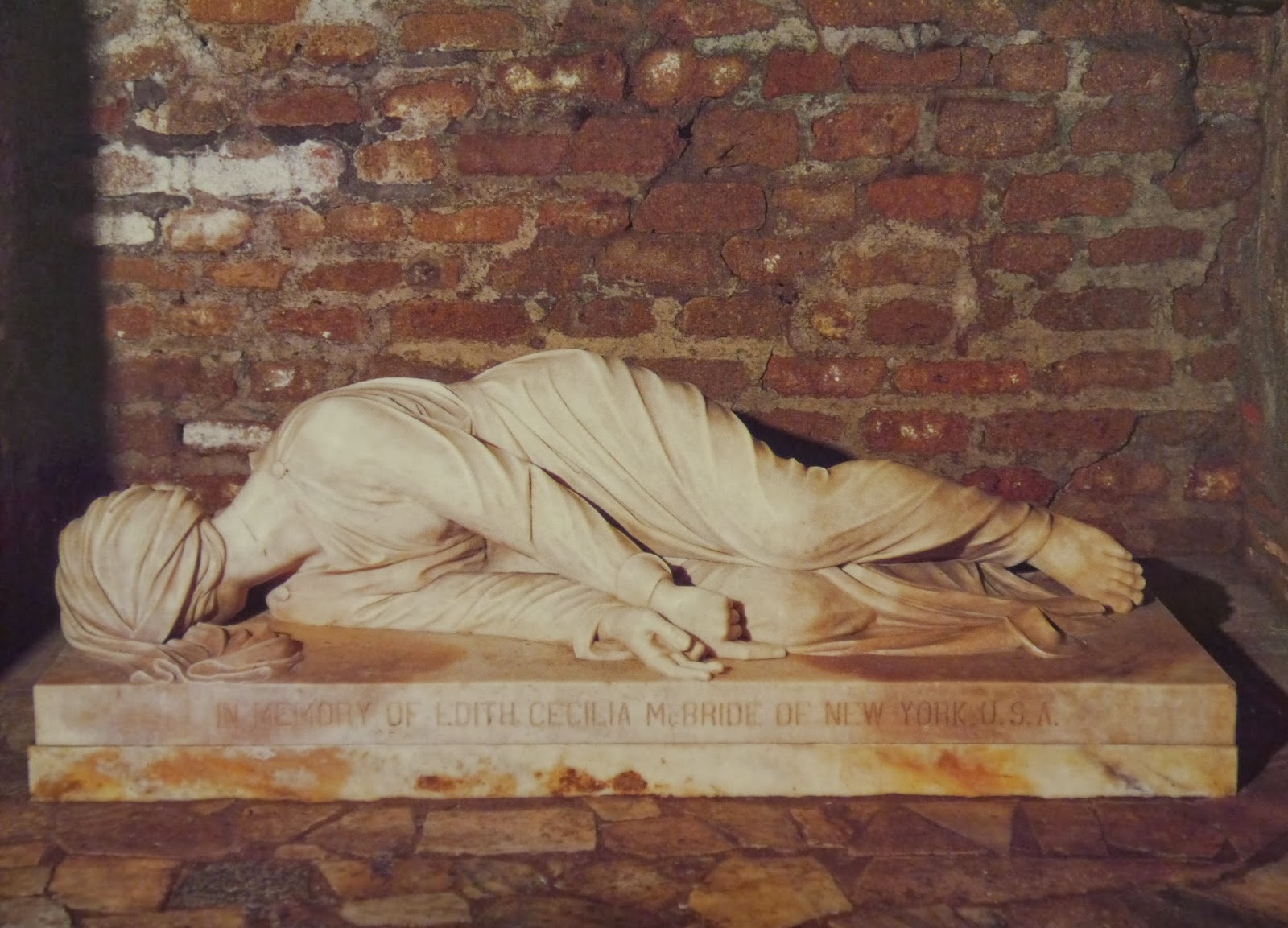
Saint Cecilia - Stefano Maderno, 1599-1600
This blog has explored the story of Saint Cecilia before - following the tale told in the lovely frescoes of the Bentivoglio Chapel in Bologna. But to round out the story, I couldn't resist visiting a couple of the saint’s holy sites in Rome.

Frescoes in the Catacombs.
Early 9th century.


Deep underground in the Catacombs of Saint Callixtus is a space where Saint Cecilia’s body is said to have rested. The ancient man-made cave in which this space is located has been hollowed out and enlarged several times to accommodate all the pilgrims who wished to visit. The walls still have traces of ancient frescoes.

Saint Cecilia’s remains have long since been removed to her Basilica in Trastevere, but in the niche in the Catacombs is a replica of the sculpture of the saint by Stefano Maderno. The original was made in 1599-1600.

Copy of the Maderno sculpture in the catacombs of Saint Callixtus.
Wiki tells us that:
Stefano Maderno is best known for the seemingly unposed, naturalistic recumbent marble of Santa Cecilia in the Church of Santa Cecilia in Trastevere (1599–1600). The sculpture was a counter-statement to the current dry and hectic complications of Mannerism, to which it confronted a simple sweeping outline and a stark pose. This is not a sanitized hagiographical representation of a saint, but the graphic representation of an uncorrupted corpse, claimed to be positioned just as it had been found. The saint's tomb had been opened in 1599, and Cardinal Paolo Emilio Sfondrato commissioned Maderno, aged 23 at the time, to recreate the martyr's body in marble. 
Basilica of Saint Cecilia in Trastevere, Rome.
Over in Trastevere, not only do Saint Cecilia’s remains (and some of her husband, St Valerian) rest in the crypt of the Basilica bearing her name, the church also has the original of the Maderno sculpture - a luminous white thing, remarkably modern in style. Cecilia lies forward on her face, her hair and face covered by a cloth, her white neck showing the axe wound that finally killed her, after several miraculous escapes from death. Her fingers form a ‘secret’ Christian symbol: 1, 2, 3 -- the Trinity. Here's Wiki again:
The pavement in front of the statue encloses a marble slab with Maderno's sworn statement that he has recorded the body as he saw it when the tomb was opened in 1599. The statue depicts the three axe strokes described in the 5th-century account of her martyrdom. It also is meant to underscore the incorruptibility of her cadaver (an attribute of some saints), which miraculously still had congealed blood after centuries. 
Hmmm....
"Behold the body of the most holy virgin, Cecilia, whom I myself saw lying uncorrupt in her tomb. I have in this marble expressed for thee the same saint in the very same posture and body."

The day that I visited Saint Cecilia’s Basilica in Trastevere, the Benedictine nuns were singing an afternoon service for Saint Martin’s Day (but he’s another story), their wavering and rather tuneless voices drifting up into the church rafters. Saint Cecilia is the patron saint of music, so 'm sure she'll appreciate the effort. BTW, this site suggests that "the origin of this seems to be found in the antiphon taken from her Acts: “As the musical instruments (at her wedding feast) were playing, Cecilia sung (in her heart) to the Lord, saying: ‘May my heart remain unsullied, so that I be not confounded’.” 

The Basilica dates from the 5th century, rebuilt in 822. Tradition has it that it is built where Saint Cecilia lived, before her career took a nose-dive to martyrdom. She lived in Trastevere? Who would have thought?

St Martin's Day in the Basilica of Saint Cecilia, Trastevere.


Catacombs

Ready to go...down....?

Inside the Catacombs of San Callixtus.
Rome has a population of about 2.7 million people - living people, that is. Its ghosts number millions more. And nowhere are these ghosts more apparent than in Rome's catacombs -- kilometres of tunnels dug in the tufa rock under the ground in areas outside of Rome's walls, where the early Christians buried their dead. Along the old Appian Way the Christians of the first, second and third centuries AD - before Constantine converted all Romans to Christianity - dug deep into the soft tufa rock to form networks of tunnels lined with niches for their dead.

The Catacombs of San Callixtus stretch for a winding 17 kilometres over four deep levels. You can visit them with a guide, and see the regular niches for the poor, family vaults painted with Christian-themed frescoes, and larger chapels, some where early popes (bishops) were buried. Originally martyrs were buried in the Catacombs, resulting in everyone wishing to be interred nearby. The "important" bones have long since been removed. The Catacombs were seals many centuries ago, to guard against looting, with many only re-discovered in the q9th century. San Callixtus was excavated by Giovanni Battista de Rossi, who is sometimes called "the founder of modern Christian archaeology."

The "star" of the San Callixtus Catacombs is our old friend, Saint Cecilia. You can stand quietly before the spot where she's said to have been interred, which now houses a replica of the Stefano Maderno sculpture of the saint (made in 1599-1600), in the naturalistic and sombre pose in which her remains are said (or imagined) to have been found.

Saint Cecilia's resting place, Catacombs of San Callixtus.
Catacombs of San Callixtus.
Next along the Old Appian Way is the "Basilica of San Sebastian Outside the Walls" (San Sebastiano fuori le Mura), built above more Catacombs. These are nearly as extensive at Callixtus, but as your guide leads you down you may find the tunnels here narrower, the ceilings lower and the experience a little more claustrophobic. Everywhere are the symbols of Christianity, including a fish (a crude early acronym: the Ancient Greek word for "fish" apparently forms and acronym referring to Christ. Obscure now, perhaps, but presumably effective short-hand in an era of illiteracy and persecution.)

Pilgrims' graffiti, San Sebastiano.

Pagan tomb, San sebastiano.


San Sebastiano was, as you might expect, the site where the poor arrow-riddled saint was interred when he was martyred in 288 AD - though he recovered from the arrow-wounds, apparently, and was in fact beaten to death. His actual remains are up above now, in the Basilica. The first church here was a great basilica built in the early 4th century over several pagan tombs and parts of a Roman villa. Initially it was called Basilica Apostolorum, the Basilica of the Apostles, and was dedicated to SS Peter and Paul. This was because there was a tradition that the relics of these two apostles had been transferred here for safe-keeping during a persecution in the reign of the emperor Valerian, 238. Surviving graffiti in the catacombs bear out this tradition -- the Basilica is one of the seven great pilgrimage churches of Rome.

San Sebastiano. In his Basilica Outside the Walls.
On your tour of the Catacombs you can see the ancient pilgrims' graffiti on terracotta shards; and several pagan tombs, once in the open-air but now below ground. As to Saints Peter and Paul, St Peter is of course buried under the big Basilica of his name in Vatican City. St Paul is said to be buried somewhere out towards Ostia. It was difficult to keep track of everybody when they were members of an outlawed religion.

But at the Catacombs of the Old Appian Way, the ghosts still gather.

Thursday, November 7, 2013

Reconstructing a Church


Santa Marìa della Vitoria.
I’ve toured a lot of cathedrals and churches in Europe, in various states of repair and sometimes disrepair. But in a personal first, I recently toured a cathedral that is under restoration. In order to raise a bit of money, and to keep a connection with the community, the restorers of Santa María della Vitoria give guided tours, hard-hats included, of the re-construction site. It’s a novel experience, not only to see the restorers at work, but also because you’re taken up into the innards of the church, climbing narrow spiral stone stairs behind the walls, and walking along the semi-hidden balconies high above the nave.

The church was originally built in the late 13th and through the 14th century. It was incorporated into the medieval walls protecting the small city of Vitoria - or Vitoria-Gasteiz, to give the town its full name. It’s located in the Basque Country, in a district called Àlava, and in fact is the regional capital of the Basque Autonomous region and site of the Basque Parliament.

Touring the Triforium.
If you visit the website of the Cathedral you can take a pretty cool virtual tour of the church under restoration, choosing between the various levels of the building - from the basement (an old crypt which will be used as a museum) where the columns holding up the church have been sternly buttressed; the lower level of the church (the nave and transept); the ramparts walk, which takes you outdoors along the rim of the church roofline with views across the town; the Triforium, where you can look down on the nave; the ceiling level (visit the currently enshrouded pipe organ); and the bell tower.

Wonky arches.

Bricks giving way.
From the high positions it’s disturbingly easy to see the collapse of the roof structure, with arches squished, bricks out of alignment, and rather severe-looking cracks in the walls. In the early stages of the reconstruction, bones and skulls of those buried in the nave floor could be seen poking out of the ground. They’ve since been removed and, presumably, re-interred somewhere.

The poor cathedral suffered from poor building and particularly poor re-building, to the point where it had to be closed to the public fro fear of collapse. Wiki gives the story:
The history of the Cathedral of Santa Maria (popularly known as Old Cathedral), is itself a synthesis of the history of Vitoria-Gasteiz. Built on the cemetery of the primitive village of Gasteiz (which today can be accessed through the excavations), the church of Santa Maria collapsed with the fire of 1202, and Alfonso VIII of Castile (who had conquered the square just 2 years earlier), ordered the city be rebuilt and raised at the site of a former church that was to serve two very different purposes: to save souls and store weapons. Thus was born the Cathedral of Santa Maria, both church, and a temple-like fortress that served as entry to the city. 
The project was changing with the centuries, so that each change was made without taking into account the above, this was the case in the 15th century (when the church became collegiate), and finally in the sixties, when it was decided to reverse the works of strengthening of the external walls and widen the windows purely for aesthetic reasons. What we ended up with was forcing the temple to close for fear it will collapse during the Masses. 
Today the cathedral is again open, and offers visitors a unique experience: a trip through time in layers. Since the remnants of the original village, following the current Vitoria-Gasteiz, to the Gothic redesign of the mid-20th century, passing through foundations of more than a millennium old, and plans Romanesque and Gothic, all perfectly discernible by the colour of materials used at each stage.


The main entrance to the cathedral is rather special. The wide portico includes a chapel which has already been fully restored. A light show is played upon the walls, illustrating how the stonework was painted in bright colours over most of the centuries of its life, with successive re-painting jobs documented in the archives. Restorers in the 1960s were rather appalled by the thick layers of paint they found, and prised most of it off, leaving the bare stone we find rather beautiful today. However, the current fashion in restoration is to at least acknowledge and investigate how the painted walls would have looked in their day.

The porticoed entrance also has a magnificently carved triple doorway, resplendent with deep relief carvings and a lovely madonna - who still wears a blue cloak.

Central door in a magnificent triple entrance.

You want colours with that?
Oh, and if you’d like to help out with the restoration costs, you can “sponsor a column”: local businesses have their names on columns for which they’ve presumably supplied funds to prop up. Novel.

Ken looks on.


And a curiosity: outside the cathedral there’s a bronze statue of a man in a suit looking pensive, a book tucked in his pocket. It’s author Ken Follett, author of “The Pillars of the Earth” who was, it seems particularly inspired by Santa María della Vitoria. He is reputed to have remarked that the cathedral was “one of the three most interesting cathedrals of the world.” (What the other two were, I don’t know). His historical novel “The Pillars of the Earth” was published in 1989 (and later made into a TV series), and is about the building of a Gothic cathedral in the middle of the 12th century. It was followed by a sequel entitled “World without End.”