“The World Famous Glenn Miller Orchestra” ® (source)
The concert at the Ravello Festival, on the beautiful outdoor belvedere at Villa Rufolo with views along the spectacular Amalfi Coast, was billed as “The World Famous Glenn Miller Orchestra” ® Now, Glenn Miller was in his heyday as an American big band leader in the 1930s and 1940s, and in fact died tragically young (40) in 1944 when a plane crossing the English Channel during war time was lost. He was leading his band in entertaining the troops at that time.
So who exactly would we see on the belvedere in Ravello? The look was 1940s, the tuxedos had satin lapels, there were bow ties, handkerchiefs peeking from breast pockets, the band leader wore a white jacket, and there was a girl singer in a stunning evening dress.
The music began: ‘Moonlight Serenade’, ‘Shiny Stockings’, ‘Little Brown Jug’ -- yes, it sounded remarkably like Glenn Miller’s Orchestra. When the band leader paused proceedings to introduce himself, he turned out to have an unintentionally funny Dutch accent. He was Wil Salden. As the evening progressed and various performers were introduced, it seemed that what we had here was a band of Dutchmen playing American music - playing it very well, in fact. But was this a tribute band?
Fortunately, there was a program, and I purchased one for a very reasonable €3. It was money well spent. I learnt that after the sad and unexpected demise of Glenn Miller, his band played on. And on and on, under a variety of leaders over the years, and the astute management of something called Glenn Miller Productions, Inc. In 1990, this company, presumably the official keeper of the Glenn Miller legacy, appointed Dutchman Wil Salden to be “leader of the Glen Miller Orchestra for Europe”. So - the franchise made a territorial expansion. And ever since then, Wil has been tirelessly travelling his band across the face of western and eastern Europe, and even venturing deep into Russia, playing up to 200 concerts per year - though they’ve slowed down now to only 150 -160, since travel time has increased. On night trains and in hired coaches, they criss-cross Europe. Obviously performers come and go - counting the singer, there are 16 members of the troupe - but Wil guides them indefatigably on.
The stage awaits at the Ravello Festival
For performers with such a gruelling schedule, I must say that they are consummate pros. They play vividly and authentically, and appeared to enjoy themselves (especially Wil). He plays the piano and sings; there’s a drummer and double bass player, then four trumpets, four trombones, and five saxophonists, two of whom double as clarinetists, and one who takes up the baritone sax at times. Various brass players also join the girl singer and Wi from time to time, forming a vocal quintet.
Interestingly, Wil does his best to actually replicate the Glenn Miller ‘sound’. He appears to be a close student of the Swing genre, and says in the program:
“With us, as with Glenn Miller, the clarinet plays the lead and is accompanied an octave lower by the second tenor saxophone. The accompaniment, played by two alto saxophones and the first tenor saxophone, stays within the octave between the clarinet and the second tenor saxophone. Since the lead clarinet dominates the alto saxophone, the saxophone seems half an octave higher...”
I give you this interesting quote to illustrate Wil’s passion for having his band sound as close as possible to the original. He claims that radio stations often prefer to play his band’s recordings of the old numbers because they sound authentically like the originals but are much better quality, being modern recordings.
So in a way, Wil’s band is both a descendant of the original Glenn Miller orchestra, and a very special tribute band.
“Swing, Brother, Swing!”
Swing music is danceable and hum-along-able; it’s joyous and catchy. It’s a close sister to Jazz, but a fusion of different Jazz styles, and somewhat more ‘white’. It was popular from the 1920s through to the end WWII, and one feature of Swing was the formation of “Big Bands” based on lots of brass players. From the program:
“Swing describes the style of Jazz in the thirties...On one of his albums in the late twenties, Louis Armstrong told his musicians to “Swing, Brother, Swing!” and so he gave the style a name. In 1928/29, a new way of playing developed in Harlem and particularly in Kansas. When this new style got together with the music of Chicago and New Orleans, Swing was created. It then spread along the road of historic Jazz to New York.”
I was interested to learn that ‘Swing’ had a special resonance in Germany during the inter-war years, since the ‘Jazz’ was banned by the National Socialists as ‘corrupted music’. A European overlay on Jazz added some “white precision” that “took away some of Jazz’s expressionism but gave it a clear European, singable sound that was accepted by a wide public.”
'Somewhere Over The Rainbow’
But back to Glenn Miller, who took the Swing scene by storm from humble beginnings to broadcasting and concert success across America. He was one of the country’s favourite band leaders when he enlisted in the army and flew to his fate. ‘Moonlight Serenade’ is considered his signature tune; but there are lots of others you’ll know, and possibly love. In the Ravello concert we were treated to great renditions of favourites from the Big Band era: ‘American Patrol’, ‘Ain’t We Got Fun’, ‘Somewhere Over The Rainbow’, ‘Cheek to Cheek’, ‘Don’t Sit Under The Apple Tree’, ‘Pennsylvania 6-5000’, ‘In The Mood’, ‘Chattanooga Choo Choo’, and - of course - ‘Tuxedo Junction’.
I made it to the Last Night of the Proms, and am still lying down with smelling salts in an effort to recover from the experience. I will skim lightly over the whole queuing thing - it turned out to be a fizzer. I turned up just before 6 pm, the hour the doors opened, walked to the back of the appropriate queue and was given the number 137 by stewards. Twenty minutes later, after a bag check and the usual climb up the stairs, I was standing in a perfectly good position by a railing in the gallery, looking down - sideways - on the stage. Even when the hoi-polloi without season passes were admitted, the gallery was far from full. The arena, on the other hand, was packed to the gills.
There was a bit of eyeing off of neighbours along the gallery railing, and some attempts to claim more real estate than was strictly entitled (spreading of Union Jacks, nudging of shoes along the floor), but we all settled down to sit on the floor until curtain-up. I even met the same Portuguese lady from last night, who turned up and wedged herself in beside me.
Upon arrival I was at first a bit disconcerted to note that I was severely underdressed. Black tie, white tie, buttonholes, evening gowns, tiaras and furs were out in force. For those who didn't go formal, it looked like all-over Union Jack was the dress code. However, amongst the Prommers, down-dressing remained fairly wide-spread. And as for flags, once the auditorium filled up it was clear that despite the clear predominance of Union Jacks, any flags would do. Multiple countries were represented. I spotted Australia and New Zealand. There were a number of breakaways with Welsh, Scottish and Irish flags, some left-over Team GB numbers, all merrily waving or draped hither and thither.
The view from the gods.
The spacious, if remote, gallery of the Royal Albert Hall.
It was clear from early on that this was going to be a night of ritual. The BBC Symphony and Chorus ladies had eschewed formal black for merry red, green and purple long frocks. The gents wore white tie with carnations in their buttonholes. The conductor was the resident chief, a Czech, Jiří Bělohlávek. With everyone raring to go, off we set on The Last Night of The Proms.
The first half program was lovely stuff - high quality programming and performance. The highlight for me was a performance of the lovely "Songs of Farewell" of Delius - deliciously sad and encouraging at the same time, the pieces are a setting of Walt Whitman poetry about dying, written (or dictated) when Delius was incapacitated and close to death himself:
Now finale to the shore,
Now land and life finale and farewell.
Now Voyager depart (much, much for thee is yet in store)
Often enough hast thou adventur'd o'er the seas,
Cautiously cruising - studying the charts,
Duly again to port and hawser's tie returning:
But now obey thy cherish'd secret wish,
Embrace thy friends, leave all in order,
To port and hawser's tie no more returning,
Depart upon thy endless cruise old Sailor.
The excellent Maltese tenor Joseph Calleja joined us for some Verdi, Massenet and Puccini. His is a very impressive voice, and he was a big drawcard for me. Sadly, my position somewhere behind his left shoulder and four stories up did nothing for the sound quality, and I missed out a bit on his lustily delivered numbers. Our other soloist was a Scottish violinist with the very Scottish name of Nicola Benedetti (!) - she played Bruch's first violin concerto, and it was quite divine. Nicola herself has all the elements necessary in a classical music soloist - young, beautiful, virtuosic and looks fab in a luscious evening gown (we saw two - a white one and a black one).
Sighing over all this lovely music - and I must say that the Prom crowd are attentive listeners and appreciative applauders - we all took an interval break for icecream and G&Ts, revivified ourselves, and returned for the second half. This set out as it meant to go on with John Williams' 'Olympic Fanfare' composed for the 1984 Los Angeles Olympics (a very London 2012 choice), followed up with some more rousing party pieces and solos from Joe & Nicola (Joe's 'Granada' was great - the program claims it is the second most-performed song in the world: a Latino karaoke favourite, apparently).
Then things got serious. Our conductor took the microphone and announced that we had got to the sing-along part of the evening. The TV screens took us to crowds massed outdoors in Belfast, Caerphilly, Glasgow and across the road in Hyde Park. (I took a moment to be grateful for my indoor RAH gallery railing spot, and to feel a little ashamed of my queuing whining). Then we commenced what is apparently a regular ritualistic winding up of The Proms. Everyone - led by the arena Prommers - knew just what to do. While I had a vague notion that singing-along was involved, I had no idea what to expect. I was, thus, astonished! This is how it went:
First up, we all sang Rogers & Hammerstein's 'You'll Never Walk Alone'. Then there was a party-piece billed as Henry Wood's 'Fantasia on British Sea-Songs', from 1905. Henry Wood, you may recall, is the impressario who had the bright idea, 118 years ago, to stage Prom concerts. His 'Fantasia' is a collection of half a dozen bright pieces loosely (very loosely in some cases) based around a nautical theme. As the orchestra struck up the first of these - 'The Saucy Arethusa' from 1796 - I noticed with interest that the arena Prommers were doing a kind of on-the-spot jig, bending and rising gently from their knees in time with the beat. A peculiar sight. Some also began letting off what seemed to be party crackers. Hmmm...I thought.
Here's the 'Hornpipe' ridiculousness from three years ago.
We then had a nice solo cello bit called 'Tom Bowling', which was listened to respectfully, but with a certain air of anticipation. Turns out the anticipation was for the 'Hornpipe' - you'd know it if you heard it - which the program told me would be accompanied by "traditional clappings and stampings from the audience". Which indeed it was. One enterprising ringleader in the arena, who seemed to have a truckload of props with him, changed into his sailor's hat, brought out a hooter, and jigging, stamping and clapping abounded. So...the conductor played it all over again. Gosh....I thought.
There was one moment when the music brought a tear to my eye, and that was the rendition by the orchestra and chorus of 'Home, Sweet Home'...ah yes, there's no place like home *sniff* Perhaps an understandable reaction for a foreigner amongst a close-knit tribe celebrating some of its most mysterious rituals.
The Sea-Songs bit ended with 'Rule Britannia', which I was interested to learn dates from 1740, and was the finale of a masque by Thomas Arne about King Alfred. I can see it ending a King Alfred story, but of course it also does duty as a rousing Victorian Empire number. It has verses, which our tenor sang - he came out in a Team GB track suit, but opened the jacket to reveal a t-shirt emblazoned with a Maltese Cross. Just so all Maltese understood that he was only doing this for the money or the glory, I suppose. It was good-natured, as was the crowd. Then a bunch of Team GB gold and silver medal winning Olympic athletes paraded out and helped the crowd sing 'Rule Britannia' one more time.
But I must tell you - unless you have actually experienced it, I am not sure I can adequately describe the experience of being in a 5,500 seat auditorium filled with British people furiously waving Union Jacks and singing "Britons never ever shall be slaves!" Well, no. Let's hope not...I thought.
'Rule Britannia' from three years ago. Somehow it doesn't seem quite so weird with the fabulous Sarah Connolly playing Admiral Lord Nelson.
But wait, there's more. And I was ready for this one: Elgar's 'Land of Hope and Glory', from 1901, a genuine Empire-rousing number if ever there was one, and sung enthusiastically by the flag-waving Prommers. Those fortunates actually in seats were even moved to rise to their feet for this one. It is indeed a fine tune - apparently Elgar himself recognised it as "a tune that comes once in a lifetime", and considered reserving it for a symphony, and recycled it a number of times. But in the hope of giving you just a flavour of the proceedings, here's the words (imagine 5,500 people singing and waving flags):
Land of Hope and Glory Mother of the Free, How shall we extol thee Who are born of thee? Wider still and wider Shall thy bounds be set; God, who made thee mighty, Make thee mightier yet.
I couldn't help but spare a thought for the working poor, unemployed and under-employed of Britain; and also to reflect that I, in fact, being of entirely British descent through colonial immigrants, am in fact "born of thee". But admittedly I didn't know all the words off by heart like the locals.
From five years ago, with our conductor Jiří Bělohlávek.
By this stage, overwhelm was beginning to set in. But there was more. Now we sang that extremely strange song, 'Jerusalem', based on the words of William Blake (1804). Now here's a real mystery. Forget the question of the inflatable banana being waved in the arena. What is this about? Having been in London for two years now, I have encountered numerous reference to this song. I believe I even heard David Cameron proposing that it be adopted as some kind of sporting anthem for Britain. There was that play with Mark Rylance about deep British mysteries which was entitled 'Jerusalem'. So what is it about? It is about speculation that Jesus Christ made it to England's shores as a child, and might have founded "a new Jerusalem" - and ends with a call to "fight" for just that. Is it jingoistic? Is it religious? (it is often found in hymnals). Is it just plain weird? One thing is for sure, most of those people lustily singing have NO IDEA what they are singing about. They just love the well-known melody, the tradition, and the bit about "England's green and pleasant land". And the "Chariots of Fire". I couldn't bring myself....Here's the words. You judge:
And did those feet in ancient time Walk upon England's mountains green? And was the Holy Lamb of God On England's pleasant pastures seen?
And did the Countenance Divine Shine forth upon our clouded hills? And was Jerusalem builded here Among these dark Satanic mills?
Bring me my bow of burning gold! Bring my arrows of desire! Bring me my spear! O clouds unfold! Bring me my Chariots of Fire!
I will not cease from mental fight; Nor shall my sword sleep in my hand Till we have built Jerusalem In England's green and pleasant land.
The middle aged lady standing next to me, she of the encroaching shoes and the interval G&T, became really quite animated while loudly singing "Bring me my bow of burning gold! Bring my arrows of desire!" It was a bit fearsome.
"Jerusalem" From three years ago.
Finally the jingoist and scary singing and flag and banana waving seemed to over. Our lovely Czech conductor made a very sweet speech, culminating in bringing out his recent CBE and hanging it round his neck, and the arena Prommers started an unscripted chorus of 'He's a Jolly Good Fellow'. There was just one last song: the National Anthem, and this was surprisingly beautifully done. The chorus took the first verse, and the audience the second (luckily the words to this were provided in the program). The entire orchestra stood while they played, and of course the whole auditorium was on its feet. People stopped being silly and became a little solemn. The arrangement was by the excellent Benjamin Britten, from 1967. It is said that the Queen, when she first heard it, declared that she had never been so affected by the Anthem, adding "and I have heard it once or twice".
Last year, Britten's lovely arrangement, with BBC Singers; BBC Symphony Chorus; BBC Symphony Orchestra Conductor: Jiří Bělohlávek
So on this more dignified note the evening ended - almost. The Prommers once again began an impromptu (or is it always done?) round of 'Auld Lang Syne', everyone in seats, gallery and arena joining crossed hands to sing the old Scottish number about remembering friends. I found myself hand-clutched by the scary lady beside me who just a few minutes earlier had wished to brandish a "bow of burning gold". As we disbanded and headed for stairs, loos, busses and taxis, I felt an impulse to wish everyone a Happy New Year or Merry Christmas -- but "Happy Proms" was all there was. It was just a classical music concert series, after all.
Barking mad, the lot of them. I mean that in the nicest possible way.
It has been Proms season again in London - that two month period in the summer when Londoners come out to enjoy classical music, presented by some of Britain and the world's best bands, principally at the Royal Albert Hall in Kensington.
One can buy Proms seats like any other performance; but the slightly quirky angle is that one can alos pay only five quid for a "promming" ticket - entitling one to stand in the arena, or in the rarified air of the upper gallery, of the RAH. Standing for two or three hours to listen to music may not be you or my idea of the very best way to enjoy a concert, but plenty of Londoners would disagree with us. They've been doing it for 118 years - here's the history. The BBC Proms website - it is the Beeb that presents the Proms concerts - describes "How to Prom":
The popular tradition of Promming (standing in the Arena or Gallery areas of the Royal Albert Hall) is central to the unique and informal atmosphere of the BBC Proms. Part of the Proms audience has always stood in the Arena, directly in front of the orchestra, and many consider this the best position in the hall. However, you can also stand high up in the Gallery and just let the sound drift up to you. Up to 1,400 standing places are available for each Proms concert at the Royal Albert Hall. The traditionally low prices allow you to enjoy world-class performances for just £5.00 each (or even less with a Season Ticket or Weekend Promming Pass). There are two standing areas: the Arena, located directly in front of the stage, and the Gallery, running round the top of the Hall. All spaces are unreserved.
The venue: Royal Albert Hall.
Being rather unadventurous, and really wanting to see a couple of great concerts, I took the precaution of booking a couple of seats. At 'Prom 69' I heard the wonderful Leipzig Gewandhaus Orchestra under the baton of Riccardo Chailly play Messiaen (difficult) and Mahler (glorious). At 'Prom 72' I was blown away by John Adams conducting a semi-staged performance of his own 1987 opera 'Nixon in China'. I'm still recovering from that transcendant experience, especially Kathleen Kim as Madame Mao waving "the book! the book!" at the end of Act 2. Those high notes! The drama! All the singers were brilliant - the baritone Gerald Finley is now absolutely on my faves list.
Pre-performance. Anticipation.
But what of the Prommers? Looking down from my seat in the rafters of the choir, I observed the protocol. The doors open 45 minutes prior to curtain-up, and those who have presumably queued for the privilege make a dash for the prime spot - front line along the stage. Other saunter in more mildly and take up central positions, often chatting amongst themselves. There seems to be a white line around the rim of the arena where there is "no standing". There also appear to be about half a dozen seats reserved for less mobile people - not sure how you secure those. Prommers seem to sit on the floor until the performers appear. Indeed, some sit right through, or partly through, the performance. They tend to be at the back of the bunch, presumably happy to hear but not see the performers. It seems to me that standing for so long must be distinctly uncomfortable, but there are quite a number of downright elderly people amongst the Prommers. As to what goes on up in the gallery -- we'll see.
...LATER...
In the interests of research, I took myself and my Gallery Season Pass along to the second-last night of the Proms. Arriving just on 45 minutes before curtain-up, I joined the end of a not very long queue which shortly began entering the RAH, and making its way up a great number of stairs to the gallery - an eyrie in the rafters that gives a great, if distant view of the whole auditorium. It was nice up there. Surprisingly few people. I watched what other Prommers did, and secured myself a cosy spot standing at the gallery railing beside a pillar. There were three or four others there when I joined them. In a little while our ranks swelled to six ir seven, plus a handful of standers-behind. There was still masses of space in the gallery. A number of people chose to sit themselves against the back wall right from the start - 'comfort' (though I use the word loosely) over view and sound quality, I guess. Still, some did bring their yoga mats to sit on.
First, the music. The Vienna Philharmonic playing Haydn's 'London' Symphony (his 104th and last); then after interval Richard Struass' 'Alpine' Symphony, or tone poem. The Haydn was short and sweet. Ideal for a first time Prommer. The Strauss was absorbing and wondrous, also ideal for a first time Prommer. I really didn't notice the standing up. Much. It helped to have the rail to lean on. Various position changes helped, but at no point did I need to sit down (which was lucky, because I'm not very good at the lotus position on a hard floor. Or on any floor.)
As to my fellow Prommers, conversation broke out easily. The Portuguese music lover next to me discussed possible strategies for dealing with The Last Night. A young lady said she had come "on a whim". She hadn't heard of Haydn, and her friend and I had to explain that the Strauss wasn't "the waltz guy". But she seemed to enjoy herself. Things got chummy. Spots were minded, programs lent.
I learnt that you are not allowed to bring your own food and drink into the auditorium, a stricture which bags of picnic goodies blithely ignored. I learnt that there are a few seats along the back wall available for Prommers, and they are supposed to be for people who can't stand, though Prommers have to work out amongst themselves who is the most decrepit and seat-deserving. I learnt that while they send a program seller up to the gallery, they don't send an ice-cream seller. Oh, and the loos are two floors down. I mention this because unless you hear from someone who has been at the front, so to speak, you will never have this information.
And The Last Night? between my new Portuguese acquaintance and one of the door ladies whom I questioned closely, it seems there are secret protocols and Special Orders for Prommers. None of these had previously been communicated to me; I had (foolishly, it turns out) trusted merely to the assurance in the ticket-buying information that access to The Last Night was guaranteed for season pass holders, of which I am one. It seems, however, that there is a whole arcane queuing system at work. One can put one's name down at the stage door, I was told, obviating the necessity to camp out overnight (!) But one has to be in the queue by 10 am and receive a number, and still be there when they check at two-hourly intervals throughout the day, until the doors open at 6 pm. When I suggested that this was fine for those who wanted a prime position, and I had a guaranteed entry, and perhaps I'd just come along at say 6 pm...I was met with a puzzled look. The implication seemed to be "why wouldn't you want to queue?" The door lady gave me a copy of her instruction sheet. All she said seemed to be true.
I toddled off, stunned. "Barking mad, the English", I thought. No concert could possibly be worth this hassle. I nearly tripped over the first camper. At home I searched the internet for clues to this puzzling behaviour. I found the queuing rules for the Last Night; I found descriptions from English people of how it all works, and the assurance that "it is all very civilised". Excuse me? You sell me a ticket and then it is "civilised" to require me to stand from 10 am to 6 pm in a queue? I also found the comment that the system was in place "for fair queuing". These people are insane. What is it about queuing that attracts them? The longer the queue, the happier they are to be involved with it.
However, I also found the repeated statement that season pass holders (that's me, remember) are guaranteed entry to The Last Night - provided only that we turn up more than 20 minutes before the performance. So as I see it, I can get there when the doors open, join the queue, and trot on in. Yes, I may - indeed, certainly I will - have to be content with a spot standing somewhere at the back of the gallery, all hopes of a view obscured by other standing Prommers. But they have to let me in. Don't they? It's only fair, surely. And civilised.
In case you're wondering, the seats in the auditorium - all 4,500-odd of them - are allocated much earlier by ballot. I did find a ticket scab site offering one seat high in the circle for £400, plus £80 in "service fees". You may also be wondering what kind of amazing concert this is that it can command such prices, such demand, such queueing stupidity. Frankly, I don't really know. The attraction for me is that an excellent operatic tenor named Joseph Callaja is involved; and also I'm interested to observe the species "Englishman" at one of its curious rituals. Yes folks, these people camp overnight for the joy of singing "Land of Hope and Glory" with their fellow English people. I'm told they do that. In fact, as a warm up there is a singing workshop across the road in the Royal Academy of Music. Cor blimey.
To be continued.....
Here is the Vienna Philharmonic playing part of Richard Strauss' 'Alpine' Symphony -- "Sunrise"-- at the 2012 Proms: the Second-Last Night of the Proms, my first promming experience:
Olympic ceremonies are known for a number of traditional elements. They have to be garish, cacophonous, feature lots of parochial and patriotic symbols of the host city and country, use as many performers as humanly possible, and include bad music. There must also be surprise(s), and fire.
The London 2012 Opening Ceremony ticked all the boxes - its content was so successfully local that there are parts of it that the rest of the world will never figure out. The Closing Ceremony was a little clearer: we had the London Eye, Battersea Power Station, Big Ben, St Paul's, London buses, black cabs...yep, and really bad music. Well, some of the performers, such as John Lennon and Freddie Mercury, are dead, so perhaps that can be forgiven. Others were, I thought, dead, but apparently The Who still lives. The Spice Girls reunited (again) for the occasion, jiggling in evening dresses on top of black cabs being driven around the arena.
Evening falls, anticipation rises...
The ground of the Olympic Stadium was a covered, not in athletes (they came in later in reduced numbers - many gone home already, I guess), but in a great spread-out Union Jack. The sun rose over London, an actor dressed like Winston Churchill (let's not forget he was half-American -- sorry, I couldn't resist) popped out of the top of Big Ben. I think he read something from 'The Tempest' again, but I'm not sure, because stadium sound quality is a difficult thing for all concerned.
The athletes (or what's left of them) join us.
Actually, although all of the above is true, I will confess to enjoying myself. If we skim lightly over that rapper person, and the girl in the bad body suit, and the weird sequence with the inflatable octopus (what was that about?)... Eric Idle sang "Always Look on the Bright Side of Life", which is always good. Small children in white joined the deceased Mr Lennon to sing "Imagine", which was, if nothing else, appropriate for the Olympic Games. And - highlight of the night, folks! - the Stomp guys and gals battered and, well, stomped, through the London icons with not only precision timing but also a great deal of panache AND acrobatics. And through my binoculars I think I spied the charming Mr Dan from the gym! Stomping with the best of them, his feet in boots attached to a couple of 40 gallon drums. Don't try that at home.
I liked the straightforward London imagery. I liked the dousing of the flame (accompanied by a chorus of "awww" from 80,000 throats. I liked my seat close to Mayor Boris determinedly waving the Olympic flag one more time before he handed it on to the Mayor of Rio de Janeiro. In fact, in summary, I liked the 2012 Games. It was a privilege to be there.
George Benson has been in town. Lucky me - I grabbed a couple of tickets the moment I heard about the tour via Jazz FM. He was playing on of the biggest gigs in town - the Royal Albert Hall, capable of seating 5,500 people. It also has that enormous pipe organ, known as ‘The Voice of Jupiter’, but no one expected George to use that.
Though our tickets were more or less in the gods - perched waaay up high - Misha and I enjoyed ourselves, not leaping too hastily from our seats as did some other enthusiasts, but swaying around and singing along a bit and taking bad iPhone pictures. A wonderful evening. Made a change from opera.
I told you we were waaaay up high.
Ah, Mr Benson. I think I can do no better than to quote in full the review of this night at the Albert Hall that he has chosen to post on his website (partly because it is so amusing):
Backed by a meaty, well-drilled group, Benson delivers a judicious mixture of jazz standards and the big-selling lurve-songs his fans demand.
It takes a true star to fill the Royal Albert Hall on a European Cup semi-final night, something George Benson achieved with customary aplomb. True, the majority of his fans are female and of certain ages but most of their menfolk were also present.
By the close everybody was out of their seats and swaying to the Benson beat with an upstanding, body-popping, hand-clapping abandon that would have astonished their osteopaths.
Earlier, American trumpeter Christian Scott had smartly opened the show with a Dizzy Gillespie tip-tilted trumpet and a terrific drummer named Jamire Willliams in his youthful quartet. They deserved more than their 45 minutes in the spotlight.
George himself appeared a little thicker around the waist than usual but gave a thoroughly compelling performance, singing and simultaneously playing guitar as soulfully and creatively as only he can.
His current album, Guitar Man, is supposed to signal a return to the jazz fold but in large venues like this, commercial factors also apply.
Backed by a meaty, well-drilled group featuring two keyboards, bass, rhythm guitar and drums, Benson paced the evening cleverly, delivering a judicious mixture of jazz standards and the big-selling lurve-songs his fans demand.
Moody’s Mood for Love, Breezin’, Mambo Inn and This Masquerade — a particularly powerful version — were thus interleaved with Turn Your Love Around, In Your Eyes, Never Give Up on a Good Thing and other soul hits, climaxing inevitably with Gimme the Night.
At this point a nearby hen-party of five mature ladies with complicated hairdos began jiving in line abreast. There’ll be some sore ankles in Epping this evening.
George did indeed look a little stockier than his sexy promo shots, and they ran out of his new CD at the merchandise stand. But he gave us two solid hours of music, and you should have seen the hot pink jacket he changed into for the second half. Gimme the night...
Filled the Hall...
Whenever dark has fallen
you know the spirit of the party
starts to come alive.
Until the day is dawning
you can throw out all your blues
and hit the city lights.
'Cause there's music in the air
and lots of loving everywhere
so gimme the night. Gimme the night.
You need the evening action,
a place to dine, a glass of wine,
a little late romance.
It's a chain reaction.
You'll see the people of the world
coming out to dance.
'Cause there's music in the air
and lots of loving everywhere
so gimme the night. Gimme the night
Can’t argue with that, George.
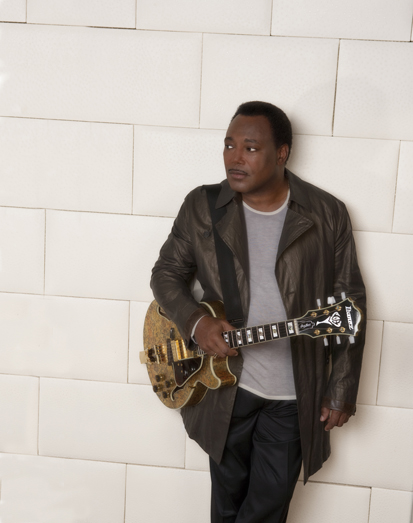
The nice image of George is from http://georgebenson.com/gallery/
What is he doing? Reading a novel or dramatizing it?
When new and interesting things go on in the arts, it’s often about crossing genres - mixing music with poetry or painting, dance with drama, film with just about anything. recently I experienced a couple of amazing collisions: music and architecture, drama and the novel.
Grande Messe des Morts, Berlioz, the LSO
Assembling under the dome in St Paul's.
The LSO unpacks at St Paul's.
In St Paul’s Cathedral the London Symphony Orchestra assembled along with a choir of about 200 voices and performed Berlioz’ Requiem - Grande Messe des Morts, composed in 1837. Well! Wow! And...wow! Berlioz apparently composed the piece intending for it to be played in a large cathedral, and there can be few more appropriate venues than Wren’s magnificent church. The piece famously involves the placing of ensembles of brass and percussion in four remote locations, and on this night they were in the transept and above us on balconies. When it came their turn to contribute, the sound effects were nothing short of heart-stopping. Even a little terrifying.
Apparently this piece is performed every few years in St Paul’s, to kick off the City of London Festival. I quote from Guy Dammann’s review in the Guardian:
If your sense of aw lacks an existential dimension, Berlioz’ great Requiem will restore it. Being enveloped by the omnidirectional swell of sound at the onset of the Tuba Mirum, or dangled on the yo-yo of hope and despair that the Lacrimosa spins with such masterful theatricality, are not experiences one forgets. One of the wonders of hearing this piece in this space, is how the quieter sections emerge with the greatest impact. While the tumults of the four brass bands of the apocalypse are still raging, the subdued desperation of the soprano’ cry of “salva me” just manages to escape, its quiet insistence intensified precisely because it reverberates in our minds rather than in the further reaches of Wren’s great dome.
The conductor was the venerable an fragile old Sir Colin Davis, and the lone soloist was tenor Barry Banks.
“Gatz” - F. Scott Fitzgerald performed by Elevator Repair Service
Now playing at the Noel Coward Theatre is an 8.5 hours theatrical marathon that is receiving rave reviews. It is a performance visiting fro New York, and performed by a theatre group called Elevator repair Service. And yes, they really do this: they read every line of F. Scott Fitzgerald’s novel “The Great Gatsby”, every “he said” and “she said”. Every word.
At first I wasn’t sure it worked. After the first couple of hours I felt that I was reading a novel in a less comfortable way, unable to put it down or take a tea break: force fed, as it were. Then after a long dinner interval, I settled down and started to see what the company was adding to the novel: comic lines where I hadn’t noticed them, subtle characterisations, some visual admixture...kind of like reading a novel via someone else’s head. A strange and extremely interesting experience.
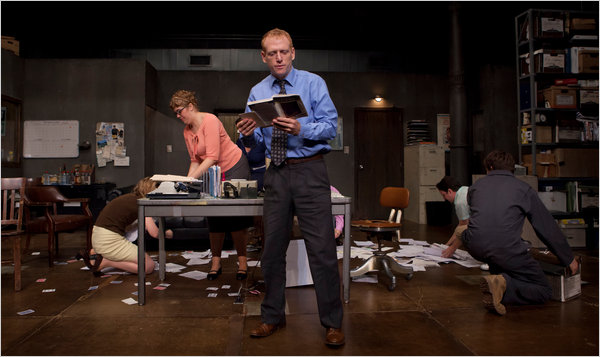
And the company did manage to build up to the tense and dramatic climax of the story - and this even though the whole thing was set in a very dreary office, the central character starting as a bored office worker reading the novel, but soon assuming the character of the narrator Nick. His office co-workers assumed the other character roles as the story progressed, and the whole thing was remarkably convincing. A success.
Huge kudos to the whole company for the marathon effort. But a very special bouquet must go to Scott Shepherd, playing “Nick”, whole read the whole novel. Every word.
And on the subject of cross-genre, let me repeat an apposite quotation from the program:
“[Nick Carraway] is both stage manager and chorus, recreating situations in all their actuality, and at the same time commenting upon them. Sometimes he even devises the action - contrives the circumstances by which the actors are brought together on the stage: it is he who arranges the reunion of Gatsby and Daisy.” - Brian Way.
Read some comments here.
And a great review from the NYT.
Nick reads on, through the party scene.
And Aurora take it further.....
And now in my in-box comes an invitation to the Aurora Orchestra’s latest gig - Aurora are past masters of cross genre collaboration, commissioning paintings to accompany their music, adding a bluegrass band into their classical music mix. But this time they look likely to excel themselves. Here’s the description:
maxamorphosis maksemawfesis/ noun [zoology; musicology; choreography] rare process of transformation involving endangered species of violus-saltator(viola-dancer). Reaction commonly initiated by contact with simultaneous varying tempi and whispering strings, with resultant flutters in the piccolo and marimba. Also reliant on gradual release of enzymes (C+G+D+A) by specimen. Process discovered July 2012 by Julian Philips and Mickaël 'Marso' Rivière.A collaboration between composer Julian Philips and choreographer Mickaël 'Marso' Rivière, Maxamorphosis features Max Baillie as viola soloist alongside Aurora Orchestra and dancers from Company Decalage and Bboy's Attic.
The BBC Symphony Orchestra is known as the “Associate Orchestra” of The Barbican, which is the home of the LSO - the London Symphony Orchestra. But don’t be fooled by the “associate” tag - this is no second-string orchestra. Amongst its many excellent attributes is its commitment to so-called new music, that is, contemporary compositions of what is colloquially known as “classical music”. The orchestra has also, to date, performed the works of Australian contemporary composer Brett Dean more often than any other orchestra.
And so to The Barbican one rainy Saturday (St Patrick’s Day, actually) to meet with Brett Dean and the BBC Symphony, and a few bright young things of the Guildhall Chamber Ensemble, for a day of total immersion in Dean’s work.
Viola
As a fan of his opera ‘Bliss’, and a supporter of its first production by Opera Australia in 2009, I had the skin-tingling experience of sitting one row in front of the composer while he heard his first opera performed right through (at the orchestra rehearsal) for the first time. I also heard the opera at its dress rehearsal, then in Melbourne, and in Edinburgh, where it toured for the Festival in 2010. I also went to Hamburg that year to see and hear Simone Young conduct a completely separate German production of ‘Bliss’. So you might say that I have already been pretty well immersed in Dean’s music.
However, I wasn’t familiar with his orchestral music - now I’m a die-hard fan. Dean was a prodigy from Brisbane who ended up as a viola player with the hugely prestigious Berlin Philharmonic Orchestra in his mere twenties. He has been composing since the 1990s, often for his instrument, the viola, but since the 2000s has produced a number of darkly original works, many on commission. Here’s how the day went:
At 11 am we gathered in a well-hidden room somewhere on the fourth floor of The Barbican (cross over the conservatory on a glass bridge and wind around a circular bit of the building I hadn’t before encountered) where Brett was interviewed by a journo chappie named Tom Service (not entirely sure who he was, he didn’t say - perhaps we all just should have known)...this went well. Dean is an easy interviewee, very generous with his anecdotes and reactions. The slight astonishment one felt in the room that a boy from Brissie could have had such a spectacular career was mitigated with a little ripple when Brett mentioned that his grandparents came from somewhere near Birmingham. “Ah!” you could hear the British audience thinking. “That explains it!” This session was rounded off with Brett himself performing one of his early works for solo viola, a piece called ‘Intimate Decisions’. It was - excuse the French - bloody beautiful. And that’s my review in a nutshell.
We then had an hour to refresh ourselves - I grabbed a bowl of soup - and at 1 pm it was into the Barbican Hall (the big one) for a chamber music concert by the Guildhall New Music Ensemble - a group of very talented, very young people, conducted by Brett himself. We had a flautist, a pianist, and three woodwind players, and for the later pieces a couple of strings. The first offering was called, obscurely, ‘Polysomnography’ - but all was revealed when the program explained that it consists of five movements roughly based on five cycles of sleep patterns. Mesmerising. As was ‘Voices of Angels’, inspired by the poetry of Rainer Maria Rilke.Then a young soprano, Jenavieve Moore, joined us for ‘Wolf-Lieder’, five movements evoking the Viennese composer Hugo Wolf (he came to a sticky end).
With a bare half-hour to spare (it’s hard work being totally immersed) we assembled in The Pit, one of The Barbican’s small film theatres, to watch a screening of ‘Bliss’. Ah! My sixth time. And very enjoyable, despite the awful quality of both the visuals and the sound - it was the ABC’s television recording, and didn’t translate too well to a bigger (though not big) screen.
Another half-hour refreshment break, and we were back in another smaller cinema - a mere screening room, really, although without the plush seating - for another Q&A with Brett and Mr Tom Service. Included was a 10 minute screening of the Australian Youth Orchestra’s performance at the 2012 BBC Proms at the Royal Albert Hall of Dean’s ‘Ampitheatre’.
At 8 pm the culmination of the day: big concert with the BBC Symphony Orchestra themselves, under the baton of David Robertson, playing Dean. Ahhh...!
We opened with ‘Testament’, written for 12 violas - the number of violas in the Berlin Philharmonic, for whom it was written in 2002. It had the curious sound of bows with no rosin, giving a shushing sort of effect, gradually brightening up as regular rosined bows were added. And there - at viola No. 10 - who is that we espy? The composer himself.
‘The Lost Art of Letter Writing’ (Dean is nothing if not topical) followed. This is a violin concerto of four movements, each based on a letter, written respectively by Brahms (in love with Clara Schumann), Van Gogh, Hugo Wolf and Ned Kelly’s Jerilderie Letter. The soloist was Renaud Capucon, a wonderful French violinist who appeared to enjoy himself immensely.
BBC Symphony in full flight Photo from: http://www.blog.wills-words.com/?p=235
After the interval, things got heavy. The BBC Singers joined the orchestra for a choral performance of Dean’s ‘Carlo’. This is often performed with a midi recording of the voices, and the composer had told us earlier how excited he was to hear it tonight with a live chorale. Musically, I found it very dark and rather groaning. According to the program, the piece is based on the madrigals of Carlos Gesualdo who experimented in chromatic harmony in the late 16th century (rather ahead of his time), while also murdering his philandering wife and her lover (and getting away with it, but experiencing a great deal of morose remorse). Sounds like my reaction was warranted.
The finale was nothing short of spectacular. The piece was from 2011 and is called ‘Fire Music’. The inspiration for the composer was the horror of the 2009 Victorian bushfires, when over 200 lives were lost as fierce fire whipped by unpredictable winds wiped out bush townships. Dean was living in Melbourne at the time. Not only did the orchestration evoke the threat, the wind, the overwhelming conflagration, but Dean had also placed three sections of the orchestra off the stage and around the auditorium - one was above me in the circle, and two others were at each side, at the back of the stalls. Live surround-sound! When something percussive made the exact noise of a bushfire crackling through the bush just behind my right shoulder I turned, startled and afraid. The climaxes were overwhelming. It’s not often orchestral music brings a tear to my eye, but....hey! I was totally immersed.
Photo of Brett Dean from http://www.boosey.com/cr/news/Brett-Dean-in-Scandinavia-Fire-Music-premiere-in-Stockholm/12283
While compiling the post about theatre I have seen in the last few months in London, I realised that there is a lot of music I haven’t told you about either. As with theatre, London is a cornucopia of wonderful concerts and musical performances. In fact, there is so much to choose from that I regularly go into “choice overload”...what a good problem to have!
Here’s the concert-going round-up:
August
The Proms: ‘Rinaldo’, Handel, Glyndebourne production semi-staged, Royal Albert Hall.
Exciting to experience the famous 'Proms' and enjoyed this production.
‘The Turn of the Screw’, Benjamin Britten, Glyndebourne.
Glyndebourne is always fun, even when it rains - picnic in the field in full evening dress - and this production was excellent. Really spooky.
The Proms, ‘Elijah Oratorio’, Mendelssohn, Royal Albert Hall.
One of the great English oratorios, played in the enormous RAH with a massive choir. What's not to enjoy?
The Proms
October
LSO Benjamin Britten’s ‘War Requiem’, with Simon Keenlyside, at The Barbican.
Beautiful music, brilliant orchestra; Keenlyside a little disappointing.
Dimitri Hvorostovsky (baritone & piano) at The Barbican.
Delightful, just the two of them on the Barbican stage.
Waiting for Dimitri.
November
The Gewandhaus Orchestra, Beethoven’s 'Ninth Symphony', at The Barbican.
Spectactular! What an orchestra, and what a rousing rendition of the famous 'Ninth'.
‘The Queen of Spades’, opera by Tchaikovsky, Opera North at The Barbican.
This was a little patchy. The production was squashed on the Barbican playhouse stage, and the two principals were only adequate.
Academy of St Martin in the Fields, Mozart concert, King’s Place.
Adorable - King's Place is an excellent intimate recital venue, and the Academy played some lovely chamber pieces. Beautiful viola thing.
December
‘Messiah’, Handel, Academy of Ancient Music at The Barbican.
One has to have one's 'Messiah' at Christmas, and this year I heard it on original instruments. Very good.
Back to The Barbican. Again.
February
‘Der Rosenkavalier’, Richard Strauss, English National Opera at The Coliseum.
Super favourite opera by favourite composer, with a cast to die for.
London Philharmonic ‘Music for Valentine’s Day’ at The Barbican.
Aurora Orchestra ‘Far, Far Away’, with Harry Oakwood Blues Band at St Luke’s LSO.
Fantastic - my favourite chamber orchestra, into cross-genre collaborations, and this one included a blues band. Wonderful location in abandoned church.
If you thought Valentine’s Day dates were just for young lovers, think again. The crowd on 14th February at a “Valentine’s Day Classics” concert at The Barbican was decidedly, er, not young. But they looked, on the whole, very happy with the music presented under the general theme of Love.
I too enjoyed it - more than I really expected. Although the orchestra wasn’t the greatest (sorry, London Concert Orchestra, but I’ve got used to the LSO) they did an acceptable job with some classic numbers. Here’s what the organisers thought would be a good repertoire for St Valentin’s Day:
Tchaikovsky’s ‘Romeo and Juliet Fantasy Overture’ - first performed in 1870. I had not heard this before, and found it interesting and evocative. Of course, the lovers do die in the end in this story, so we were off to a questionable start.
Elgar’s ‘Salut d-amour’ - first performed 1889 at the Crystal Palace, so a good British number. And we moved to stronger romantic ground here with a young Elgar having composed the rather lovely piece for his then wife-to-be, Caroline Alice. He called her
‘Carice’ and dedicated the music to ‘Carice’. Awww...
That's more like it.
Johann Strauss II’s ‘Blue Danube Waltz’ - first performed 1867. Now, you can’t go wrong with the ‘Blue Danube Waltz’. Rousingly performed and a crowd favourite. Almost the Austrian national anthem.
George Gershwin’s ‘Rhapsody in Blue’ - first performed in 1924, having been composed in about 3 weeks after Gershwin forgot about the commission. He played the piano part at the first performance. We had an excellent young pianist named Vic McLean. This was a highlight: ‘Rhapsody in Blue’ is lovely music, and a great early 20th century favourite.
Offenbach’s ‘Orpheus in the Underworld Overture’ - first performed 1858. While the story of Orpheus and Eurydice is at least about a couple, the connection to romance doesn’t really matter when the overture contains so many recognisable melodies - including that other French national anthem, the Can Can.
Here's the Can-Can in it's operetta context.
Bizet’s ‘Carmen’, selections of all the famous bits (although without the singers that you get in the operatic version). Yes, Les Toréadors, the Act I Prelude, Aragonaise, Intermezzo (beautiful), Habanera and Danse bohème. You could almost see Escamillo on his horse. of course, this is another lover story that ends badly, with Don Jose stabbing carmen int eh end. But by this stage of the concert, such concerns were mere nitpicking.
Tchaikovsky (again) - the Waltz from ‘Sleeping Beauty’ - based on a fairy tale from 1697, about the baby Princess Aurora being cursed to sleep for 100 years if she pricks her finger. But no matter: the kiss of a handsome prince can awaken her. Back on strong romantic ground.
Ravel’s ‘Boléro’ - first performed in 1928. It was stunning then, and it is still stunning. This was a highlight of the night, though as far as I can tell, it has nothing to do with romance, except perhaps for its mesmeric effect. The whole thing is just one melody repeated in the same sequence by different instruments in the orchestra, building up gradually to being played by the whole complement. It is as if the melody is trapped and can’t take wings, and the effect is tension and absorption. Loved it. I also learnt from the program notes that Ravel was inspired by the sounds of factories he visited on the Rhine: the dark satanic mills made music. Think about that when you hear that constant snare drum beat and the cacophonous finale. You really can envisage a great foundry at work. I learn something every day.
More than 9 million pople have viewed this Andre Rieu version of Ravel's ‘Boléro’.
Oh, and the encore? ‘Lara’s Song’ from ‘Doctor Zhivago’. Just a little saccharine to take away the taste of the factory.
A word about your sponsor: this concert was presented by an entrepreneurial outfit known as Raymond Gubbay Limited, which is responsible for any number of popular classical presentations in London. Usually they fill the 5,000+ seat Royal Albert Hall with amplified operas, massive choirs, and other such rousing presentations. They manage to book some very big stars, and the concerts usually sell out. Personally, I’m sorry that I am going to have to miss ‘The Queen’s Diamond Jubilee Singalong’ later in the year, where there will be 5,000 patriotic locals joining in such numbers as Rule Britannia, Land of Hope and Glory, We’ll Meet Again, and various hits from Lulu, Elton John and The Beatles. I wonder if Her Maj will be there? Sounds like fun.