Showing posts with label The British. Show all posts

Monday, September 24, 2012

The Last Night of the Proms with the Poms


Dress Code for Prommers


I made it to the Last Night of the Proms, and am still lying down with smelling salts in an effort to recover from the experience. I will skim lightly over the whole queuing thing - it turned out to be a fizzer. I turned up just before 6 pm, the hour the doors opened, walked to the back of the appropriate queue and was given the number 137 by stewards. Twenty minutes later, after a bag check and the usual climb up the stairs, I was standing in a perfectly good position by a railing in the gallery, looking down - sideways - on the stage. Even when the hoi-polloi without season passes were admitted, the gallery was far from full. The arena, on the other hand, was packed to the gills.

There was a bit of eyeing off of neighbours along the gallery railing, and some attempts to claim more real estate than was strictly entitled (spreading of Union Jacks, nudging of shoes along the floor), but we all settled down to sit on the floor until curtain-up. I even met the same Portuguese lady from last night, who turned up and wedged herself in beside me.

Upon arrival I was at first a bit disconcerted to note that I was severely underdressed. Black tie, white tie, buttonholes, evening gowns, tiaras and furs were out in force. For those who didn't go formal, it looked like all-over Union Jack was the dress code. However, amongst the Prommers, down-dressing remained fairly wide-spread. And as for flags, once the auditorium filled up it was clear that despite the clear predominance of Union Jacks, any flags would do. Multiple countries were represented. I spotted Australia and New Zealand. There were a number of breakaways with Welsh, Scottish and Irish flags, some left-over Team GB numbers, all merrily waving or draped hither and thither.

The view from the gods.

The spacious, if remote, gallery of the Royal Albert Hall.


It was clear from early on that this was going to be a night of ritual. The BBC Symphony and Chorus ladies had eschewed formal black for merry red, green and purple long frocks. The gents wore white tie with carnations in their buttonholes. The conductor was the resident chief, a Czech, Jiří Bělohlávek. With everyone raring to go, off we set on The Last Night of The Proms.


The first half program was lovely stuff - high quality programming and performance. The highlight for me was a performance of the lovely "Songs of Farewell" of Delius - deliciously sad and encouraging at the same time, the pieces are a setting of Walt Whitman poetry about dying, written (or dictated) when Delius was incapacitated and close to death himself:

Now finale to the shore, 
Now land and life finale and farewell. 
Now Voyager depart (much, much for thee is yet in store) 
Often enough hast thou adventur'd o'er the seas, 
Cautiously cruising - studying the charts, 
Duly again to port and hawser's tie returning: 
But now obey thy cherish'd secret wish, 
Embrace thy friends, leave all in order,   
To port and hawser's tie no more returning,  
Depart upon thy endless cruise old Sailor. 


The excellent Maltese tenor Joseph Calleja joined us for some Verdi, Massenet and Puccini. His is a very impressive voice, and he was a big drawcard for me. Sadly, my position somewhere behind his left shoulder and four stories up did nothing for the sound quality, and I missed out a bit on his lustily delivered numbers. Our other soloist was a Scottish violinist with the very Scottish name of Nicola Benedetti (!) - she played Bruch's first violin concerto, and it was quite divine. Nicola herself has all the elements necessary in a classical music soloist - young, beautiful, virtuosic and looks fab in a luscious evening gown (we saw two - a white one and a black one).

Sighing over all this lovely music - and I must say that the Prom crowd are attentive listeners and appreciative applauders - we all took an interval break for icecream and G&Ts, revivified ourselves, and returned for the second half. This set out as it meant to go on with John Williams' 'Olympic Fanfare' composed for the 1984 Los Angeles Olympics (a very London 2012 choice), followed up with some more rousing party pieces and solos from Joe & Nicola (Joe's 'Granada' was great - the program claims it is the second most-performed song in the world: a Latino karaoke favourite, apparently).

Then things got serious. Our conductor took the microphone and announced that we had got to the sing-along part of the evening. The TV screens took us to crowds massed outdoors in Belfast, Caerphilly, Glasgow and across the road in Hyde Park. (I took a moment to be grateful for my indoor RAH gallery railing spot, and to feel a little ashamed of my queuing whining). Then we commenced what is apparently a regular ritualistic winding up of The Proms. Everyone - led by the arena Prommers - knew just what to do. While I had a vague notion that singing-along was involved, I had no idea what to expect. I was, thus, astonished! This is how it went:

First up, we all sang Rogers & Hammerstein's 'You'll Never Walk Alone'. Then there was a party-piece billed as Henry Wood's 'Fantasia on British Sea-Songs', from 1905. Henry Wood, you may recall, is the impressario who had the bright idea, 118 years ago, to stage Prom concerts. His 'Fantasia' is a collection of half a dozen bright pieces loosely (very loosely in some cases) based around a nautical theme. As the orchestra struck up the first of these - 'The Saucy Arethusa' from 1796 - I noticed with interest that the arena Prommers were doing a kind of on-the-spot jig, bending and rising gently from their knees in time with the beat. A peculiar sight. Some also began letting off what seemed to be party crackers. Hmmm...I thought.


Here's the 'Hornpipe' ridiculousness from three years ago.

We then had a nice solo cello bit called 'Tom Bowling', which was listened to respectfully, but with a certain air of anticipation. Turns out the anticipation was for the 'Hornpipe' - you'd know it if you heard it - which the program told me would be accompanied by "traditional clappings and stampings from the audience". Which indeed it was. One enterprising ringleader in the arena, who seemed to have a truckload of props with him, changed into his sailor's hat, brought out a hooter, and jigging, stamping and clapping abounded. So...the conductor played it all over again. Gosh....I thought.

There was one moment when the music brought a tear to my eye, and that was the rendition by the orchestra and chorus of 'Home, Sweet Home'...ah yes, there's no place like home *sniff* Perhaps an understandable reaction for a foreigner amongst a close-knit tribe celebrating some of its most mysterious rituals.

The Sea-Songs bit ended with 'Rule Britannia', which I was interested to learn dates from 1740, and was the finale of a masque by Thomas Arne about King Alfred. I can see it ending a King Alfred story, but of course it also does duty as a rousing Victorian Empire number. It has verses, which our tenor sang - he came out in a Team GB track suit, but opened the jacket to reveal a t-shirt emblazoned with a Maltese Cross. Just so all Maltese understood that he was only doing this for the money or the glory, I suppose. It was good-natured, as was the crowd. Then a bunch of Team GB gold and silver medal winning Olympic athletes paraded out and helped the crowd sing 'Rule Britannia' one more time.

But I must tell you - unless you have actually experienced it, I am not sure I can adequately describe the experience of being in a 5,500 seat auditorium filled with British people furiously waving Union Jacks and singing "Britons never ever shall be slaves!"   Well, no. Let's hope not...I thought.


 'Rule Britannia' from three years ago. Somehow it doesn't seem quite so weird with 
the fabulous Sarah Connolly playing Admiral Lord Nelson.

But wait, there's more. And I was ready for this one: Elgar's 'Land of Hope and Glory', from 1901, a genuine Empire-rousing number if ever there was one, and sung enthusiastically by the flag-waving Prommers. Those fortunates actually in seats were even moved to rise to their feet for this one. It is indeed a fine tune - apparently Elgar himself recognised it as "a tune that comes once in a lifetime", and considered reserving it for a symphony, and recycled it a number of times. But in the hope of giving you just a flavour of the proceedings, here's the words (imagine 5,500 people singing and waving flags):

Land of Hope and Glory
Mother of the Free,
How shall we extol thee
Who are born of thee?
Wider still and wider
Shall thy bounds be set;
God, who made thee mighty,
Make thee mightier yet.

I couldn't help but spare a thought for the working poor, unemployed and under-employed of Britain; and also to reflect that I, in fact, being of entirely British descent through colonial immigrants, am in fact "born of thee". But admittedly I didn't know all the words off by heart like the locals.


From five years ago, with our conductor Jiří Bělohlávek.


By this stage, overwhelm was beginning to set in. But there was more. Now we sang that extremely strange song, 'Jerusalem', based on the words of William Blake (1804). Now here's a real mystery. Forget the question of the inflatable banana being waved in the arena. What is this about? Having been in London for two years now, I have encountered numerous reference to this song. I believe I even heard David Cameron proposing that it be adopted as some kind of sporting anthem for Britain. There was that play with Mark Rylance about deep British mysteries which was entitled 'Jerusalem'. So what is it about? It is about speculation that Jesus Christ made it to England's shores as a child, and might have founded "a new Jerusalem" - and ends with a call to "fight" for just that. Is it jingoistic? Is it religious? (it is often found in hymnals). Is it just plain weird? One thing is for sure, most of those people lustily singing have NO IDEA what they are singing about. They just love the well-known melody, the tradition, and the bit about "England's green and pleasant land". And the "Chariots of Fire". I couldn't bring myself....Here's the words. You judge:

And did those feet in ancient time
Walk upon England's mountains green?
And was the Holy Lamb of God
On England's pleasant pastures seen?
 
And did the Countenance Divine
Shine forth upon our clouded hills?
And was Jerusalem builded here
Among these dark Satanic mills?
 
Bring me my bow of burning gold!
Bring my arrows of desire!
Bring me my spear! O clouds unfold!
Bring me my Chariots of Fire! 
 
I will not cease from mental fight;
Nor shall my sword sleep in my hand
Till we have built Jerusalem
In England's green and pleasant land.

The middle aged lady standing next to me, she of the encroaching shoes and the interval G&T, became really quite animated while loudly singing "Bring me my bow of burning gold! Bring my arrows of desire!" It was a bit fearsome.


"Jerusalem" From three years ago.

Finally the jingoist and scary singing and flag and banana waving seemed to over. Our lovely Czech conductor made a very sweet speech, culminating in bringing out his recent CBE and hanging it round his neck, and the arena Prommers started an unscripted chorus of 'He's a Jolly Good Fellow'. There was just one last song: the National Anthem, and this was surprisingly beautifully done. The chorus took the first verse, and the audience the second (luckily the words to this were provided in the program). The entire orchestra stood while they played, and of course the whole auditorium was on its feet. People stopped being silly and became a little solemn. The arrangement was by the excellent Benjamin Britten, from 1967. It is said that the Queen, when she first heard it, declared that she had never been so affected by the Anthem, adding "and I have heard it once or twice".

Last year, Britten's lovely arrangement, with BBC Singers; BBC Symphony Chorus; 
BBC Symphony Orchestra Conductor: Jiří Bělohlávek

So on this more dignified note the evening ended - almost. The Prommers once again began an impromptu (or is it always done?) round of 'Auld Lang Syne', everyone in seats, gallery and arena joining crossed hands to sing the old Scottish number about remembering friends. I found myself hand-clutched by the scary lady beside me who just a few minutes earlier had wished to brandish a "bow of burning gold". As we disbanded and headed for stairs, loos, busses and taxis, I felt an impulse to wish everyone a Happy New Year or Merry Christmas -- but "Happy Proms" was all there was. It was just a classical music concert series, after all.

Barking mad, the lot of them. I mean that in the nicest possible way.


Saturday, July 21, 2012

Verbosity


Wise words.


'Verboseness': an expressive style that uses excessive or empty words.


The very first time I visited England, back in the early 1990s, one of the same-but-different curiosities which struck me was the over-blown verbosity of the public signs. For example, I recall a sign that said something like:

“Please do not feed the pigeons that congregate here. Feeding them encourages them to congregate and unfortunately they cause a great deal of damage which is expensive to repair. Thank you.”

In any other country, such a sign would likely read merely:

“Do not feed the birds”

This turned out to be not an isolated example, and today I still chuckle at the copious amounts of text that the English prefer to use when communicating via signs. Part of it is the urge to politeness (at least in writing!) - the need to begin with “please” and end with “thank you”. But part of it just seems to be an innate love of chatting. Perhaps this is not inappropriate in the land where the English language itself originates.

I have collected a few examples for your delectation:


"No bicycles"

"Flush toilet paper only"

"Cross at your own risk"

"Closed"


Awww...someone cares.

Thursday, July 12, 2012

Summer Socialising


An Afternoon on the Thames
June in London this year, it has been reported, was the wettest month on record. It was also one of the dullest, with so few hours of daylight that it was only slightly less miserable than June 1987. I am quoting from the newspaper reports - the terms “dull” and “miserable” appear to be part of the usual lexicon when discussing the British weather. Yes, every stereotype you ever heard seems to be true.

Thames Ditton
But there was one lovely day, at least. On a Sunday in mid-June the sun surprised everyone and actually shone for the whole day. Brightly and warmly. No rain fell. The English know the drill - when this happens, they get out of the house, immediately, and socialise, ride bikes, wear summer dresses (ladies) and take their shirts off (gents). Everyone is very happy. In fact, so happy is everyone that you almost think that it is worth the wet, grey days just for the thrill of seeing them gone.

On this auspicious occasion I was the happy recipient of not one, but two invitations to garden parties of two different kinds. I have been here long enough to know that advantage must be taken of days like this, so I accepted them both. 


Firstly, I set off by train to Surbiton to enjoy an afternoon on the Thames, at Thames Ditton, in fact. I discovered, upon arrival, that the riverside location of the party was on the opposite bank to the Park of Hampton Court Palace - where kings used to hunt for deer and so on. It now forms a lovely green backdrop to dog-walkers, cyclists and people mucking around in boats on the river. 

The At Home party involved lots of chatty people, kind hosts, the opportunity to muck about in a boat ourselves, lots of Pimm’s, and sun umbrellas. It was absolutely delightful, and restored one’s faith in England - not to mention assisting with the Vitamin D levels. Thank you, Isabel and David.

One thing about this time of year - when the sun does shine, it shines for a very long time. A sunset at 10.30 in the evening is about par for the course in June. Thus I was able to spend the long, warm evening at the next party, a Bar Mitzvah (my first!) held at home in the garden of a big family house in Crouch End in north London.


Everyone happy.

A great garden for kids.

The ceremonies involved all the family, and some friends, of the Bar Mitzvah Boy, making speeches and performing. And very excellent they were too. All to the accompaniment of shrieks of gaiety from the dozens of children enjoying the playground at the end of the garden, the clink of glasses as the grown-ups enjoyed their cocktails, and the chatter of dozens of interesting new people for me to meet. And all topped off with a fun photo booth. Thank you, Misha, and congratulations Max.


Congratulations, Max.


Max's smallest sister Delilah contributes to the festivities


 Photo booth fun.

Monday, July 9, 2012

Public Schoolboys

"South Downs"


An aspect of English life that is quintessentially English has to be the tradition of educating boys (in particular, though not exclusively) at so-called Public Schools. These are, as you may appreciate, in fact private schools, but there you go. The most famous amongst these schools are probably Eton and Harrow, long-established institutions, traditionally rivals.

Now, I am in no position at all to report on English Public Schools, other than at second-hand. In fact, my stock of knowledge on the subject is drawn more or less exclusively from fiction, and with that comes lots of stereotypes. A little more was added to my store of knowledge by two plays I recently saw at the Harold Pinter Theatre - short plays, performed on the one bill. Both addressed aspects of the Public School experience, and both were written by men who endured that system as boys. 

South Downs - David Hare

“South Downs” was written by David Hare, who attended a school called Lancing, set on the South Downs between Brighton and Worthing. It boasts the largest school chapel in the world, a large Gothic revival building. Judging by the play, religion - High Anglican - played a central role in school life in the 1960s, when Hare attended. The program tells us:
The school can be seen as an extension of the call in the 1830s under men like Newman for a renewed connection with the Catholic roots of the Christian faith; its founder was Canon nathaniel Woodward who had followed the Oxford Movement as a student and went on the establish a small empire of schools, starting with Lancing in 1848. and including Ardingly and Hurstpierpoint. It was this Anglo-catholic background which was to colour much of the school’s traditions and spirit, providing in Woodward’s words “sound principle and sound knowledge, firmly grounded in the Christian faith.” A great many of the teachers were clergy, and well into the 1960s a good number of the pupils were sons of churchmen, and daily chapel attendance was compulsory....Though a mixed school now which also caters to day pupils, until the 1970s the school was strictly boys and boarding only, operating in the familiar house-system run by housemasters, with prefects also in charge of the boys. Its most famous pupil was the novelist Evelyn Waugh...
In Hare’s play, the story revolves around the boys, in particular an intelligent misfit wonderfully played by Alex Lawther. His difficulty fitting in is eased by the kindness of one of the boys’ mothers; but the message is really about having to dissemble in order to survive the institution. Hare wrote the play in 2010, though it is set in 1962. 

Anna Chancellor in "South Downs"


The Browning Version - Terrance Rattigan

“The Browning Version” was written by the amazingly clever Terrance Rattigan, of whom I am a big fan. It is also about a microcosm of life in a Pubis School, this time Harrow, and is set in the 1940s. This play centres more on the masters than the boys, in particular a sad departing Classics scholar, late of the Lower Fifth, who endures a variety of humiliations but s moved to tears (in a famous scene) by a gift from one of his boys. The master is played wonderfully by Nicholas Farrell. The gift scene is very affecting - not a dry eye in the house, I’d say.

"The Browning Version"

Rattigan attended Harrow in the 1920s. It is one of England’s most historic Public Schools, having been founded under charter from Elizabeth I in 1572. The program tells us:

Growing gradually throughout the 17th and 18th centuries, it expanded considerably with the Empire (the architecture of its impressive buildings is predominantly Victorian) and has for the last two and a half centuries accounted for no less than seven British Prime Ministers (among them Palmerston, Sir Robert Peel and Winston Churchill), as well as various scientists, businessmen, artists, statesmen, sportsmen, actors and kings. Among the writers it has produced are Sheridan, Byron, Trollope, L P Harvey and, of course, Rattigan....Then as now it was a boarding school with boys divided into houses under housemasters, to which students were confined after evening ‘lock-up’. Classics was the school’s most prestigious subject, having been the first to be taught at the school, but Rattigan distributed his energies equally into Harrow’s theatre...and cricket. The annual match at Lord’s against Eton (then a four innings game over two days) is the oldest fixture in the sport’s history...

Interestingly, “The Browning Version”, being a short one-act play, has in the past usually been performed with another of Rattigan’s short pieces. However, to honour his centenary (2011) Hare was asked to produce a new companion piece. “South Downs” is thus said to be inspired by the Rattigan play. It is a worthy contender, even up against the marvel that is the writing of Rattigan. For the record, the two plays here have different directors, Jeremy Herrin for the Hare, and Angus Jackson for the Rattigan. I should also mention Anna Chancellor, an imposing figure who plays the principle female roles in both plays. (The casts mostly overlap).

"The Browning Version"

It is clear why “South Downs” is called “South Downs” - that is the locale of the school in which it is set, and references to Brighton reinforce this. But why is “The Browning Version” called “The Browning Version”? Because the small book given by the boy Taplow to his master Crocker-Harris is ‘Agamemnon’ in translation - the Browning version, in fact.


Here's  a review.
And here is another, which doesn't like the Hare piece (don't believe it).
And here's Michael Billington's complimentary review.


Images from:
http://tweedlandthegentlemansclub.blogspot.co.uk/2010/11/harrow-school.html
http://www.guardian.co.uk/stage/2012/apr/29/south-downs-browning-version-review
http://www.telegraph.co.uk/culture/theatre/theatre-reviews/9246051/South-DownsThe-Browning-Version-at-Harold-Pinter-Theatre-Seven-magazine-review.html
http://wowoffers.heartoflondonbid.co.uk/NewOffersThisMonth/SouthDownsAndTheBrowningVersion1

Friday, March 16, 2012

British Comedy


Just back from the Haymarket Theatre and one of the current hot ticket items in London: ‘One Man. Two Guvnors.’ There have been rave reviews, tickets have been hard to get, I've seen morning queues outside the theatre in the freezing cold waiting for returns. I thought I should check it out.

The program, and the show itself, makes a claim to be in the long tradition begun by Commedia dell’Arte, through Restoration comedy, melodrama, music hall, vaudeville, circus and pantomime. It is written by Richard Bean, and is based on a play written in 1746 by an Italian playwright named Carlo Goldoni.

The principal plot point is a servant who acquires two separate masters, with a view to profit, and needs to keep the existence of each a secret from the other. So far, so potentially funny. The London production relies very heavily on physical comedy, and that rather butt-clenching and often boring business of bringing up members of the audience onto the stage (though - spoiler alert - in this case they’re plants). It also has a full complement of not merely risque but out-and-out crude jokes, and even a fart. Plus a good dose of xenophobic references, principally to Australia, though Norway (?) and Japan (??) cop it too.

Ah, was it the repeated anti-Australia jokes (which elicited hearty roars from the audience) that put me off? Or was it that people falling down stairs and having their faces smashed by doors and so on are about as funny as ‘Funniest Home Videos’, that is, not at all? The plot was as complicated as you’d expect from a play based on an 18th century play - they are famously intricate and not always easy to follow. We even had that old pantomime staple, the ‘kitchen scene’, in this case waiters serving food, allowing for those, er, hilarious gags of food-throwing, soup-spilling and setting something on fire. In the grand tradition of farce, doors were repeatedly opened and shut while the characters (one in disguise) dashed in and out just missing each other by moments. As yes, all the ingredients were there.

I’m still not entirely sure why I didn’t laugh much. I used to laugh at British comedy - well, actually I didn’t laugh much at Benny Hill, but I did laugh at Frankie Howard, and at ‘On The Buses’, and of course at ‘Ab Fab’. Tonight’s theatre program has a short analysis of that unique genre, “British Comedy”, and says:

“The British have never really lost their relish for smut...Sometimes British humour is summed up as simply ‘pee-pee ca-ca’ and it cannot be denied that we have always had a fascination with bodily functions...”

Do I actually detect a note of pride?

I mustn’t leave this luke-warm review without complimenting the actors. This kind of stage business is difficult to do, especially falling down stairs convincingly and repeatedly. And several members of the cast over-played their characters sufficiently to be actually funny. That can only be a good thing for a comedy, don’t you think?

Here's Michael Billington's review in the Guardian of the show when it was at The Adelphi Theatre with James Corden in the main role (he has been replaced now by Owain Arthur). You will note that the reviewer "especially enjoyed Rooper's dismay at the prospect of exile to Australia and 'a terrible outdoorsie life, sustained by lager, barbecues and opera'" and suspects "you would had to have had a humour by-pass not to enjoy it."

Vive la difference. I don't even understand that anti-Australia joke. let me know if you do.

It seems also that the show is moving to Broadway, and Billington predicts that it will knock 'em dead. I haven't heard of plans to send it to Sydney.


Monday, August 29, 2011

One Year Ago...

Lazying around on holiday in Ravenna
and completely ignoring my blog: August 2011

After the Summer Holiday Hiatus (and with apologies to any regular blog readers out there), La Vie Boheme is back....! This return is only fitting, since August marks the anniversary of this blog, and the beginning of my adventure in leaving Sydney to try out the European - or at least British - lifestyle. Yep, allowing for a few slight discrepancies due to international time differences, today marks One Whole Year since I arrived in sunny London.

Today - the Monday Bank Holiday of 29th August - is, in point of fact, actually sunny. Momentarily. This (I have discovered) is something to be grateful for in London. It is not all I have learnt, and what could be more fitting today than that I share a few of my pithy insight with you?

1. London, indeed England, is a very big place. Possibly one could argue that it is also stuffed with too many people, and is on the skids economically and socially. I might be influenced in this comment by the fact that during April not only was the weather rubbish (as they say) but London and other British cities experienced the frightful phenomena of disaffected youth rioting and looting in their streets. I was sensibly ensconced on the Amalfi Coast at the time. Many locals, however, have come out rather touchingly with "I (HEART) London" signs and so on, and the Notting Hill Carnival this weekend seems to be going along with no trouble.

2. On the plus side, I am convinced that there is not a city on earth which offers such a cornucopia of cultural experiences as London. Theatre, opera, music, dance, art, exhibitions, history, museums...*faint* After a whole year of indulging without a trace of self-control, I am bloated and overwhelmed with it all. The Proms last night...Ralph Fiennes in 'The Tempest' tomorrow...Glyndebourne Opera last Friday, a choral eucharist in Southwark Cathedral on Sunday, a ticket for Shakespeare at The Globe next week that I don't think I will be able to use...ever heard of "decision overload"? It's a nice problem to have, but I need to control this addiction.

3. As a gateway to travel in Europe, this is, as I had hoped, a very excellent base. I can - and have frequently - hopped on the Eurostar to Paris, or the train out to the airport to fly off to...well, wherever I want, at a moment's notice and for very reasonable cost, and with only a one hour shift in time zones. Heck, I've even been known to go to Madrid for dinner. And in fact I'm going to Copenhagen for dinner this weekend. I've been to Spain, Italy, France, Germany, Greece...and I still have a mighty long list ahead.

4. The English have no sense of service, but I've learnt to chill out about that. Yes, it's a broad generalisation - as is saying that the North Americans have a fabulous sense of service - but even allowing for exceptions, both statements are broadly true. Thus, to live in London without your temper exploding, you must learn to allow ample extra time for all service transactions, be they getting served or getting the bill in a cafe or restaurant, dealing with telecoms or other service providers, waiting in queues for anything at all, and travelling on the tube (where the stoic British nature comes in very handy). The one exception to this is the TV license people, who are very swift and active indeed in chasing their fee, and very difficult to convince when you say you don't have a television ("Why don't you NEED a TV?")

5. London is vibrant and huge and busy and full of action, but sadly grubby and often downright ugly (memo to self: live near a park; they're lovely.) The English countryside (in its good bits, anyway) is unbelievably picturesque.

6. Birkbeck College was, overall, a disappointment. I loved some lecturers, but sadly too few. The 'star' prof, A C Grayling, left the College at the end of term under a cloud of very badly-reasoned academic abuse, I didn't get as many opportunities for consultations as I hoped, and the facilites for classes were mostly quite squalid. And to date I have received not one single assessment for any of the nine pieces of work I have submitted (results are due October; perhaps I should be nicer until they are out.)

The three worst experiences:
1. The dark winter. The VERY dark winter.
2. The Philosophy Lecture Room at Kings College (aka 'the yellow hole of Calcutta').
3. Wasting possibly three weeks of my life waiting for cafe waiters.

The three best experiences:
1. The first lecture on Plato, with a great lecturer, erudite fellow students, fabulous and vigorous and engaged discussion. Ditto most lectures on Nietzsche.
2. Walking my 'hood: Bloomsbury.
3. Snowy winter afternoons on the grubby sofas at the back of the Cafe Nero on the Strand, waiting for class and reading philosophy with other student types. Ditto the Starbucks on Tavistock Square.
4. Early morning forays to Spanish Class at the Insituto Cervantes on Eaton Square, and the great classes. Pero, todavía no hablan español. 
5. The Fabulous Birthday Concert in St Brides, Ludgate Hill.
(I know, I know...that's five. But there have really been more highs than lows!)

The year has been made especially special by many friends, some old (well, not that old), and many new. Muchas gracias, mis amigos: Kyle, Andrew (and Kaiser & Greta), Brigitta & Michael, Rachael, Genevieve, Matthew, Madame Thomas, Francis, Danielle, Josephine, Marilyn & Jim, Catherine, Patrick, Petra, Andy, Simone, Peter & Maria, Tamara & Barton, Louise & Rodney, David, Marilyn & Adam, Anna & Marius, John, Misha, Izzy, Carrollanne, Alan & Michelle, Claire & Paul; and visitors: Evan, Natalie & Tanya, Alex, Ken, Paul, Chris & Victoria, Giocondo, Eva & Sam, and Harry (almost). And trainer-extraordinaire at the gym, the amazing Dan. For those of you who have visited my eccentric abode in St Pancras train station...the news is that with the end of my lease I am moving - to the bucolic suburban neighbourhood of St Johns Wood (Jubilee Line, folks). My new home 'burb has a lovely park, a nice high street, a Carluccio's (my flat-hunting centred around the Carluccio's locations, of course), Lords Cricket Ground, a farmer's market on weekends, and Abbey Road Studios. Yes, I get to cross THE pedestrian crossing every day!


And what does the next year hold for 'La Vie Boheme'....?


Continuous improvement, I hope. You'll see (if you care to follow) some changes in the content, which will focus more on travel stories and less on personal anecdotes, theatre experiences and philosophy, though these will no doubt still creep in. Travel is, of course, about a lot more than Roman ruins and nice hotels.

I'm adding a page about my writing and books.

I'm diving into the Twitter-sphere (if you don't hear from me for 3 weeks, send a rescue party. With champagne.)

I hope you'll continue to join me on the great adventure, both actual and virtual. Thank you to everyone who reads regularly, follows and comments. I hope to repay your interest with regular and interesting posts. If there's anything you want me to write about, give me a wave.

Happy Anniversary.


Sunday, July 10, 2011

In the News


I had drinks with Tim the other day, an ex-colleague from Sydney, who has been living in London for the last 12 years. He and his family are about to move back to Australia. One of his concerns was: “we’ll only have two newspapers to read!” He looked a little shocked when I ventured to suggest that one needs nothing more than the Sydney Morning Herald.

London has a choice of about a dozen papers  - I tried to find the exact number, but it seems they are too numerous to count...and of course a famous (or infamous) one has just closed its doors after 168 years. Yes, the News of the World, a Sunday tabloid rag, has  shut up shop with its last - 8,674th - edition today. The papers here are generally grouped into three groups - the mass market tabloids, or "red-tops" (e.g. The Sun), middle-market tabloids (e.g. the Daily Mail), and quality broadsheets (e.g. The Times). Then there’s the free newspapers - Metro in the mornings and The Evening Standard in the - as you would expect - evenings. As well as covering the spectrum from bleedin’ awful tabloid rubbish through mildly sensational middle-brow, the papers also cross from right to left of the political spectrum. As regular blog readers will know, when I moved to London I chose The Guardian as my daily press, and The Observer on Sundays. The Independent was a second choice. Here, folks, we are well into the leftie spectrum, but hey - that’s where I’m happy. Living in St Pancras International train station I also have the option of the leading European dailies, and if I could read French, Spanish, German or Italian, no doubt that would be good. European house guests have found it very convenient! And I do sometimes treat myself to the International Herald Tribune, the international (in this case, the Europe-based version) of the New York Times.

But what, I hear you ask, is the local spin on the demise of the News of the World? Well, since I am a confessed Guardian reader, I can report that there is much chortling in leftie ranks. The Guardian has been pursuing the Murdoch empire over phone-hacking allegations ever since I arrived in London and took it up as my daily press. So it is perhaps understandable that it should now be crowing, since it has emerged in a fast-breaking deluge of scandal that not only did NOW journalists hire seedy private eyes to hack the phones of celebrities, they also did the same to those of crime victims, including deleting voicemails and emails, and, moreover, paid bribes to policemen. Interestingly, they also thought - until The Guardian put them right - that this was perfectly alright and “business as usual”. 

The invasion of celebrities’ privacy was hard pressed to rouse much sympathy from the Great British Public (who seem to like their titillating Sunday junk - NOW claimed 7.5 million readers every Sunday!) But when details of the targeting of crime victims emerged, some kind of heretofor invisible line seemed to have been crossed and outrage now abounds. News Corporation (who owns NOW) shut it down straight away (there’s a pay TV deal in the works worth billions that looks under threat - whoops!), though the alleged (but pretty much admitted) transgressions happened four or five years ago and were perpetrated by people no longer working at the paper.

In my opinion the closure of such an awful rag is a great thing. Here’s one memorable headline it has used in the past that I’ve seen quoted, just as an example: 

“Nudist welfare man’s model wife fell for the Chinese hypnotist from the Co-op bacon factory” 

The final edition is emblazoned with headlines past and present - they seem weirdly proud of them: “Caught!”, “Drug deal video”, “Beckham’s secret affair”, “Jacko’s deathbed”, “Fergie ‘sells’ Andy for £500”. Puzzlingly, they also claim to be “the world’s greatest newspaper”. Teary-eyed staff talk not so much about losing their jobs but about missing the ‘cult-like’ ‘family’ atmosphere of the NOW newsroom. How come they don’t see how dreadful tabloid journalism is? Come to that, how come 7.5 million weekly readers don’t see it? Just one of those cultural mysteries....

A couple of intrepid celebrities have been leaping about with glee on the grave of the NOW. A comedian named Steve Coogan said:
“People keep saying it is a bad day for the press. It is a wonderful day for the press: a small victory for decency and humanity...People talk as if they had fallen below their usual high standards. They were already in the gutter, it’s just that they have sunk lower than anyone thought they could.”

He also described the tabloid as “a misogynistic, xenophobic, single-parent-hating, asylum-seeker-hating newspaper”. As he said in what was described as a “heated exchange” (love that cliche - so evocative) he told a former NOW editor “Your attitude is ‘we are only trying to sell newspapers’, or ‘we are investigative journalists’. You are not fighting corruption, you are not bringing down institutions that are inherently corrupt. You are just trying to find out who is sleeping with who.” 

It is only fair to give the ex-editor’s response (though you can probably guess it): “we would have no freedom of the press....you have a publicist and spend your whole life trying to get into the papers....we do these kiss and tell stories and 5 million people read the paper, and then when a good story comes along and bad guys get exposed, 5 million people read it.” There’s some spooky social anthropology in that last excuse for bad behaviour. But how about this one, justifying actual criminality:
“So you take a million quid a movie and then you bleat about the fact that someone listened to your phone messages.”
Wow. And I thought Australia had a Tall Poppy Syndrome problem. 

So here’s to one less newspaper in London, the city with more papers than you could ever read. There is no hope of reading across the spectrum to balance out your journalist-viewpoint intake - you should just choose your poison, recognise it for what it is, and settle down in your self-allotted slot. I can do no better than to end this post with the famous clip about British newspapers from the late lamented (although now revived as a West End stage show) “Yes, Prime Minister”.


The delightful examples of front pages from the News of the World come from the paper's web site and a gallery they proudly extol as "best front pages". I rest my case.


Saturday, April 30, 2011

Two brides today.


"Larry"
We interrupt the travelogue to report on the wedding fever which hit London today, Friday 29th April 2011. Yes folks, today the Royal Wedding sent Londoners into mad British holiday mode. The British appear to equate their Royals with serious patriotic fervour, and the town was painted red, white and blue. Now, I didn’t plan to take too much notice of it all, except for noting a photo of Larry, the Downing Street cat, posing in a Union Jack bow tie for the occasion, and the fact that Carluccio’s was completely empty this morning (except for me – the manager suggested I go home so that they could close). But then my baser instincts overcame me and I watched the proceedings on the internet. The sky was overcast but it didn’t rain, the bride wore her hair down, the dress was conservative, the ceremony traditional, there was no soloist (though the choir boys were lovely), and the fly-past by Blitz era fighters shook my windows. Harry didn’t drop the ring, the dear old Queen looked nice in yellow, no one made any interesting mistakes.

Oh, and the ration of utterly ridiculous hats reached what must be an historic high. An enjoyable day of ritual, pageant and a very chaste peck (or two) passing for a kiss on the balcony.

Hot off the presses: first pics

That completes my report of one Royal wedding. This evening I attended another, in a manner of speaking. Co-incidentally (because operas need a much longer lead time to organise than Royal weddings) Covent Garden tonight had scheduled “The Tsar’s Bride”, a Russian opera by Rimsky-Korsakov. It was a fitting way to spend the Wedding Afternoon and Evening, I thought.

Royal Wedding Street Party
First, I set out just after The Balcony Scene at Buckingham Palace, and made my way on the trains to Earlsfield, dodging Union Jack-draped monarchists wandering home from The Mall. In Earlsfield I was seeking the home of a couple of die-hard republican friends, and what should I find in their street but a genuine Royal wedding street party, complete with bunting and balloons. The republicans admitted to taking a peek at The Wedding on TV, and eventually they abandoned their principles sufficiently to spend the afternoon discussing the hats, the Dress, the Queen, the carriages, Diana, the horses and Prince Harry’s paternity. We ate roast lamb and toasted the happy couple with a nice Spanish Rioja.

Then off we set for the opera house, and were very pleasantly surprised with “The Tsar’s Bride”. Although popular in the Russian repertoire, the opera is rarely performed in Western Europe or the USA, and in fact this production is the first in any major English opera house. Now, if someone says that an opera is 3.5 hours long (with only one interval!), in Russian, dark and tragic, and nearly everyone dies, you don’t really expect to be in for a jolly evening. But in an inspired move, this production moved the action from the reign of Ivan The Terrible in the early 1500s to present-day Russia. The result was absorbing.

In the first act the scene was a cheap restaurant with vodka-drinking secret police, half-naked table-dancers and an impressive mink coat. Action moved to a derelict street corner, with girls in short skirts and mobile phones. After interval, the scene opened on a rooftop swimming pool terrace where an oligarch was throwing a party for tastelessly overdressed women; and the final scene was in the oligarch’s sumptuous reception rooms, where everyone was dressed for the wedding in – you guessed it – tails and hats. The cast was almost all...Russian.

The swimming pool scene.
Not wishing to stereotype, of course, but the theme here was about authority, power and money, historically and currently. Have you heard the one about two oligarchs who meet in the street? “How much did you pay for that tie?” “$500”, comes the reply. “You fool, I know a place where you could pay twice that!” They say there’s rich, there’s super-rich, and then there’s Russian rich. There are 25 billionaires in Moscow, as well as most of Russia’s 88,000 dollar millionaires.

But the story? I hear you ask. It is based on the true life story of Marfa Sobakin, the third wife of Ivan The Terrible, who died of suspected poisoning within days of her wedding to the Tsar. The opera opens with the Tsar choosing a new bride: 2000 girls have been gathered from across Russia for him to make his selection. If this were a Zefferelli production at The Met, we’d probably have had 2000 girls, but as it was we made do with somewhat fewer. The plot is complicated, but satisfyingly operatic, with secret police, a baddie who loves the heroine, an innocent tenor who is the childhood sweetheart of the heroine, a spurned mezzo, a love potion, a poison potion, and – naturally – a mix-up of the two. In the final scene, the colour scheme is heavily purple. You know what they say in show-biz: “If there’s purple, someone dies”. First the tenor is wrongly accused and executed, then the spurned mezzo is stabbed, then the baddie has his throat cut, then the Tsar’s poor bride wastes away. Here's a review.

The cast takes their curtain call.
I must say that the Buck House do was rather more cheerful. But at curtain call one of the cast unfurled a “William & Kate” Union Jack, to the delight of the audience – at least two of whom appeared to have come straight from Westminster Abbey, since they were wearing tails (him) and a substantial hat (her).

Just to finish off the day, the cab driver who drove me home told me that he had been a policeman at the time of Charles & Diana’s wedding, and had been on duty at The Mall the whole day. Everyone has a Royal wedding story in this town. This has been mine.

As waved tonight at the opera.

Images from:

Thursday, January 20, 2011

London Vignettes: Mid-January 2011

Uniquely London
Today I had seven hours of classes (a student's work is never done) so this blog entry will be a little briefer than usual. Here's how London presented itself to me today:


  • Two more people asked me for direction in Belgravia today - and again I was able to assist. I must have acquired a definite air of a local.
  • Después de la clase, salí del Instituto y  gira hacia la izquierda a Hyde Park Corner...(we did directions today).
  • But then (there being only 30 minutes to get to the next class halfway across London) I hailed a black cab - that uniquely London form of transport. I have found a website run by someone called 'Bob The Brit' and here Bob tells you all about black cabs. Bob says that cabbies have to pass a 'Knowledge of London' test: Drivers are required to know the details of 320 routes covering 25,000 streets within a six mile radius of Charing Cross. 
  • It sped me on my way past Buckingham Palace, the brooding pile at the edge of Green Park.
Buckingham Palace. I didn't stop in for tea, I was late for class.
  • On the monument in front of the Palace (a Winged Victory, perhaps?) there was a gent in suit and tie, and bowler hat, standing on the balustrade holding a soccer ball. I have no idea why.
  • Along The Mall, grey-coated guards were marching back and front in front of an imposing looking building, wearing another special London feature: the busby (although apparently not unique to Britain).
The Busby. Also worn by Hungarian hussars.
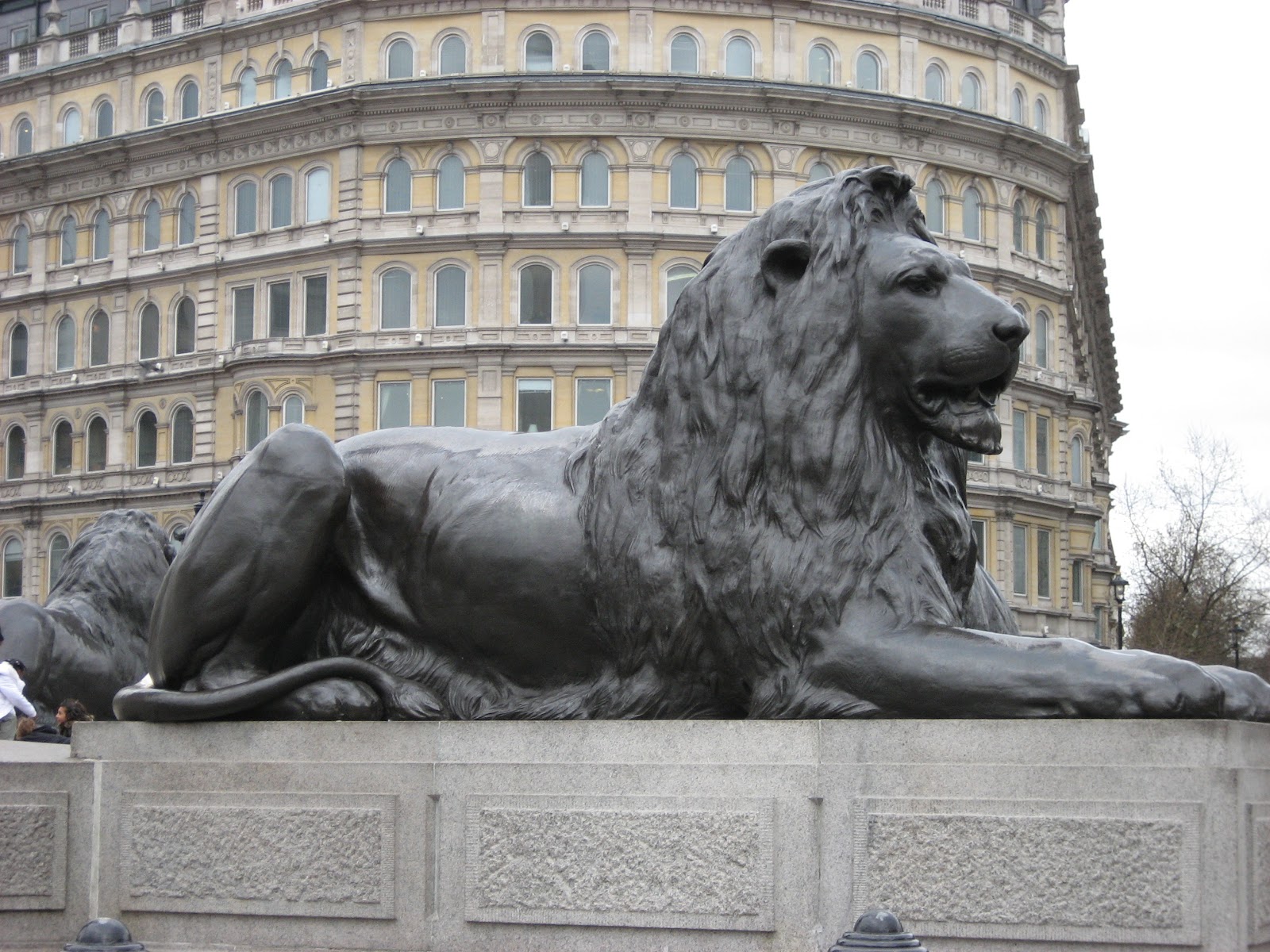
  • We circled around Trafalgar Square, where we spent so long in traffic that I was able to contemplate the sheer size of those lions in Trafalgar Square.
One of the 'big guys' in Trafalgar Square
  • Passed the Beauchamp Hotel in Bloomsbury and wondered how a word like that ever came to be pronounced "beecham".
  • Home after late class on the No. 91 bus. Have learnt to take the bus home. Red double-decker. Here is 'Bob The Brit' on the subject of red buses.
Mine is the No. 91

Another day in London Town.


Images from:

Sunday, January 16, 2011

A Weekend in the Country

Newslands Corner, Surrey

The mud was satisfyingly squishy, the pheasant remarkably near to its source, and the family life around the Aga all that I'd been led to expect from reading English novels.

Annette Locator: Horsley, Surrey
I spent a lovely weekend in the country with Marilyn and Adam and their two boys, Chris and Luke. The hospitality at 'Brook Cottage' was wonderful, and that big Aga standing warmly in the kitchen corner produced a scrumptious Sunday roast lunch. Although of course Marilyn deserves some of the credit. For those who may not have heard of an Aga, it is a great cast iron stove which runs on gas (these days) and is kept warm and toasty day and night. It is generously endowed with cooking ovens, of varying temperatures. It was invented in 1922 by Dr Gustaf Dalen, a Swedish Nobel prize winner. People who own them become besotted addicts quite swiftly. They write in to online forums with fond stories of their stove, and all it means to them. Check out the Aga website where you can also find a list of 'famous owners' (starting with the British PM David Cameron). You might find it a bit surprising to find such reverence for a cooking appliance, but all I did was sit in front of it for a couple of days, and I'm a convert!

Saturday began with a 45 minute train journey into the wilds of Surrey, followed by an excellent coffee at The Pink-Footed Duck deli in the village of Horsely. I was given a mini-tour of Horsely (East and West), which took approximately five minutes. I learnt that the local butcher, Conisbee's, has been in business, and in the same family, for 300 years. Game featured heavily on its sign-board. I also learnt that the local manor family gloried in the name of 'Lovelace'.

St Martha's on the Hill
How to build a hedgerow.
At the delightful 'Brook Cottage' we lingered over a lunch in which cheese and wine featured; then Marilyn and I set of for a tramp in the countryside. Admittedly the weather was a little grey, but we were not actually rained upon. As far as I can recall the names of the places, we began at Newlands Corner, and walked in the direction of Albury, ending up at a Saxon era church site called St Martha's on the Hill (the present church was built in 1850 on the site of an old Saxon church). And then back across the fields. It was wonderful -exercise, fresh air, views across the Downs. We met a horse, heard partridge being shot, stomped about in a lot of mud, found a new hedgerow under construction (thereby learning a lot), and spent a few windy, contemplative minutes atop St Martha's Hill.

Excellent mud. Broke in the boots.
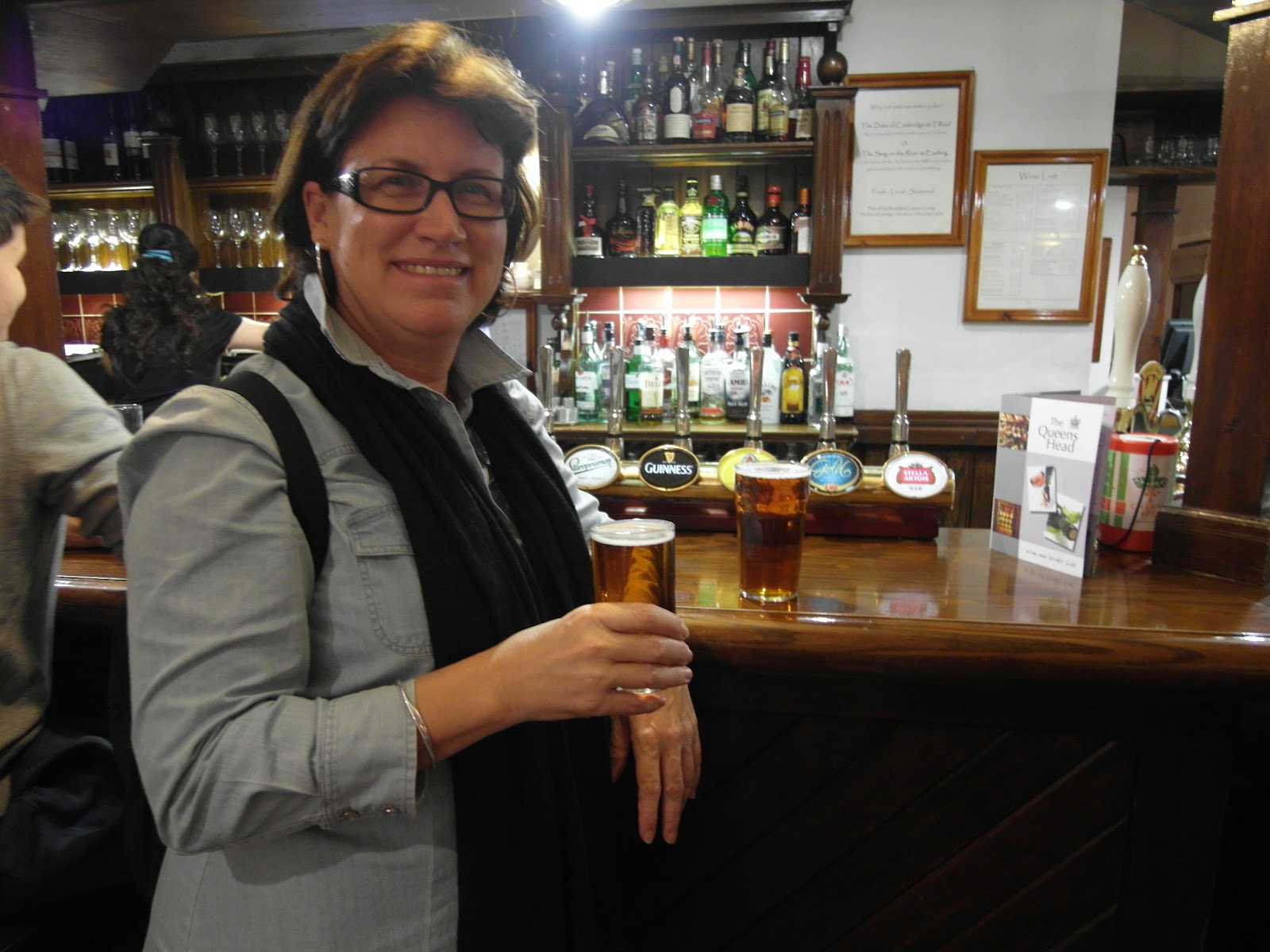
After this exercise, we trooped off to one the many pubs in the vicinity, this one evocatively named The Queen's Head  (which Queen? why her head? I can easily become sidetracked by English pub names). I was encouraged to try the local brew, and managed 'an 'alf'. Then to dinner - on the specials board I noticed...partridge. Local food.

Ah, yes. An English pub. Beer a bit warm, but pleasant
Shere. With stocks.
A lazy Sunday morning was spent in a nearby village named Shere (said to be possibly the most-photographed village in Surrey)...tilted tudor houses with doorways about four feet high, a stream through the middle of town (with ducks), a pub called 'The Whitehorse Inn' which still has its stocks out the front, a 12th century church (with a 1902 lych gate designed by Edwin Lutyens, of all people). The North wall of the Chancel has apertures in it. These were where an 'anchoress' named Christine Daughter of William the Carpenter, made her contacts with the church. In the 14th century she lived in a cell built against the north wall of the church, enclosed there by her own wish ('details in the church pamphlet', which I don't have, but really must find). An 'anchoress' is apparently, a woman who has withdrawn from the world for religious reasons.

I learnt this interesting stuff from a small booklet obtained in 'The Lucky Duck Tearooms', where we enjoyed a cream tea and fruit cake. There is a lot of other good stuff in there, from the Domesday book to JM Barrie and George Meredith organising cricket matches...but we had to get on home to put the roast in the Aga. Which was duly accomplished, with the aforementioned excellent results.
A new friend.
A lovely weekend in a quintessentially English bit of country. Even under the grey skies of winter it was evocative and charming. In spring and summer it must become impossibly post-card pretty. Of course, I was inevitably reminded of the typical snatches of poetry associated with such landscapes...'England's green and pleasant land', 'seasons of mists...', 'this sceptred isle'...where are they from? Blake? Keats? Shakespeare? All of the above. And if you're interested, there is a special magazine which mixes them all up:
'This England is a quarterly patriotic magazine for all who love our green and pleasant land'. I came across this magazine by chance, but it's contents sound intriguing:
All the regular features can be enjoyed in the winter issue – “Exploring England’s Coastline”, “Poets’ Corner”, “A Royal History of England” etc – but there are also a number of articles commemorating special anniversaries: the owner of an original Dunkirk “Little Ship” from 1940 tells us about his experiences, 100 years after his death the aviation and motoring pioneer Charles Rolls is remembered, and we take a walk along the cobbles of “Coronation Street” to celebrate 50 years in the company of Hilda Ogden, Ena Sharples, Ken Barlow and the rest…
Very English.


The Aga. Impressive.


Map from : http://www.postcode-info.co.uk/east-horsley-info-63071.html