Showing posts with label USA. Show all posts

Friday, December 6, 2013

Backstage!

The scene we saw in rehearsal (source)
In the final exciting instalment of a weekend of opera in New York City -- a peek backstage on a Monday morning, courtesy of a wonderful new friend with a dream job behind the scenes of one of the world's greatest opera houses. She escorted us on a tour of the prop room, the costume department, the wig maker's domain; we threaded our way through carpenters and sopranos and harps in cases; we peeked at the famous auditorium from the orchestra pit; we bumped into and said 'hi' to Peter Gelb, the head man of The Met himself. Read about life backstage at the opera company here.

Tom Watson, wig-maker.
Tom Watson is the wig maker at The Met (and moonlights on Broadway):
With a healthy head of hair, [some singers need] no wig fitting. Just in case, the Met’s wig department has head moulds of roughly 75 singers. “If we know who’s coming in, sometimes I can pull their head off,” and fashion a hairpiece quickly, the Met’s wig master, Tom Watson, said with macabre shorthand. (source)
And then to the auditorium to watch an hour or so of a piano rehearsal of Verdi's 'Falstaff '- with none other than the revered James Levine conducting from the podium (in his new wheelchair). We sat a couple of rows from the front, with a great view into the pit and up onto the stage. An opera-lover's heaven. This is The Met’s first new ‘Falstaff’ since 1964 (they like to squeeze the lemons dry at The Met). From the little I saw of it, it will be worth the wait.

The Falstaff in this production is Italian Ambrogio Maestri, who apparently speaks only Italian. The English director Robert Carson fortunately is fluent in Italian (most people running around backstage in an opera house are multi-lingual, it seems!) The piano rehearsal is the director's domain - where he directs the cast in their acting and staging and so on. At the next rehearsal, the orchestra rehearsal, the conductor takes over and the music is all-important. At this piano rehearsal, they were trying out one of the final scenes which involves a huge chorus augmented by actors. There's lots of fake smoke and everyone wears antlers and cloaks, and people are pushed around on rolling tables - chaos! But brought together so expertly by the consummate professionals involved (with just a little bit of sniping between the director and the chorus-master, who clearly was anxious to look after "his" chorus).

As for Signore Maestri, he's a fine figure of a Falstaff, ably supported by some other very fine figures, including the incredible voice of Stephanie Blythe as Mistress Quickly. It's worth checking out Signore maestri's website - he demonstrates Italian cooking!

Read a synopsis of the story of Falstaff here.

It was brilliant. My only regret - and it's a severe one - is that I won't get to see the full performance. But it is being broadcast on The Met's HD cinema program...hmmm...

Thursday, December 5, 2013

Strauss at The Met


Marina Serafin and Alice Coote: 'Der Rosenkavalier' (source)
A weekend in New York is always a great opportunity for a weekend at The Metropolitan Opera House. This incredible company has the resources, the history, the support, the house and the singers to stage scads of opera, all usually in unforgettable style. My recent NYC weekend included two Richard Strauss operas (I'm a big Strauss fan), plus the exciting opportunity to visit backstage and sit in on a rehearsal. Opera-lovers' Heaven!

Der Rosenkavalier was first up....

Richard Strauss composed the music to Hugo von Hofmannsthal's libretto in 1911, and it's revered as one of the best-loved operas in the repertoire. Occasionally you'll hear someone deriding it, but trust me, they're only kidding - everyone loves 'Rosenkavalier'!  This particular production, all sumptuous period Vienna, debuted at The Met in 1969!! It's renowned for being one of the longest-running productions in opera history, and those traditional Viennese wigs still look fresh. Well, fresh-ish. The rumour is that this will be the last run for these venerable sets and costumes (which I've seen before, with Renee Fleming as The Marchallin). It was good to see the last run.

The conductor was Edward Gardner (England). Octavian, the trouser-role, was sung by mezzo Alice Coote (England), a veteran of the part, and a singer I like very much. Elina Garança was scheduled to sing Octavian, but the Latvian diva withdrew due to pregnancy (it is an energetic role). Her replacement for the first three performances is Alice Coote. (Daniela Sindram will sing the role in the December performances).

The Marchallin is Martina Serafin (Austria), who was regal and lovely. Perhaps slightly too regal, visually speaking, since she's a head taller than Alice Coote. A little belief had to be suspended to work with the story of a 17-year-old youth in the arms of the statuesque aristocrat.

Baron Ochs, an annoyingly comic role, was sung - comically - by Peter Rose (England). He was a pretty good Ochs. Sophie, the young ingenue for whom Octavian dumps the Marchallin was sung - at the last minute - by Erin Morley (USA). Excitingly, she was the understudy who got to go on, replacing Mojca Erdmann (Germany) who became, er, indisposed, at around the time of the dress rehearsal. It was an excellent Sophie, well sung - congrats to the whole cast for adjusting to the change. That trio -for which the opera is famous - was, as it's supposed to be, to die for.

Sumptuous sets on their last run. (source)
Here's a review from the New York Times - wholly congratulatory. This review from the FT is less impressed.

Anne Schwanewilms as the Empress in 'Die Frau ohne Schatten'  (Source)
'Die Frau ohne Schatten' was next...

Still Strauss, but a change of pace in 'Die Frau ohne Schatten' (The Women Without a Shadow). This was the work of Strauss and von Hofmannsthal  a few years later, in 1919. It's not performed very often, partly because the storyline is quite obscure, the opera is long, and you need a huge orchestra and an inventive staging. And you also need five excellent principals who can sing difficult music. This production premiered at The Met in 2001, and manages to handle the story convincingly -- the spirit world of the Emperor and Empress alternates with the grungy hovel of the Dyer and his Wife, each being lowered and raised to and from The Met's copious basement space. It's great theatre.
...in 2001... Herbert Wernicke startled the basically conservative Met with an astonishingly progressive production of Richard Strauss’s magnificently bloated Die Frau ohne Schatten. He actually made theatrical sense of Hugo von Hofmannsthal’s high-minded, hopelessly convoluted libretto.
And superlative singing, particularly by the US soprano Christine Goerke as The Dyer's Wife. I'd heard rave reviews, and  they weren't kidding. Her incredibly rich voice handled the wide range of the role, and her acting was utterly focussed and spot on. The conductor  was Russian wunderkind Vladimir Jurowski. The other important roles were also superbly performed: The Nurse - Ildikó Komlósi (Hungary); The Emperor - Torsten Kerl (Germany); The Empress - Anne Schwanewilms (Germany); and Barak, The Dyer - Johan Reuter (Denmark) - he was excellent in this role of 'the nicest man in opera.'

The story? Well, I'm not sure you have time...the 'woman without a shadow' is a reference to the Empress, a spirit who married a human and so cannot have children. She tries to buy a 'shadow' from the Dyer's Wife, who lives in poverty and frustration...read the whole whole synopsis here.

Here's a review raving about the production. The New York Times was impressed. "Goerke unmissable in the Met's Die Frau ohne Schatten" says one review. I agree!

Christine Goerke (The Dyer's Wife) and Johan Reuter (Barak the Dyer) (source)
It's sometimes said that Strauss and von Hofmannsthal had Mozart's great operas in mind when composing these two of their own:
If “Der Rosenkavalier” amounted to Strauss and Hofmannsthal’s “Marriage of Figaro,” a sophisticated comedy of thoroughly grown-up relationships, then “Frau” — started in 1911, completed in 1917 and first staged in 1919 — was their “Magic Flute,” a fable intertwining the fates of two couples in a mystical rite of passage. (source)
Although I can see the link, don't come to these two expecting Mozart - they are both thoroughly Strauss-ian and incredibly involving. Loved them.


Wednesday, December 4, 2013

Jansing & Co


In the 30-storey high Rockefeller Tower in New York City the best-known tenant is the television broadcaster NBC. Your blogger is not a great TV-watcher, but was thrilled to bits to be invited to sit in the "control room" during the broadcast of a live-to-air news show, Jansing & Co, by none other than the show's delightful and dedicated host, Chris Jansing.

Control room!
After passing through the tight security that is de rigeur in all New York high rises these days, especially the iconic ones, a one-floor-only lift whisked up to one of the NBC locations in the Tower.
Chris was wearing a chic purple dress today, and had been in the office since about 5.30 am preparing for the 10 to 11 am broadcast. As she headed to her set, we were escorted by her friendly producer to a corner of a crowded control room, a space stuffed with monitors of all shapes, sizes and functions. Some were tuned to rival networks, but most were trained on the studio set where Chris sat, smoothing her hair and looking cool, calm and collected.

The show focusses on current news stories - it opens msnbc's news coverage for the day (the hugely popular NBC Morning Show is broadcast from another NBC space in the Rockefeller Center, across the road). On this particular day the subjects under discussion included bad weather on its way across country in time to disrupt Thanksgiving travel, the recently negotiated deal between the US and Iran, a variety of differing views on US domestic politics, and an interview with studio guests - an actress (Naomie Harris) and director (Justin Chadwick) from the about-to-be released movie about Nelson Mandela's life, "Long Walk to Freedom."

This last segment was the only one to disrupt the spooky calm that everyone seemed to be able to preserve despite being live-to-air. The movie contingent, travelling with an extensive entourage, managed to be rather late in getting to the building, and to the studio. In the control room, the producer began to speak a little more loudly and a little more urgently - "can you SEE them?" -- "OK, you can see Justin. Can you see Naomie?" -- "OK, OK - they're IN the building!"

After delaying the segment until the end of the show, and with seconds to spare as the intro rolled after the ad break, the guests slid into chairs on Chris's set. With aplomb and charm, she rolled into the interview...and then we were done.

I asked the producer how everyone managed to stay so calm. "Oh, we do this every day," she said. "If we mess up this one, there's always tomorrow's show!" A glimpse into the world of live TV, NBC style. Thanks, Chris!

Watch the show on-line here.

Chris at work.
Photo and logo sourced from msnbc.

Tuesday, December 3, 2013

Little Italy

Deep in Manhattan...(source)
On a recent visit to New York City for four days, I ate nothing but Italian. Granted, I was visiting with an actual Italian, but still...New York City has many neighbourhoods, and "Little Italy" has been established for a century. It even has its own website.
Geographically, it centres around Mott and Mulberry Streets, St Patrick's Old Cathedral (at 263 Mulberry), and a cluster of restaurants, delis and cafés all channeling the Old Country.


Let me take you on a tour of the Little Italy sites I sampled...
Emilio's place...
Join me for dinner at Emilio's Ballato restaurant at 55 E Houston St. Emilio is from the Amalfi Coast. As such, he is careful about his food, careful about his guests (no reservations, BTW) and if you're an Italian from the Amalfi Coast you get to invade his kitchen to give instructions about your dinner. This reviewer complains that "Ballato’s clubbiness can seem off-putting, especially as owner Emilio Vitolo scrutinizes newcomers from his front corner table" but is won over in the end:
Vitolo favors unfussy preparations of classic dishes. Almost all are winners. Hearty rigatoni alla Bolognese comes in a thick sauce with beef, veal, and pork, while baked shrimp benefits from pristine seafood and simple garlic and bread crumbs. An extensive and reasonable wine list includes Ballato’s own label, produced by a Tuscan friend. A private dining space in back has hosted celebs like Billy Joel, Lenny Kravitz, and Tom Hanks, while a central-casting mix of outer-borough Italians, younger locals, and wide-eyed tourists people the spare main dining room. The club vibe pervades, but doesn’t exclude: If Vitolo doesn’t know your name when you’re seated, he will by the time you’ve finished your espresso and nibbled on a plate of on-the-house biscotti.
Lou and Sam's place...
 For your deli requirements - gorgeous imports from Italy - the motherlode is at Di Palo's, 200 Grand Street. Lou is one of the brothers running the place, and his son Sam is in charge of the wine enoteca (all Italian wine, of course). Various other daughters, wives, brothers, sisters-in-law, aunts and uncles assist: heirs to a business that's been in the family for several generations. Lou and Sam have visited the Amalfi Coast, and source some of their products and wines from the region.

New Yorkers crowding Di Palo's
Pick up your panettoni in Di Palo's
In Di Palo's enoteca we find...wine from our friend Alfonso's Tramonti vineyard on the Amalfi Coast, Monte di Grazie. 
And a sample of his old vines!

On the corner of Mulberry and Grand is a small, slightly amateurish but very sincere small museum, the Italian American Museum. What better location? This historic location on the corner of Mulberry and Grand Streets once housed “Banca Stabile” which was founded by Francesco Rosario Stabile in 1885. During its heyday, the bank offered the newly arrived immigrants from Italy much more than financial services. It was a link for the Immigrants in the United States with their relatives in Italy. In addition to a full range of banking services, it also provided the following services: telegraph, travel via steam ships, import-export, notary public, and post office; a kind of all in one immigrant community service centre. (source: their website).

Some Napoli presipo in the Museum - and a lectern for those special occasions.
The Italian American Museum goes to explain (on it's website) that it "is more than an immigration museum. Its purpose is to document the myriad of contributions made by the people of Italy and their descendants to the very fabric of American society from its earliest origins and its philosophical underpinning through philosophers, explorers, adventurers, industrialists, scientists, educators, politicians, and everyday extraordinary people, telling the whole story which continues to flourish and evolve in America today. Italian Americans are the fifth largest ethnic group in the United States of America today, with distinct cultural values and traits which distinguish them as a people within the greater multicultural American society. Thus, the museum serves as a point of reference for those who are Italian Americans and those who wish to learn about Italian Americans."

Papers from the bank vaults documenting the immigrants who arrived by sea, 
The Library of Congress tells part of the story here:
Most of this generation of Italian immigrants took their first steps on U.S. soil in a place that has now become a legend—Ellis Island. In the 1880s, they numbered 300,000; in the 1890s, 600,000; in the decade after that, more than two million. By 1920, when immigration began to taper off, more than 4 million Italians had come to the United States, and represented more than 10 percent of the nation’s foreign-born population. 
What brought about this dramatic surge in immigration? The causes are complex, and each hopeful individual or family no doubt had a unique story. By the late 19th century, the peninsula of Italy had finally been brought under one flag, but the land and the people were by no means unified. Decades of internal strife had left a legacy of violence, social chaos, and widespread poverty. The peasants in the primarily poor, mostly rural south of Italy and on the island of Sicily had little hope of improving their lot. Diseases and natural disasters swept through the new nation, but its fledgling government was in no condition to bring aid to the people. As transatlantic transportation became more affordable, and as word of American prosperity came via returning immigrants and U.S. recruiters, Italians found it increasingly difficult to resist the call of “L’America”. 
Famous Italian-Americans commemorated: Here, Serpico "The cop who defied the system."
And here's a photo of our friends at Di Palo!
Did you know that the chief sculptor of Mount Rushmore was an Italian, Luigi Del Bianco?

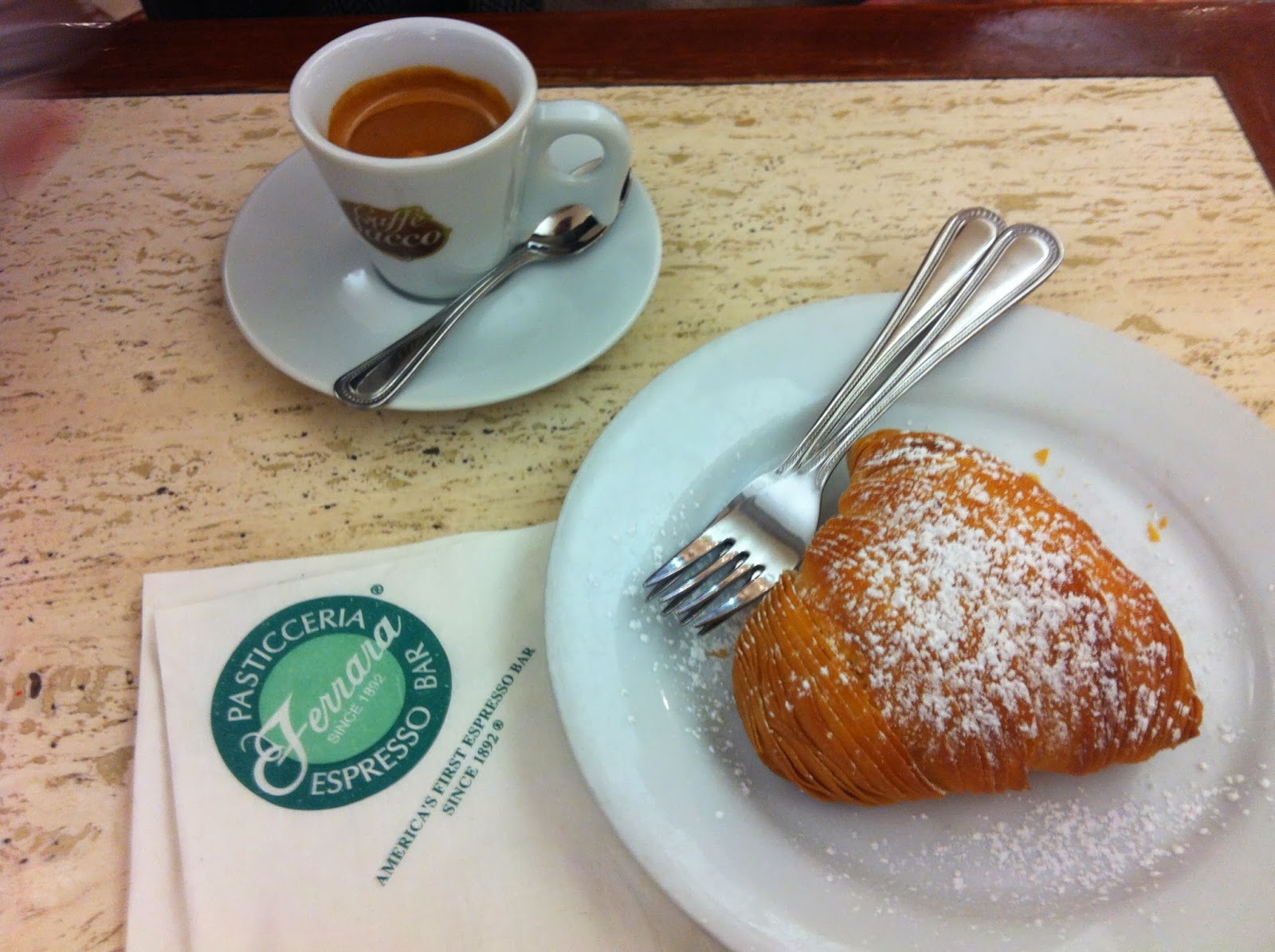
And finally, let's stop for an espresso and sfogliatella at Ferrara Bakery and Café, 195 Grand Street
between Mulberry & Mott St. As they exclaim on their website:

For four generations, the Ferrara family has been delighting Little Italy with its outstanding Italian/French desserts. Cannoli, sfogliatella, gelati and more have been made right here since 1892.
Today, not only can you come in and enjoy the "Ferrara Favorites" along with specialty coffees, lattes and espressos, you can now order for delivery anywhere in the continental USA for a taste of Little Italy at home!

I can report that both the espresso and the sfogliatella were, indeed, like a taste of home.


Monday, December 2, 2013

Tower Tours

Your brave correspondent at Willis Tower "Skydeck Ledge", Chicago.
Trusting Skidmore, Owings and Merrill.
There's recently been a lively discussion, shall we say, over the title of "tallest building in America", or "tallest building in the Western Hemisphere." That last description circumvents consideration of Taipei 101, the Petronas Towers in Kuala Lumpar, or anything the Middle East can come up with: Burj Khalifa in Dubai has been the tallest building in the world since 2010 and stands at 2,722 ft to the tip of its spire.

The Guardian outlines the issues. Fox News announces the "winner". One World Trade Center, with its 408 ft steel spire, measures 1,776ft. It's a symbolic reference to the year of the US Declaration of Independence. The contention is over whether its steel attachment is an antenna or a spire. If the Council on Tall Buildings and Urban Habitat had decided that it's an antenna, One World Trade Center would be reduced to a mere 1,368ft building – smaller than the 1,451ft Willis Tower in Chicago. However, to the chagrin of Chicagoans, the Council decided that the attachment was a spire - an integral part of the building. The spikes on top of the Willis Tower, which, if 'counted', would make it even higher still, are officially 'antennas.' Although the Willis Tower folk are remaining dignified through this dispute - Willis's top floor, at 1,354ft, will always be higher than the One World Trade Center’s 1,268 ft - Chicago mayor Rahm Emmanuel was heard to mutter, of the One World Trade Center spire: "If it looks like an antenna, and acts like an antenna, then it's probably an antenna."

Or, as the recently updated Wiki entry puts it:
Upon completion, One World Trade Center in New York City surpassed Willis Tower through its structural and pinnacle heights, but not by roof, observation deck elevation or highest occupied floor.

View East from the 103rd floor of Willis Tower.
Willis Tower, Chicago (source)
Willis Tower  began life as Sears Tower, and is still often referred to by that former name, such is the iconic stature of the building. The name change to 'Willis' dates from 2009; the building was completed in 1973. Here's Wiki on the tower.

The Sears Tower observation deck, called the Skydeck, opened in 1974. It's located on the 103rd floor of the tower, and is 1,353 feet (412 m) high. Tourists who venture up can experience how the building sways on a windy day, and can see far over the plains of Illinois and across Lake Michigan to Indiana, Michigan and Wisconsin (on a clear day). The Skydeck competes with the John Hancock Center's observation floor across town, which is 323 feet (98 m) lower [John Hancock is 100-storeys and 1,127-foot (344 m) tall]

In 2009 Willis Tower's owners installed retractable glass balconies, extending out approximately four feet over Wacker Drive from the 103rd floor. They call this "The Skydeck". The all-glass boxes allow visitors to look through the floor to the street 1,353 feet (412 m) below. The boxes can, we're assured, bear five short tons of weight (about 4.5 metric tons). As you can see from the pic above, I trusted them on this....


However, I did want the FULL story before I ventured out over Chicago from 103 floors up, and here's what the brochure told me:
Original Sears Tower architecture firm Skidmore, Owings and Merrill (SOM) designed The Ledge so that the fully enclosed glass boxes retract into the building, allowing easy access for cleaning and maintenance.
Experts in international structural glass design, Halcrow Yolles, fully designed and detailed all the glass and steel components. Beginning with the architect's original concept, the engineers took the design one step further by eliminating all perimeter structural steel at the sides and along the floor of the glass enclosures and creating a near-invisible support system.
MTH Industries, the Chicago-based 120-year-old glass and architectural metal contractor that installed the Cloud Gate in Millennium Park, installed The Ledge’s 1,500 pound glass panels. Each box is comprised of three layers of half-inch thick glass laminated into one seamless unit. The low-iron, clear glass is fully tempered for durability.
Looking north over Chicago from Willis Tower. The John Hanock Building is the black one in the centre.
The Skydeck.

One World Trade Center in New York City, the new "tallest building in America", has just opened for business. It will, I believe, have an observation deck for visitors but this is not yet operational. You can, however, rent an office there. New Yorkers, and all Americans, have been watching the building of the new tower with anticipation, and celebrated its completion this month. Here's a video of the workers installing the spire that enable the "Freedom Tower" to eclipse Willis:


One World Trade Center - "Freedom Tower", NYC
(source)
One World Trade Center facts:  1,787' Pinnacle / 1,373' Roof | 108 floors. The observation deck will be on the 100th to 102nd floors, once it opens.

Meanwhile, there are other options in New York City if you'd like to get a bird's eye view from a tall tower. The Empire State Building, completed in 1931 and standing 1,454' (443 m) high, has been welcoming visitors to its outdoor viewing platforms for many years. The observatory there is on the 86th floor. The Rockefeller Center is also well-known for its viewing platform called "The Top of The Rock", which is on top of the tallest building in the complex, the 1933 Art Deco skyscraper officially named the GE Building - 70 floors, 850' (259 m).

During construction, photographer Charles Clyde Ebbets took the famous photograph "Lunch atop a Skyscraper" on the 69th floor.

"Lunch atop a Skyscraper" 1930
On solid, er building, this time, On Top of The Rock. 70th floor.
Central Park in winter, from the 70th floor, Top of The Rock.

NYC from The Top of The Rock. The Empire State Building is centre left;
the new Freedom Tower is to its right, in the distance. You can even see lady Liberty from here.
The Rock at night.
The Rock is home to NBC, and the
famous 'Rainbow Room.'


Just so you're clear on the current state of play in "World's Tallest":

The new World Trade Center in NYC is now the fourth tallest building worldwide, behind Dubai’s Burj Khalifa, at 2,717 feet tall, Shanghai’s Shanghai Tower, at 2,074 feet tall, and the Makkah Royal Clock Tower in Mecca, which stands at 1,972 feet.

But it's all in how you measure these things, as Chicago has found out this month. Don't fret if you can't clim to be absolutely THE tallest - there's plenty more records you could list. Taipei 101 (101 stories above ground and 5 below), for example, is able to make these claims:

Upon its completion in 2004 Taipei 101 claimed the official records for:
Ground to highest architectural structure (spire): 508 m (1,667 ft). Previously held by the Petronas Towers 451.9 m (1,483 ft).
Ground to roof: 449.2 m (1,474 ft). Formerly held by the Willis Tower 442 m (1,450 ft).
Ground to highest occupied floor: 438 m (1,437 ft). Formerly held by the Willis Tower 412.4 m (1,353 ft).
Fastest ascending elevator speed: designed to be 1,010 meters per minute, which is 16.83 m/s (55.22 ft/s) (60.6 kilometres per hour (37.7 mph)).
Largest countdown clock: Displayed on New Year's Eve.
Tallest sundial. 


They're both, er, TALL.


Sunday, December 1, 2013

America Windows

Detail, Marc Chagall's 'America Windows'.
Wandering through the wonderful Chicago Art Institute the other day, followed the corridors from the old wing (the ex-World's Congress Building from the Chicago World's Fair of 1893) to the spectacular piece of architecture that is the Modern Wing - opened in 2009 and Designed by Pritzker Prize–winning Italian architect Renzo Piano. I paused on my way, at the juncture where the two buildings meet, to admire a set of luminous blue stained glass windows. These were Marc Chagall's 'America Windows', purpose made for the Art Institute and recently reinstalled. They were new to me, though I've admired Chagall's stained glass in churches, such as Zurich's Grossmüster and Frauenkirsch. These windows int eh museum are lovely things, beautifully lit. I looked them up:
Marc Chagall’s America Windows were a gift to the Art Institute of Chicago created by the artist for their specific context. Long a favourite of visitors, the searingly blue light creates a powerful background for the moments and events that occur across the piece...Removed to protect the pieces during the construction of the Modern Wing, the pieces were extensively conserved, and a new context was required that could better protect the pieces from the effects of temperature and humidity.
The new location allowed implementation of integrated systems that carefully address every aspect of the conservation and presentation of the system. Vinci Hamp Architects coordinated a team of structural, M&E and fire safety engineers along with Lux Populi to integrate what is, perhaps, the most refined light box around. The studies included photometric studies to ensure evenness of the illumination without flattening out the perceived depth of the piece (observe how most stain glass windows in museums appear flat), optimum colour temperature and rendition to best reveal the tones and elements of the piece, elimination of edge effects, thermal moderation to prevent condensate or thermal cracking and numerous other aspects.
Marc Chagall. America Windows, 1977. A gift of Marc Chagall, City of Chicago, and the Auxiliary Board, commemorating the American bicentennial in memory of Mayor Richard J.Daley.
Here's a bio of Marc Chagall, who was born in Belarus (then the Russian Empire) in 1887.


Renzo Piano's Modern Wing of the Chicago Art Institute.


Saturday, November 30, 2013

The White City

(source)
In 1893 the soot-blackened, hog-killing, rather foul and grimy -- but vibrant -- city of Chicago beat out New York and Washington DC to become the host city for the great World's Fair of that year, also known as the World's Columbian Exposition (commemorating the 400th anniversary of Christopher Columbus's discovery of the North American continent). Even back then, Chicago was a hotbed of talented architects, a characteristic it kept through the twentieth and into the twenty-first century.

Flocking to the World's Fair, Chicago, 1893(source)
To produce this massive fair - and make sure that Chicago and the US of A kept up with, or preferably surpassed, the city of Paris (which had hosted the previous World's Fair) - a band of dedicated architects and rich (very rich) entrepreneurs got together. It was touch and go for a while, but they did it, and spectacularly. The resulting Fair Grounds, built to the south of the grimy city in the Jackson Park area, was comprised of mostly temporary buildings in grandiose neo-classical style. When time was running short, the decision was made to basically whitewash the lot of them. The result was very wonderful and very white. The Fair was dubbed "The White City".

The Rookery, Chicago
The lead architects on the project were Burnham & Root, though Root passed away before the Fair (he died of pneumonia early in the planning process). Their firm had nurtured several up and coming men who later became architectural 'names', including Louis Sullivan and a young Frank Lloyd Wright. The shape of the Fair was formed from the 'control room' on the top floor office of Burnham & Root in a landmark building they'd built in the Chicago Loop, on South La Salle Street not far from the Board of Trade Building, named The Rookery. Today you can visit that top floor office - at the soaring height of eleven stories, where Burnham & Root conferred with their fellow architects, and the famous landscape architect from New York, Olmsted, over plans and schemes. The group could see the Jackson Park area from the windows, if they looked.


THE office, of Burhman & Root, 11th floor, The Rookery, Chicago.
Visiting The Rookery is fascinating in itself. Take a guided tour and learn all about it:
The Rookery...was revolutionary in several respects. Its architecture was unique and much more ornate than had been seen to date in commercial buildings. The Rookery successfully implemented many new and breakthrough building technologies - including metal framing, elevators, fireproofing, electrical lighting, and plate glass - that established the commercial acceptance of the modern skyscraper. At 11 stories tall, The Rookery was one of the earliest examples of metal framing with masonry walls on such a large scale. Today, it is considered the oldest standing high-rise in Chicago. 
Moorish, Romanesque Commercial, Indian, Venetian, Arabian, Islamic, Byzantine: all these words have been used to describe the Rookery’s exterior motifs. Some critics said that the mix of styles lacked unity, but others felt that the repeating patterns were an interpretation of American culture, reflecting a spirit of conquest.
Frank Lloyd Wright's idea of an office building atrium.
FLW's decorative touches, Rookery atrium.
The oriel staircase, The Rookery
The building is probably still great to work in - it has a wonderful large atrium letting in light to interior offices. These were favoured in the early days, since it was better to look inwards than outwards onto the dark, stinky streets. The atrium was remodelled in 1905 by none other than Frank Lloyd Wright, who covered it in light marble and delicate art deco decorations.

The first Ferris Wheel (source)
But back to the Fair - people flocked to it, 27 million visitors in 6 months. "Sell the cookstove if necessary and come. You must see the fair." wrote author Hamlin Garland in a letter to his parents in 1893. And what did they flock to see? The grandiose white buildings, the landscaping of a previously marshy area, the artificial lake with an island and a steam boat. But above all the exhibits - examples of the latest technology in the Electricity Building and the Manufactures Hall. The whole fair was powered and lit by the new-fangled electricity -- not using coal and gas allowed The White City to stay white.

They also came to see new inventions, like Wrigley's Juicy Fruit chewing gum. They came to see and ride the amazingly huge world's first Ferris Wheel (designed by a Kansas engineer named Ferris, expressly to out-do the Paris Fair's Eiffel Tower). And they came to see curiosities (including native peoples) from far-flung countries around the world which they'd be unlikely ever to visit, and to see animals and crafts, minerals and plants, that were strange and curious.
(source)
At Chicago's Field Museum.
You might pause to wonder what happened to all those stuffed wild animals, mineral specimens, fossils, jaw-bones, Indonesian gamalans, Japanese kimonos. Answer: many of them ended up forming the initial collection of Chicago's natural history museum, called The Field Museum (after business man and department store pioneer, Marshall Field, who donated the wherewithal). The Field Museum has rummaged in its basements and curated a fine exhibition (runs until September 2014) where once again you can marvel at the things that made the eyes of 1893 pop. I was particularly taken with the stuffed animals, in excellent condition even after 120 years in the basement. Many are the work of the man who became the Museum's own taxidermist, Carl Akeley. (Two of his elephants are on display in the Field's main hall).

(source)
There's a great review of the Exhibition from the new York Times here, with pics of some of the exhibits. The Museum's display is enlivened by some rather intriguing animated postcards. Video artists have taken postcards from 1893 and added in some moving figures. It's just like being there. Sort of.

The White City is said to have inspired a whole movement focussed on urban planning:
The White City is largely credited for ushering in the City Beautiful movement and planting the seeds of modern city planning. The highly integrated design of the landscapes, promenades, and structures provided a vision of what is possible when planners, landscape architects, and architects work together on a comprehensive design scheme...Where the municipal art movement focused on beautifying one feature in a City, the City Beautiful movement began to make improvements on the scale of the district. The White City of the World's Columbian Exposition inspired the Merchant's Club of Chicago to commission Daniel Burnham to create the Plan of Chicago in 1909, which became the first modern comprehensive city plan in America. (from Wiki)
The Fair had more than 200 buildings, almost all of which were designed to be temporary. Their facades were made not of stone, but of a mixture of plaster, cement, and jute fibre called staff, which was painted white, giving the buildings their "gleam". Architecture critics derided the structures as "decorated sheds". (Wiki) In any event, the whole lot burnt down in a big fire in July 1894, about six months after the fair closed. A couple of survivors, which were intended to be permanent, remain: the Palace of Fine Arts (original home of The Field, now Chicago's Museum of Science and Industry); and the World's Congress Building in Grant Park (now the Art Institute of Chicago).

And in the Art Institute you can find, if you look closely, a few more remnants of the original fair, including these panels from the Japanese Pavilion, restored and displayed in the oriental art section of the galleries:

Panels from the original Japanese pavilion at the 1893 World's Fair, Chicago.