Showing posts with label Padua. Show all posts

Tuesday, October 22, 2013

Il Gattamelata

'Il Gattamelata'
There’s a book on my bookshelf entitled ‘The Wreck of Western Culture - Humanism Revisited’ by John Carroll, an Australian professor of sociology. I read it some years ago, and was entranced by a discussion in Chapter Two about an equestrian statue that stands in Padua, in front of San Antonio’s Basilica. The statue was made by Donatello around 1447. In art history terms, it’s an early example of Renaissance statuary. The prof uses it as a kind of metaphor or example of a profound change of thinking that signalled the rise of humanism in western Europe.

What’s so entrancing about the statue? I’ve never been entirely sure, but when I found myself in the vicinity of Padua I just had to go and find it...despite the grey rainy day...

The statue is called ‘Il Gattamelata’, which was the nickname of the gentleman it depicts mounted on his horse - he was a 14th century condottiere, or mercenary. I’ll let Professor Carroll explain its significance a little more:

“For over five hundred years now, the small square in front of the cathedral of San Antonio in Padua has worshipped a different god than he who rules inside the church doors, where one plunges into the dark. There is awe in the square, open to the heavens. To come in sight of it - and it is best to do so at noon in the full light of day, and to lift the eyes and look - from that moment on, one is in the thrall of humanism. True, it is possible to sidle up to the cathedral with head lowered, the first signs being the stalls for tourists and pilgrims selling plastic knick-knacks, garish red charms and crudely painted virgins, all the paraphernalia of modern Italian Catholicism. They can crowd out the square.

Verrocchio's 'Il Colleoni'
What does command here, set on a high and massive stone pedestal, is the Gattamelata. He is the Venetian general Erasmo de Narni, on horseback, immortalised in bronze a few years after his death in 1443, by Donatello. His form is that of the medieval condottiere, the warrior who by means of his own singular, brute strength and courage could win any war. The condottiere was the hero of the earlier epoch, one embodying subhuman fantasies of the monstrous force of animal nature, at times subliminated into the chivalrous ideal of the Christian knight. The most brilliant representation of the medieval condottiere stands fewer than thirty miles from Padua, in the Campo of saints Giovanni and Paolo in Venice - that is, Verrocchio’s equestrian statue of Il Colleoni. A mountain of a man, rearing up in his stirrups, Il Colleoni thrusts his massive torso and neck, his thick and crude features glowering from under a steel helmet like those of an enraged beast. He is a hulk of indomitable power.

The Gattamelata is mounted on a strong, square warhorse, formidably serviceable, with stocky legs, the neck and chest of a bull, and a fierce head. This charger has the attributes that Verrocchio was to give his warrior. The Gattamelata himself is the epitome of balance, and confidence of a different order - its source is inward. He sits lightly in the saddle, his posture straight and relaxed. he looks ahead, without helmet. In his right hand, which is forward over the horse’s mane, he delicately holds a baton. Whereas his charger strives, he is composed. Donatello underscores the point by making the rider proportionately smaller in relation to the bulk of his horse. The human individual is master of powerful forces surging beneath him: they champ, they pull, they are vastly stronger yet, through his own will, his own force of character, nothing to do with physical strength only to do with balance, and a clear and concentrated mind, he is master. The baton is also suggestive of a scroll, symbol of knowledge, of the rational human mind conquering the volcanic chaos of nature. The Gattamelata is renaissance man.

The Gattameleta on his plinth.
He has nothing to obey but himself; he needs nothing above or beyond the I. he is the value-creating individual - on the move. There is such intensity focused between the brows, such inviolable purpose buried in the eyes, that the head itself, bare to the heavens, becomes the sacred site. A concentrated mind may move the very earth.

Humanism, nevertheless, needed an ethic, a central moral axiom, to secure its foundation. The clarity and steady vision with which the Gattamelata looks straight ahead, taking in the world, is not enough. Neither is his commanding will. He is so superbly in form because he embodies the humanist ethos. He does obey one external - he is a gentleman, or in the Italian characterisation of Castiglione, a courtier. And, as a gentleman, he is under the command of honour...The principal role of the humanist hero was...to become so awesomely noble that the rest of common humanity would believe in the culture he exemplified.

The ease and grace of the Gattamelata is predicated on the knowledge that he is right, doing what he has to do...Donatello’s...vision is different. he saw the concentrated, essential value, and stripped away the rest. What remains is the grace of pure form. The Gattamelata on a bright noon is an exhilarating tribute to the human individual. It’s message is, ‘I like him!’ "

And you thought it was just a statue of a man on a horse.


Monday, October 21, 2013

San Antonio

The tomb of San Antonio, Padua.
Saint Anthony of Padua

This blog’s review of Roman Catholic saints has covered the lesser-known as well as the some famous figures. Today we visit with one of the Big Names, Saint Anthony of Padua. And along with the saint’s big name, is his BIG basilica, in Padua (or Padova, as it’s known in Italian). The Basilica, often called simply ‘Il Santo’, was declared an international shrine by Pope John Paul II in 1993:
“Of all the shrines in the world, the basilica dedicated to Saint Anthony, as proved over the centuries, is of special importance. As everybody knows, it holds the body of the great teacher and miracle worker; millions of people come in pilgrimage from all over Italy, Europe and the world...”
Religious trinkets.
On my visit, on an ordinary rainy Monday in September, the Basilica’s facade was shrouded in scaffolding (Italy is under perpetual restoration), the vendors of religious trinkets huddled under the dripping awnings of their carts in the courtyard outside. Inside, troupes of pilgrims queued to walk reverently around the large white chapel in the centre of which sits the sarcophagus holding the saint’s body. It’s traditional for the pilgrims to spend some time with their palms flat on the surface of the tomb, their foreheads resting on it was they make their silent prayers; perhaps they kiss it. The tomb is surrounded with small photographs and tributes to the saint from those who’s prayers have been answered. 

Talking to Saint Anthony

The Basilica, which is run by the Friars Minor Conventual, helpfully provides small slips of paper and pencils so that you can write down your request to the saint and leave it with him, to mull over and weigh the merits of your request. 


Talking to San Antonio

As the basilica info says: “When you go to the tomb of St Anthony you have so much to say. Once there, you can’t say it all, because there is not enough time. You want to leave something of yourself there, in order to lengthen that dialogue which was interrupted too soon.”

You can pick up a small postcard on you way out of the basilica, and mail it in, too. Or - and here’s something they didn’t think of in the 13th century when the church was built - you can email! dearsaintanthony@mess-s-antonio.it Amazing!


The altar of the Basilica. A little gloomy, but adorned with
Donatello's bronzes.

The Art in the Basilica

Once you’ve visited the strangely glowing white chapel of the saint, the Basilica contains other things of interest. First amongst these must be the beautiful bronze statues on the high altar, created by Donatello in 1444 - 45, in the early Renaissance period. There are frescos from as early at the 1300s; and the saint’s chapel was renovated in the 1500s by Renaissance artists including Andrea Briosco. The main artistic feature of the chapel are large bas-reliefs carved on the walls between 1505 and 1577, illustrating - rather vaguely - scenes from the saint’s life. The sculptors’ name are carved on most of them, perhaps the most prominent being Jacopo Sansovino. The Rough Guide describes them as “the most important series of relief sculptures created in sixteenth century Italy.”


The saint's tomb surrounded by white bas-reliefs.
Behind the altar are small side chapels, one holding a reliquary with a curious relic of the saint: his tongue and vocal chords, which are said to be ‘immaculate’ (i.e. perfectly preserved). The ornate Baroque chapel was closed behind great golden gates the day I was there, so I can’t give you more specific information about this curious item; except to say that since San Antonio’s principal claim to fame was his extraordinary skill as an orator, the preservation of his tongue seems apt.

Donatello bronze (detail)
Building of the Basilica was famously begun very quickly after the saint’s death, since he was canonised in speedy time. He died (quietly in his bed, unusually) on 13th June 1231. Only eleven months after his death, on 30 May 1232, he was declared a saint by Pope Gregory IX. Work began right away on the Basilica to house his tomb, though it wasn’t ready for that role until the start of the 14th century.

The Story of Saint Anthony

So who is Saint Anthony?  Believe it or not, he was a Portuguese named Ferdinand, and an Augustinian who swapped to the Franciscans (the present Pope’s favourite saint). I quote from the Basilica information brochure:
“He was born in Lisbon, Portugal in 1195, to a noble family, and was named Ferdinand. In 1210, he entered the Augustinian Order in Lisbon, and in 1212, he was sent to Coimbra. In 1220, just after being ordained, he meets the first Franciscans from Assisi and is fascinated by them. In Morocco, five of them are martyred and their remains brought back to Coimbra. This fact shakes Ferdinand who leaves the Augustinians to become Franciscan, changing his name to Anthony.” [the emphasis is the Basilica’s]
The newly re-named Anthony went looking for adventure and glory. The story ranges across the 13th century Mediterranean world and he meets a celebrity:
“He goes to Morocco and looks for martyrdom, but immediately becomes ill. In the spring of 1221, he decides to return to Portugal, but a hurricane blows the ship of course, and he lands in Sicily. In May of that year, he goes to Assisi for the “Chapter of the Mats”. There, he meets St Francis and listens to his admonitions. After the Chapter, Friar Graziano, the Provincial of Romagna, takes Anthony back with him and sends him to the hermitage of Monte Paolo, near Forli, where he works and prays.”
Basilica of San Antonio, Padua (without scaffolding)
Anthony makes a good impression and his career goes from strength to strength.
“In September 1222, at an ordination, Anthony manifests his great knowledge of Scripture to the Friars. From that moment on, he preaches and teaches theology to the Friars, under Francis’ authority. In 1225, he preaches in france. from 1227 to 1230, he is the Provincial for Northen Italy. In 1230, he preaches in the province of Treviso, and he writes his Sermones in Padua. In 1231 he preaches daily during Lent in Padua, hears confessions and says Mass. Having retired to Camposampiero to rest, he dies in Arcella on 13 June 1231.”
Not quite so awe-inspiring in the rain and scaffolding,
but still...
A quiet cloister in Saint Anthony's Basilica, Padua.
Legends, Popularity and Iconography

Wiki's take on Saint Anthony is here. He's the patron saint of finding things and lost people. Wiki tells that:
Various legends surround the death of Anthony. One holds that when he died, the children cried in the streets and that all the bells of the churches rang of their own accord. Another legend regards his tongue. Anthony is buried in a chapel within the large basilica built to honour him, where his tongue is displayed for veneration in a large reliquary. When his body was exhumed thirty years after his death, it was found to have returned to dust, but the tongue was claimed to have glistened and looked as if it was still alive and moist; apparently a further claim was made that this was a sign of his gift of preaching.
San Antonio os a very popular saint throughout the world. He's big in New York City, where a week of celebrations surrounds his Saint's Day (13th June). He's the patron saint of Padua (of course), and of many churches in Portugal, Spain, Brazil and throughout Europe. He's also big in Asia, particularly in South India:
In Uvari, in Tamil Nadu, India, the church of Saint Anthony is home to an ancient wooden statue that is said to have cured the entire crew of a Portuguese ship suffering from cholera.
 
E Greco's San Antonio (1580)
San Antonio's iconography is a bit confused. Sometimes he's associated with a fish (because he once preached to fish, it seems). Sometimes his fervour as a preacher is represented with a flaming heart. He's often shown holding a white lily. But most often he's seen holding a small child - the Christ child. This came about through another key pattern which has him meditating on an open book in which the Christ Child himself appears (El Greco painted him this way in 1580). Over time the child came to be shown considerably larger than the book and some images even do without the book entirely.

San Antonio is a saint for all seasons. He’s a confidant and intercessor of the poor. He speaks - the Basilica Friars inform us - with whoever wishes to share in the sufferings of the body and spirit. It’s obvious that many are devoted to him:

“Saint Anthony is a travelling companion in daily life. His is not just the dispenser of grace and favours to whom we run when in need. He is the elder brother, the friend who is always there and willing to help those with problems big and small. the faithful ask him for light in their lives and for their life’s journey, They ask him to help those who are lost, to console those who suffer, to assist the poor and the forgotten. The faithful see St Anthony as an intercessor and protector.”

And now he’s on email.


Sunday, October 20, 2013

The Second-Oldest University

Visiting the University of Padua.
The University in Padua was established in 1221 (or maybe even earlier), making it the second oldest in Italy, after that in Bologna. (Wiki's list of 'oldest continuous Western universities' ranks Padua 5th, though concedes it may be older - it was founded by scholars from Bologna). As in Bologna, it’s possible for visitors to wander about parts of an old University building, known in Padua as Palazzo del Bò (“the Ox” -it’s named after an inn that used to stand there). 

Also like Bologna, Padua University has an Anatomy Theatre, built in 1594 (probably the first permanent one). William Harvey, who developed the theory of blood circulation, took his degree here in 1594. Galileo lived in Padua for quite some time, and he lectured at the University from 1592 to 1610 (they keep a lectern that it’s said he used). In 1678 Elena Lucrezia Corner Piscopia became the first woman in the world to collect a university degree - her statue is in the courtyard.


Courtyard of Palazzo del Bò.
Colourful coats of arms.
Memento of a medieval student.
The modern University of Padua is also in evidence was you stroll the streets - the usual bicycles, students and bookshops. But there’s also some more recent history commemorated in one of the entranceways to a University courtyard - the role of Padua’s students in recent wars. The entrance - called ‘The Heroes Entrance’ - is framed by large double bronze doors upon which are inscribed the names of students who died in WWI. It’s cast from bronze seized from the enemy in that war, and was made by G Orsolini and G Casanova in 1922-23.


Door of 'The Heroes Entrance' - enemy bronze.
Inside the entrance is a staircase with walls covered in modern frescoes. The staircase was designed by Gio’ Ponti. The frescoes are entitled “Mankind and Culture” and were made in 1941. They depict a wide sweep of subjects, from the birth of mankind (Adam and Eve) to the birth of culture - Chaos, the invention of fire, the development of science. A young student is depicted climbing the stairs of knowledge with his books, growing older, until at the top he’s an old man.


Frescoes on the staircase.
The Heroes Entrance houses several memorial tablets and a large marble stele in memory of students who died in “the wars for independence and freedom”, as the sign puts it, between 1848 and 1945. At the bottom of the stele a plaque explains why Padua University was decorated with the Gold Medal for Military Valour for its contribution to the resistance Movement and “the battle for freedom”. It reads:

“Centuries-old home of science and peace, glorious and liberal asylum for all those people from all over Europe who came to learn the arts that civilize human society, the University of Padua in the last appalling conflict proved capable sooner than any others of transforming itself in a centre of conspiracy and war, never tiring nor relenting despite the fury of the persecutions and torments it suffered.From the initial solemn declaration of November 9th, 1943, when the young people of Padua shouted their curse on the oppressors and openly launched their challenge, right up to the triumphal liberation of the spring of 1945, Padua had in its University a temple of faith in civil rights and a stronghold of heroic resistance. And the partisan youths of the University of Padua gave Italy their greatest and lasting offering - blood.”

School will never seem the same again.


Friday, October 18, 2013

Giotto


Padua has a few draw cards, but none so irresistible as the Giotto frescoes in the Scrovegni Chapel. They were painted around 1303 to 1305, and are things of extraordinary beauty. Almost as extraordinary is their sate of preservation. In a country absolutely replete with priceless treasures of art and antiquity, Italy has - so wisely - chosen to spend a lot of time, money and expertise in preserving these Giotto frescoes. 

Exterior of The Scrovegni Chapel.
700 years is a long time for a painting on a wall to survive. Not only do the frescoes have to resist humidity, damp, light and heat, the building itself has to remain standing, avoiding earthquakes and the bombs of war (there’s a Daniel Liebskind-designed memorial to September 11 in a park across the road, containing a hunk of metal from the Twin Towers, if you needed a reminder of how not all buildings do survive). The Scrovegni Chapel was not part of a famous church or public building. It was built as a private chapel for a well-heeled Paduan nobleman, and the adjoining palace has long since gone. But it survives.

Visitors to the frescoes must book in advance, and only 25 people are allowed in at any one time. Those 25 must assemble ahead of the appointed time-slot and wait for 15 minutes (entertained by an informative video) in a climate-controlled glass room, while the air, humidity and temperature in the waiting room are adjusted down to that of the frescoed Chapel. Each time the doors are opened and the groups go in, the Chapel is given a short breathing space to regroup before the next gentle onslaught. In this way, it’s hoped that no more of Giotto’s very ancient and beautiful lapis lazuli blue will fall from his Madonnas’ cloaks. You know something’s very fragile when your very breathing could destroy it.

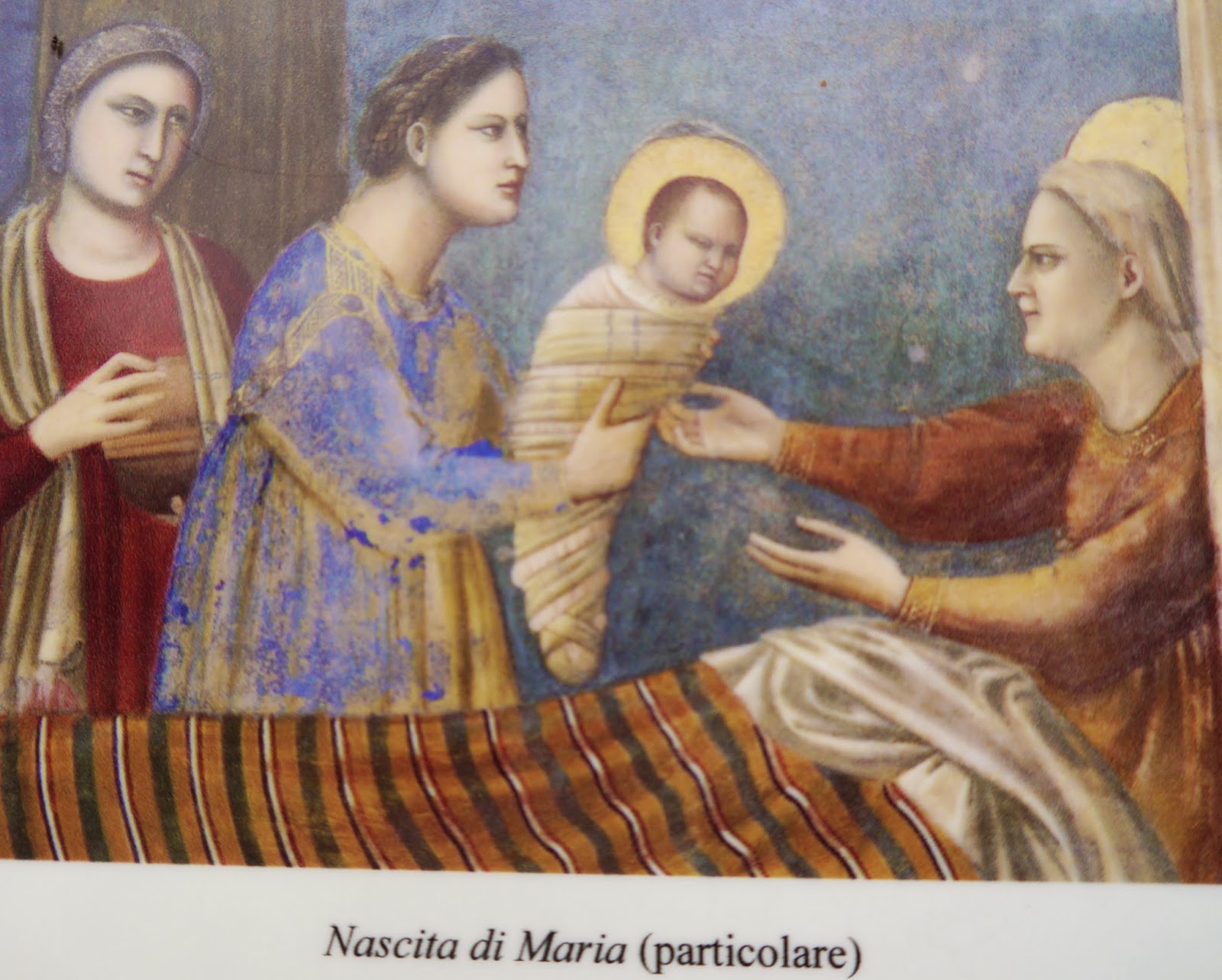
Giotto was a peasant’s son born around 1267, and studied under Cimabue. He helped the master in the monumental decorative work on the Basilica of St Francis at Assisi, and eventually outshone his teacher. His work was, and is, considered groundbreaking for its time - he aimed for natural, narrative representations of events and broke free of lots of Byzantine conventions. His figures have volume and occupy space; he arranges them in perspective landscapes, and depicts them from all angles, even from behind. Dante was writing his ‘Divine Comedy’ at the time that Giotto was painting the Chapel, and he mentions the painter in his ‘Purgatory’:

“In painting Cimabue thought that he / Should hold the field, now Giotto has the cry, / So that the other’s fame is growing dim.”


A little context for the pictures really helps. Outside the Scrovegni Chapel is an open space ringed by the crumbling walls of a Roman ampitheatre. The space was used in the 13th and 14th centuries for public plays and entertainments. These would often be drawn from the Gospels and other religious stories, teaching an illiterate populace the stories that the church (and state) wanted them to learn. 

Have you heard of the pseudo-Gospels? Sometimes they’re called the apocryphal Gospels. They’re basically legends, and were later transcribed by a certain Dominican bishop named Jacobus de Varagine into a literary work called 'The Golden Legend' ("a late medieval bestseller", according to Wiki). These are stories that don’t appear in the published version, so to speak - the Canonical Gospels - but they fill in the back story to the Biblical events. They include a whole history of the Virgin Mary’s parents, Saints Joachim and Anna. (There was a point, later on, when the Church banned poor saints Joachim and Anna - who,it must be said, probably didn’t exist. But by popular demand they were re-instated.)


What has this to do with Giotto’s frescoes? I hear you ask. Well, Giotto reflects the stories that were repeated and acted out in the public square outside the Chapel, with the upper band of six frescoes on the right hand wall telling the stories of Joachim and Anna. On the upper band of the left hand wall, he provides six scenes, mostly apocryphal, from the life of Mary.

Below these, in the middle band, are stories from the life of Christ, and now we’re firmly rooted in the Canonical Gospels: the Wedding at Cana, the Raising of Lazarus and other such favourites.

On the lower band we come to the Passion, and I quote art historian Stefano Zuffi:

“ the scenes devoted to the Passion...take on an increasingly tragic tone. One can feel the emotional build-up, indeed it is almost palpable, as Giotto competes directly with the frescoes in Assisi painted by his teacher Cimabue.”

But that’s not all. The Chapel is also painted with a variety of trompe d’oeil architectural effects, and between the story panels there are a series of painted allegorical figures of the Vices and Virtues, leading us to the entry wall, which is covered with a huge ‘Last Judgement’. This features a figure - said to be the father of the Scrovegni who built the chapel - offering a model of it to the angels. There is a story that this father was a dastardly usurer, and the Chapel was meant as an offering to move him up from Hell to Heaven. The scenes of Hell in Giotto’s ‘Last Judgement’ are said to contain more than the usual number of usurers. The ghastly ape-like devil is present.

And above all this, the vault of the Chapel is painted as a blue sky with stars. Divine? I think so.

The frescoes in the Scrovegni Chapel are considered Giotto’s greatest masterwork, and a watershed in European art. I’ve known myself moved to tears by opera or music, and occasionally by a piece of writing, but Giotto’s frescoes are the only works of visual art that have ever done that to me. The photos here (snapped from the sign outside - no photos allowed in the delicate Chapel) cannot do them justice, but perhaps they can give a small taste. Go sit in the climate-controlled room and wait your turn to see them.


Pacing around Padua

Take home memories of Padova?
The Rough Guide warns that Padua (or ‘Padova’ in Italian) might disappoint. It is, says The Rough Guide, “hemmed in by the sprawl that has accompanied its development as the most important economic centre of the Veneto.” However, it's only a short train ride from Venice, and has plenty of treasures to discover.

First and foremost, there’s the Giotto frescoes from 1305 in the Scrovegni Chapel; and every pilgrim’s goal, ‘Il Santo’, the Basilica of Saint Anthony of Padua. There’s also the second-oldest university in Italy, a couple of delightful market squares - Piazza della Frutta and Piazza delle Erbe (for your fruits and veg); and some lovely porticoed walks. 


Pretty Padua. In parts. 
Piazza della Frutta. Or maybe Piazza delle Erbe 
Padua also has the world’s oldest botanical garden, and - just for contrast - a monument to September 11 by Daniel Libeskind called “Memory and Light”. It contains part of a girder salvaged from the World Trade Centre. It looked kind of moody on a rainy day - I suspect it’s a different sight lit at night.

Libeskind's September 11 Memorial.
The largest town square in Italy. Think cars.
The Prato della Valle claims to be the largest town square in Italy, but I agree with The Rough Guide on this one: “a generally cheerless area, ringed by very wide roads...”

Padua’s Duomo is also dismissed by The Rough Guide: “an unlovely church whose architect took his design from drawings by Michelangelo”. But it does wax lyrical about the adjoining Baptistry: “one of the unclaimed delights of the city.”


Padua's Duomo. It was closed.
But the pretty Bapistry (to the right) was open.

Frescoed Bapistry.
The Baptistry was built in the 13th century, and it’s still in use today. It’s small round interior is heavily frescoed with 14th century paintings by Giusto de’Menabuoi. These do make a fascinating comparison with Giotto’s much more famous cycle in the Scrovegni Chapel - they were done a little later, but I suggest you view them first. You’ll be bowled over by them -- and then you’ll see that Giotto’s are even more amazing. 

Menabuoi’s paintings cover a smaller surface, but a lot more ground. He has many Old testament stories going on on his walls, as well as the lives of Mary and Christ, and of course the inevitable Last Judgement. Though I must say that his airy Resurrection pictures are gently surreal. 

Yes, Padua is certainly worth a stroll.


Pacing around Padua.