Showing posts with label France. Show all posts

Wednesday, August 21, 2013

Shopping in Paris

Paris? Shopping? Shoes?
Twenty-four hours in Paris, and we've seen the famous sights before - what to do? Go shopping, of course. Galeries Lafayette beckoned - the flagship store on Boulevard Haussmann in the 9th arrondissement. This upmarket wonder dates from small beginnings in 1895, and now occupies three sites clustered together. The first owners commissioned the architect Georges Chedanne and his pupil Ferdinand Chanut to design the store at the Haussmann location, where a glass and steel dome and Art Nouveau staircases were finished in 1912.

The sedate store facade hides ten floors of merchandise
and an extraordinary Art Nouveau dome.
Wow! From 1912.
We bustled into the store with a large and seething crowd of shoppers after lunch on a Wednesday. After forging our way through dozens of merchandise displays emblazoned with big brands we emerged into the centre of the ground floor - and were surprised to find ourselves under a beautiful and blazing confection of stained glass and wrought iron: the famous Art Nouveau dome of Galeries Lafayette.

The floors rise up around the dome.
Art Nouveau detail.
Looking down on the brands.
We spent some serious shopping time inspecting the incredible display of highly-priced brand-names: Louis Vuitton, Chanel, Dior, Cartier, Burberry, Dolce & Gabbana, Tiffany....finally settling on some reasonably priced jewellery and a practical backpack. Yes, we managed to buy something at Galeries Lafayette without courting bankruptcy.

Fragrance, jewellery, handbags, watches, cosmetics, fashion, shoes...
Looking upwards.
I have since discovered that it is possible to emerge on the 5th floor and take in a view of Paris which is apparently spectacular -- so intent on finding that perfect purchase, we missed this. I should have read the Trip Advisor reviews first:
We heard from a couple different sources about the free view from the roof. We went up there twice in two days. You can see almost every site Paris is famous for. You can stay up there as long as you like and just relax. A great find!
If had consulted good 'ole Trip Advisor, I might also have been a little more prepared for the loads of bussed-in tourist-shoppers who are seemingly keeping Galeries Lafayette and its expensive brands afloat:
The building is stunningly beautiful. The wide balconies that circle the grand foyer are awash in gourmet foods and luxury fashion designs. The piece de resistence is the domed stained glass roof. The department houses collections of the best designers in the world. However, the department store encourages bus loads of tourists to shop there. The last few times I've visited the store I had to maneuver my way around countless numbers of buses just to get into the store and when I finally made my way into the building I found it so crowded with tourists that I had to leave. I then walked down the street to another grand department store that was equally lovely without the impossible crowds. I would advise travelers to Paris to only visit this establishment in order to see the gorgeous interior. Don't plan on shopping there. (Trip Advisor review).
We were stunned to find that about 90% of our fellow-shoppers seemed to come from Mainland China -- I understand that the big brands can be more expensive there, but queuing for half an hour to buy a handbag? My shopping companion and I opted for a little break at the champagne bar.

Champagne break. So French.

Tuesday, August 20, 2013

Cooking Class - Michelin Star-Style

Chef Michael begins...
An opportunity for a cooking lesson/demonstration from a Micheline-starred chef in France? The answer is, naturellement, 'oui, oui!' Our chef was the amazing Michael Nizzero, presently at L'Hostellerie la Briqueterie at Vinay, near Epernay in the champagne region. A snippet of his impressive resumé from their website:
Michael Nizzero is a 28yr old Belgian Chef who joins us from The Waterside Inn, Berkshire, UK. Chef Nizzero spent 4 years at the prestigious 3 Michelin starred Waterside Inn as First Sous-chef, under Grand-chefs Michel and Alain Roux. Previous to this he was Head Chef of Pisces Restaurant, Madinat Jumeirah, Dubai. Under his guardianship this restaurant was awarded best seafood restaurant in Dubai 3 years in a row.
This already tells us that the food is likely to be pretty wonderful, but we had checked this out by dining at La Briqueterie the evening before: foie gras, delicate fish, and a cheese trolley straight from heaven. What would Chef Michael have to show us in his high-powered kitchen the next morning?

The recipe, he said, was a favourite of his which he had included on the menu ever since he had begun at La Briqueterie: Tartare de langoustines aux senteur d'agrumes , toast melba et caviar d’Aquitaine.
After a brief kitchen tour, and some attention to the day's supply of foie gras, prepping it to be baked, Michael turned to his ingredients, laid out on the stainless steel bench.

"First," he said, "kill your langoustine." They like things fresh at La Briqueterie. But if you don't have any handy langoustine, you can use instead yabbies, or scallops.

I'll give you Michael's recipe - in French, but I'm sure you can work it out - then add a photo tour of the proceedings, and a video of Michael in action. Easy to make at home! After you catch your langoustine, of course. Bon appétit.

Tartare de langoustines aux senteur d'agrumes , toast melba et caviar d’Aquitaine
4 personnes

Pour les langoustines
Langoustines 24 pièces décortiquées et taillées en grosse brunoise

Pour la garniture
Chili vert x 1 en brunoise
Chili rouge x 1 en brunoise
Ciboulette x 1 botte ciselée
Zestes de citron vert
Zestes de citron jaune
Zestes d'orange
Sel / Poivre
Frisée
Vinaigrette
Pousses de betterave x 12
Pousses de red chard x 12
Caviar d’Aquitaine x 40 gr
12 toasts Melba

Pour la vinaigrette d'agrumes
Citron vert x 2 pressés Citrons jaunes x 2 pressés Oranges x 2
Huile d'olive Papillon
Sel / Poivre

Dressage
Mélanger le jus des 3 agrumes à l’huile d’olive ; assaisonner. Ajouter ensuite le tartare de langoustines avec les brunoises de chili , la ciboulette , les zestes d'agrumes , sel et poivre et la vinaigrette d'agrumes. Dresser sur une assiette comme sur la photo.


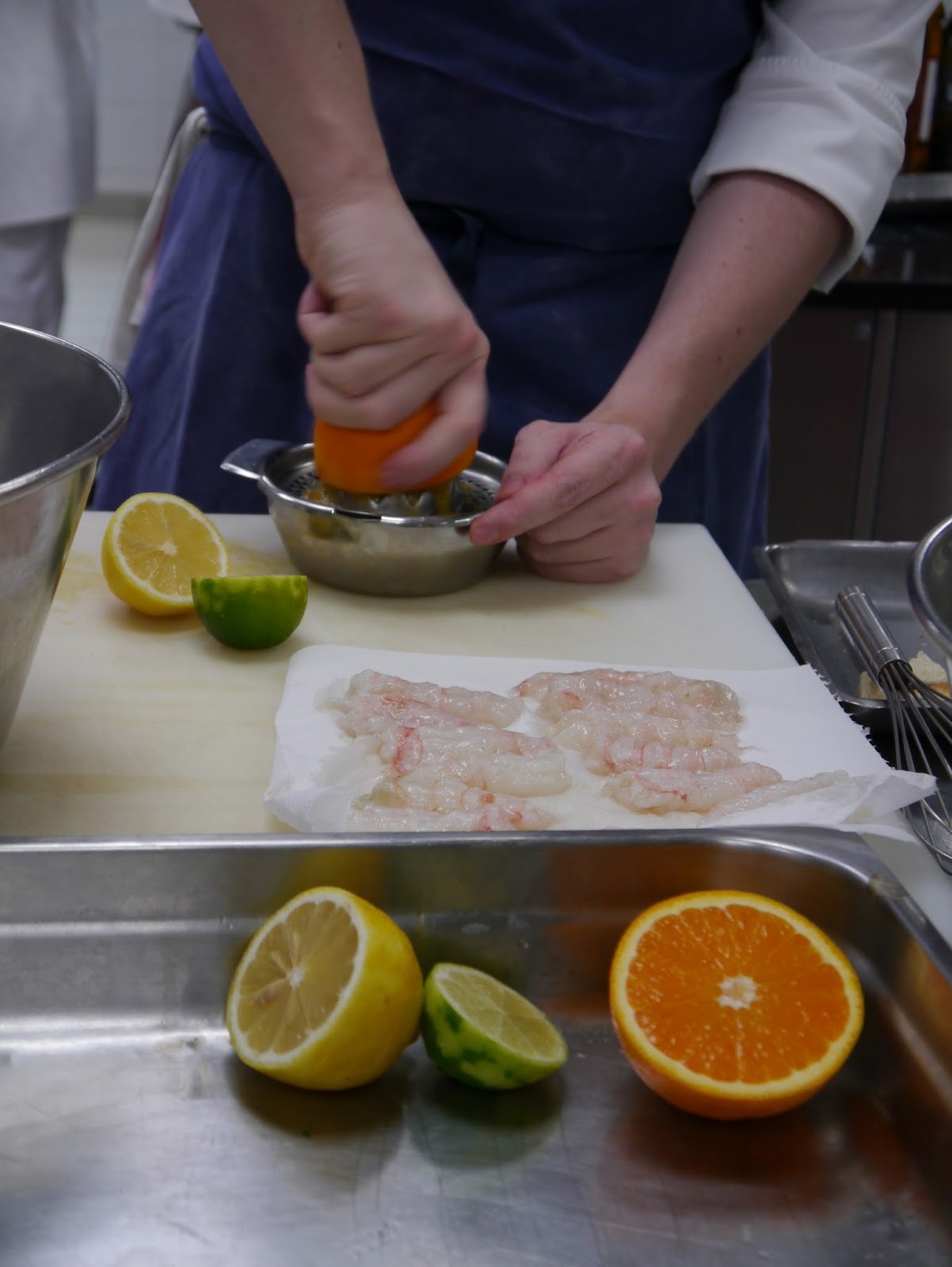
Juice of three different citrus: lemon, lime & orange.
Zest of the three citrus.
Quality virgin olive oil.
Combine half-and-half citrus juice and olive oil and season.
Chop previously prepared langoustine into 1cm chunks.
Add zest to chopped langoustine.
Mild red and green jalapeño peppers
finely diced (with the skill of a professional chef, of course)
Add diced peppers to the langoustine.
Chives, chopped finely with similar skill.
Add chives to langoustine.
Season.
Michael adds the vinaigrette to the langoustine.
Mix well.
Finished langoustine and vinaigrette mixture.
Spoon mixture into a small circular mould to shape for serving.
Decorate with tiny melba toasts.
Garnish with some delicate  greenery.
Michael's suggested brand of caviar.
Top with a generous spoonful of caviar.
Taste!
That went quickly....

Monday, August 19, 2013

The Small Producers

Small producer Herve Gallais shows us his vines.
One of the unexpected joys of our visit to Champagne was discovering the "small producers". The Champagne region has 32,000 hectares and 19,000 producers: that's a lot of people with only a hectare or two to put under vine. The price of a hectare of land in this region is between €1m and €1.9m (the more expensive are the 'grand cru' and 'première cru' areas which are said to produce the best fruit). The big producers would love to buy out the small producers, but the small guys aren't selling. They'll sell their grapes, yes, and do -- otherwise the big houses couldn't make the quantities of champagne that they do. But the small guys like to keep producing their own wonderful champagne -- some for themselves, some they sell on to lucky purchasers. The quality we found was astounding! And at a fraction the cost of the big houses, since there's no marketing spend.

The Champagne region marked in red on a map of France
Join me on a photo tour of a visit to Herve Gallais, who runs a small vineyard and champagne winery with his family in the village of Boursault.

In the village of Boursault
Chateau Boursault: Madame Cliquot's old hunting lodge

Herve explains the grape varieties.
Chardonnay -- champagne on the vine. 
Herve explains how to tell which grape is which...I didn't really get it. It's subtle.
Pinot Noir and Chardonnay. Hold that thought.
Looking out across the beautiful Marne Valley.
It's not easy having a chateau in the family.
The place is presently under slow renovation.
Not quite sure what Herve is illustrating here.
I think he's saying "we press gently..."
This is the stainless steel vat in which the first fermentation takes place.
In his own small cave Herve shows us the yeast and sugar lees in a bottle.
Learning to do the remuage.
The tasting facilities may not have been swanky, but the champagne was
delicious and plentiful, and the view divine. Plus a very reasonable price list.
A case is on its way to me!
Happy Champagne visitors: guide Sydney with us.

Sunday, August 18, 2013

More champagne? Mais naturellement...

The Tattinger Estate, Champagne
Visiting Champagne provides a cornucopia of experiences - the champagne itself, the lush French countryside, large houses, champagne, small houses, more champagne, delectable food, rose champagne, vintage champagne...well, you get the idea.

The vines!
Our base for exploring the region was the small town of Cumières, a few minutes from Epernay. Our landlord, who ran a three-room establishment, gave us lifts to nearby restaurants, stuffing his Gauloise in his back pocket and speeding dangerously through the vine-clad hillsides.

Our address in Cumières.
Dom Pérignon
Above Cumières was the even smaller village of Hautvillers, ridiculously picturesque, and the site of the rebuilt Abbey once inhabited by Dom Pérignon, the monk who some say "invented" champagne -- bless him. Wiki says:
Contrary to legend and popular belief, Dom Pérignon did not invent sparkling wine, but he did make important contributions to the production and quality of Champagne wine. The oldest recorded sparkling wine is Blanquette de Limoux, which was apparently invented by Benedictine Monks in the Abbey of Saint Hilaire, near Carcassonne in 1531. They achieved this by bottling the wine before the initial fermentation had ended. Over a century later, the English scientist and physician Christopher Merret documented the addition of sugar to a finished wine to create a second fermentation, which occurred six years before Dom Perignon set foot in the Abbey of Hautvillers and almost 40 years before it was claimed that the famed Benedictine monk invented Champagne. Merret presented the Royal Society with a paper, in which he detailed what is now called méthode champenoise, in 1662. Merret's discoveries coincided also with English glass-makers technical developments that allowed bottles to be produced that could withstand the required internal pressures during the secondary fermentation process. French glass-makers at this time could not produce bottles of the required quality or strength.
I don't think it would be wise to get into an argument about wether the English first invented champagne, but whatever his contribution, Dom Pérignon seems to have spent a good deal of his time perfecting the technique, and he's glorified for his efforts today. The Abbey, and by association, the name Dom Pérignon, is today owned by the house of Moët & Chandon. They produce a high-end vintage champagne labelled "Dom Pérignon" - first made in the early twentieth century.

Moët & Chandon caves.
Moët: the largest.
Inscrutable codes on the waiting Moët bottles -
referring to the blend, the year and the location.
That odd-looking gap supported with a couple of bits of wood?
That's were a bottle exploded.
Dom Pérignon magnums, resting quietly.
Ah! The tasting moment at Moët & Chandon.
All sizes.
Moët & Chandon is the biggest house in Champagne, both in terms of the land owned and the quantity of champagne produced. But like all the big houses they cannot produce enough grapes on their own land to make their large quantities of wine, so they buy grapes from the small producers. Moët is also one of the oldest houses, founded in 1743 by Claude Moët. Napoleon is said to have visited his friends at Moët & Chandon rather frequently - understandable. At the house, on Epernay's famed Avenue de Champagne, you can view the very tree under which Napoleon is said to have sipped champagne.

But let's leave Napoleon sipping his Moët and head on over to another large house in Reims, Pommery, where they have their own innovative champagne widow. Madame Pommery is said to have launched the first commercially successful 'Brut' champagne in history in 1874 at a time when champagne was excessively sweetened with sugar.

Pommery.
The Widow Pommery.
You'd think she'd look happier. 
Over at Pommery, they celebrate their own champagne widow - Louise Pommery, an almost-contemporary of the Widow Cliquot, and like her, successful in building a house that thrives today.

Looking upwards in the caves at Pommery. Roman excavated.
Pommery champagne waits in the dark.
Pommery's caves: attractive.
If a visit to Veuve Cliquot is about innovation, and a visit to Moët & Chandon is about the biggest, then a visit to Pommery is about quirkiness. There, they fill their caves with not only champagne, but also funky modern art works. If it's your third caves visit, and you've already had plenty of champagne, it's fun.

A little modern art with your champagne?
From the Pommery website:
Monumental exhibitions of contemporary art named "Experience Pommery" have been staged annually in the Domaine's chalk pits cellars since 2004. These selections of works provide a wide-ranging panorama of the international art scene, showing the diversity of cultures, languages and procedures. These exhibitions make the Pommery Estate an essential venue on the contemporary international artistic scene and, like Champagne, are an experience to share.
Ah! The tasting moment again!
"Madame Pommery described her Champagne in two words, joyful lightness." 

"Going a little further, Pommery has delicacy and intensity, heart and spirit, and a subtle style that is able to distinguish and promote the elegance of the flavours rather than their power. A completely fresh style, with a flash of flavours that settle on the palate to produce a tender taste."
Thierry Gasco, Cellar Master, Pommery

Saluté from Pommery.