Showing posts with label Food. Show all posts

Thursday, December 26, 2013

Going Organic This Christmas

Superfood Gingerbread Men!

We made a big effort this Christmas. Despite a Sydney Christmas occurring in mid-summer, we can't resist the old tradition of a stuffed and roasted turkey, roasted root veggies and a ham. But we can still be ethical and healthy, right? Hmmm...

Happy turkey being basted.
Happy ham.
This year we did our best to find a turkey that had lived a happy and antibiotic-free life, pecking away in a farmyard somewhere. We were helped in this quest by Sam the Butcher, and he also provided a ham from a happy pig.

The turkey's stuffing was made from a loaf of artisanal sourdough bread, from Bowen Island Bakery, where they're currently training members of the refugee community in Sydney as bakers. We went for the traditional 'Scarborough Fair' stuffing: parsley, sage, rosemary and thyme, with lots of onions.

The root veggies, the onions and the beautiful fresh herbs came from Doorstop Organics. The turkey was bated with a delicious orange glaze made with organic oranges, and - oops! - Cointreau.

The Gingerbread Men this year were of the superfood variety: almond meal & buckwheat instead of flour, coconut oil instead of butter, dates instead of sugar, goji berry eyes & almond mouths. "Ironically," said the cook, " they look drunk and overweight." But delish!

Organic parsley - super fresh.
Organic veggies.

Artisanal sourdough bread fro the stuffing.
A cup of fresh herbs: parsley, sage, rosemary and thyme.
The 'Scarborough Fair' stuffing mixture.

Magnificent orange-glazed turkey.
All that was left was to enjoy it all with family and friends around the big table.

Merry Christmas!

Carving beautifully.
Merry Family Christmas.

The turkey recipe....

Hot Orange Glazed Turkey with Scarborough Fair stuffing

a 5-6kg whole turkey
50g butter
1 large onion, peeled
3 carrots
1 cup white wine

Hot orange glaze
zest and juice from 2 whole oranges
1/4 cup honey
3 tbsp fish sauce
1 tbsp Cointreau

Scarborough Fair stuffing
1 loaf white bread
200g unsalted butter
1 tsp salt
1 bunch each of parsley, sage, rosemary and thyme
2 large onions, finely chopped
about 1 cup of water or chicken stock

1. Heat your oven to 180C.

2. Make the stuffing by removing the crusts from a loaf of bread and cutting the white bread into large cubes. Pulse in a food processor to coarse fresh bread crumbs. Fry the onions in a 50g of the butter until translucent and softened but not coloured. Remove from the heat and add the remaining butter to the hot pan, allowing it to melt. Strip the leaves of the herbs from any stems and finely shred them to produce 1 cup of shredded herbs. Into the bread crumbs mix the softened onions with melted butter, herbs, salt and a little stock or water to create a soft stuffing.

3. Rinse the turkey under running water (remove the neck if still attached) and drain well. Stuff the stuffing into both the neck and rear cavity of the bird. Truss the turkey with kitchen string; start at the neck flap, pin the wings to the body and cross the back of the bird. Loop under the parson’s nose and tie the legs together at the ankles. Rub the skin of the bird with 50g of softened butter and season well with salt.

4. Split the carrots in half lengthways (you don't need to peel them) and cut the onion into chunks. Place the carrot and onion on the base of a roasting pan and place the turkey on top of the vegetables. Cover the pan with foil and roast in the oven for 2 hours, basting every half hour with the juices collecting in the pan. After 2 hours, uncover the pan and roast for a further hour, until the skin of the bird is browned.

5. While the turkey is roasting, mix together the ingredients for the hot orange glaze in a small saucepan and simmer for 30 minutes until thick and glossy. After the turkey has been roasting for a total of 3 hours, begin to brush with the glaze every 15 minutes for an additional 45 minutes.

6. Remove the turkey from the oven and cover loosely with foil. Rest for 30 minutes in a draught-free place, continuing to brush the turkey with hot glaze every 15 minutes, even while resting.

7. Remove the turkey from the pan and drain off and reserve any pan juices. There should not be too much oil in the pan but if there is a lot then you may want to skim some of the oil. Place the pan over heat on the stove and scatter 2 tbsp of plain flour over the pan and vegetables. Scrape the bottom of the pan and add in the white wine to deglaze, roughly mashing the vegetables. Return the pan juices to the pan and stir until thickened. Strain the gravy and serve with the turkey.

Serves 10


Thursday, December 12, 2013

Otto's


There are only a very few restaurants for which this blog takes time out from its usual frenzy of opera, travel and theatre, but another of those rare moments has arrived.

On Gray's Inn Road in London you'll find the small but delightful Otto's. I have the privilege of being good friends with a good friend of Otto himself (that's only two degrees of separation, so there's something in it, surely.) I've enjoyed several lovely meals at Otto's, with said good friend, and it only keeps getting better.


The food style is old-fashioned French - traditional dishes, some prepared table-side, all delivered with flair and aplomb by well-trained young things in white coats (or Otto himself, who is never far away). Regulars are welcomed like old friends. The wine choice is lovingly discussed. The divine jamon iberico or Scottish smoked salmon is delicately carved tableside. You can have a lovely French duck thing, but you have to let them know in advance. This is slow food. Nice and slow.


The Sunday after my last meal at Otto's, the restaurant achieved a glowing review from London restaurant reviewer Tom Parker-Bowles. You can read it here. I quote a little (I can't resist - the food descriptions are a work of art in themselves):
...there’s nothing arch about Otto’s, an unashamedly old-fashioned French restaurant that acts as if nouvelle cuisine were little more than a long-forgotten fragment of some dyspeptic cauchemar.
It’s a proper, well-behaved, straight-faced sort of place, with immaculate waiters and waitresses clad in immaculate black ties and white shirts...The more cynical might call it dated, but to me, it feels like a proper dining room, a place that has matured like good Burgundy.
Snails arrive mouth-blisteringly hot, and actually have a subtle taste of their own. Astounding. Hare is one beast that could never be accused of lacking punch. And a really visceral specimen would put a tiger off his tea. Here, though, the roast saddle is pinkly restrained, the feral heft more slap than punch. Mulled pear and redcurrant sauce not only offer relief, but push the dish to ever greater heights.
Tournedos Rossini shoves two fat fingers up to parsimony and restraint, a chunk of beautiful fillet steak upon which perches a plump lobe of foie gras. Which in turn is topped with a blizzard of shaved black truffle.  Just writing about it makes the belly sag and the senses cheer.
No-nonsense, beautifully wrought classical French cooking, from the culinary ancien régime.
Because great recipes will always outlast the fickle and fashionable, as long as good chefs are there to do them justice.  At Otto’s they have both, and flawless service to match.
Here's another review - equally glowing. Here's the description of the duck dish:
...it feels like a room in which very good things can happen. Unless you're a duck. Otto's has mostly gained attention for its hulking silver duck press, originally fashioned for a luxe hotel in Provence in the 1920s, which takes pride of place in the dining room. For £120 for two – ordered in advance – Otto's will roast you a whole duck, sourced from the same farm that supplies La Tour d'Argent in Paris, the originator of this dish. It is served in two parts, legs first, followed by slices of rare breast, under a stupidly rich sauce made from the juices of the bird, extracted by crushing it in the press: those juices, the liver, cognac, other stuff, a side order of defibrillator. I will just have to find a friend and save up.

Otto. (source)

Here's a press article which introduces you to Otto's story, and his efforts with the duck.
Otto Albert Tepassé is from an Austrian family of hoteliers and restaurateurs. He worked in some of the greatest dining rooms in Paris, including La Tour D’Argent, spiritual home of the pressed duck...
Otto continues his story: coming to London, working at the original Mirabelle, moving on to seemingly every important room in town. Now, he explains, he is older, tired and simply wants to run this, his first restaurant, quietly and well....
...I wanted pressed duck at La Tour D’Argent ever since I read about it as a 13-year-old. I loved the Grand Guignol excess and mad decadence, but it was 30 years later when I finally got there. Now canard à la presse is in London, being performed by a man who understands its tradition. If you love food, I urge you to go to Otto’s, and open your heart both to a piece of pure food theatre and to that rare thing: a meal you’ll remember your whole life.

Otto's 
182 Gray’s Inn Road 
London 
WC1X 8EW 
United Kingdom 
Telephone: 020 7713 0107 
Email: enquiries@ottos-restaurant.com 

Photos are mainly from Otto's website.


Tuesday, December 3, 2013

Little Italy

Deep in Manhattan...(source)
On a recent visit to New York City for four days, I ate nothing but Italian. Granted, I was visiting with an actual Italian, but still...New York City has many neighbourhoods, and "Little Italy" has been established for a century. It even has its own website.
Geographically, it centres around Mott and Mulberry Streets, St Patrick's Old Cathedral (at 263 Mulberry), and a cluster of restaurants, delis and cafés all channeling the Old Country.


Let me take you on a tour of the Little Italy sites I sampled...
Emilio's place...
Join me for dinner at Emilio's Ballato restaurant at 55 E Houston St. Emilio is from the Amalfi Coast. As such, he is careful about his food, careful about his guests (no reservations, BTW) and if you're an Italian from the Amalfi Coast you get to invade his kitchen to give instructions about your dinner. This reviewer complains that "Ballato’s clubbiness can seem off-putting, especially as owner Emilio Vitolo scrutinizes newcomers from his front corner table" but is won over in the end:
Vitolo favors unfussy preparations of classic dishes. Almost all are winners. Hearty rigatoni alla Bolognese comes in a thick sauce with beef, veal, and pork, while baked shrimp benefits from pristine seafood and simple garlic and bread crumbs. An extensive and reasonable wine list includes Ballato’s own label, produced by a Tuscan friend. A private dining space in back has hosted celebs like Billy Joel, Lenny Kravitz, and Tom Hanks, while a central-casting mix of outer-borough Italians, younger locals, and wide-eyed tourists people the spare main dining room. The club vibe pervades, but doesn’t exclude: If Vitolo doesn’t know your name when you’re seated, he will by the time you’ve finished your espresso and nibbled on a plate of on-the-house biscotti.
Lou and Sam's place...
 For your deli requirements - gorgeous imports from Italy - the motherlode is at Di Palo's, 200 Grand Street. Lou is one of the brothers running the place, and his son Sam is in charge of the wine enoteca (all Italian wine, of course). Various other daughters, wives, brothers, sisters-in-law, aunts and uncles assist: heirs to a business that's been in the family for several generations. Lou and Sam have visited the Amalfi Coast, and source some of their products and wines from the region.

New Yorkers crowding Di Palo's
Pick up your panettoni in Di Palo's
In Di Palo's enoteca we find...wine from our friend Alfonso's Tramonti vineyard on the Amalfi Coast, Monte di Grazie. 
And a sample of his old vines!

On the corner of Mulberry and Grand is a small, slightly amateurish but very sincere small museum, the Italian American Museum. What better location? This historic location on the corner of Mulberry and Grand Streets once housed “Banca Stabile” which was founded by Francesco Rosario Stabile in 1885. During its heyday, the bank offered the newly arrived immigrants from Italy much more than financial services. It was a link for the Immigrants in the United States with their relatives in Italy. In addition to a full range of banking services, it also provided the following services: telegraph, travel via steam ships, import-export, notary public, and post office; a kind of all in one immigrant community service centre. (source: their website).

Some Napoli presipo in the Museum - and a lectern for those special occasions.
The Italian American Museum goes to explain (on it's website) that it "is more than an immigration museum. Its purpose is to document the myriad of contributions made by the people of Italy and their descendants to the very fabric of American society from its earliest origins and its philosophical underpinning through philosophers, explorers, adventurers, industrialists, scientists, educators, politicians, and everyday extraordinary people, telling the whole story which continues to flourish and evolve in America today. Italian Americans are the fifth largest ethnic group in the United States of America today, with distinct cultural values and traits which distinguish them as a people within the greater multicultural American society. Thus, the museum serves as a point of reference for those who are Italian Americans and those who wish to learn about Italian Americans."

Papers from the bank vaults documenting the immigrants who arrived by sea, 
The Library of Congress tells part of the story here:
Most of this generation of Italian immigrants took their first steps on U.S. soil in a place that has now become a legend—Ellis Island. In the 1880s, they numbered 300,000; in the 1890s, 600,000; in the decade after that, more than two million. By 1920, when immigration began to taper off, more than 4 million Italians had come to the United States, and represented more than 10 percent of the nation’s foreign-born population. 
What brought about this dramatic surge in immigration? The causes are complex, and each hopeful individual or family no doubt had a unique story. By the late 19th century, the peninsula of Italy had finally been brought under one flag, but the land and the people were by no means unified. Decades of internal strife had left a legacy of violence, social chaos, and widespread poverty. The peasants in the primarily poor, mostly rural south of Italy and on the island of Sicily had little hope of improving their lot. Diseases and natural disasters swept through the new nation, but its fledgling government was in no condition to bring aid to the people. As transatlantic transportation became more affordable, and as word of American prosperity came via returning immigrants and U.S. recruiters, Italians found it increasingly difficult to resist the call of “L’America”. 
Famous Italian-Americans commemorated: Here, Serpico "The cop who defied the system."
And here's a photo of our friends at Di Palo!
Did you know that the chief sculptor of Mount Rushmore was an Italian, Luigi Del Bianco?

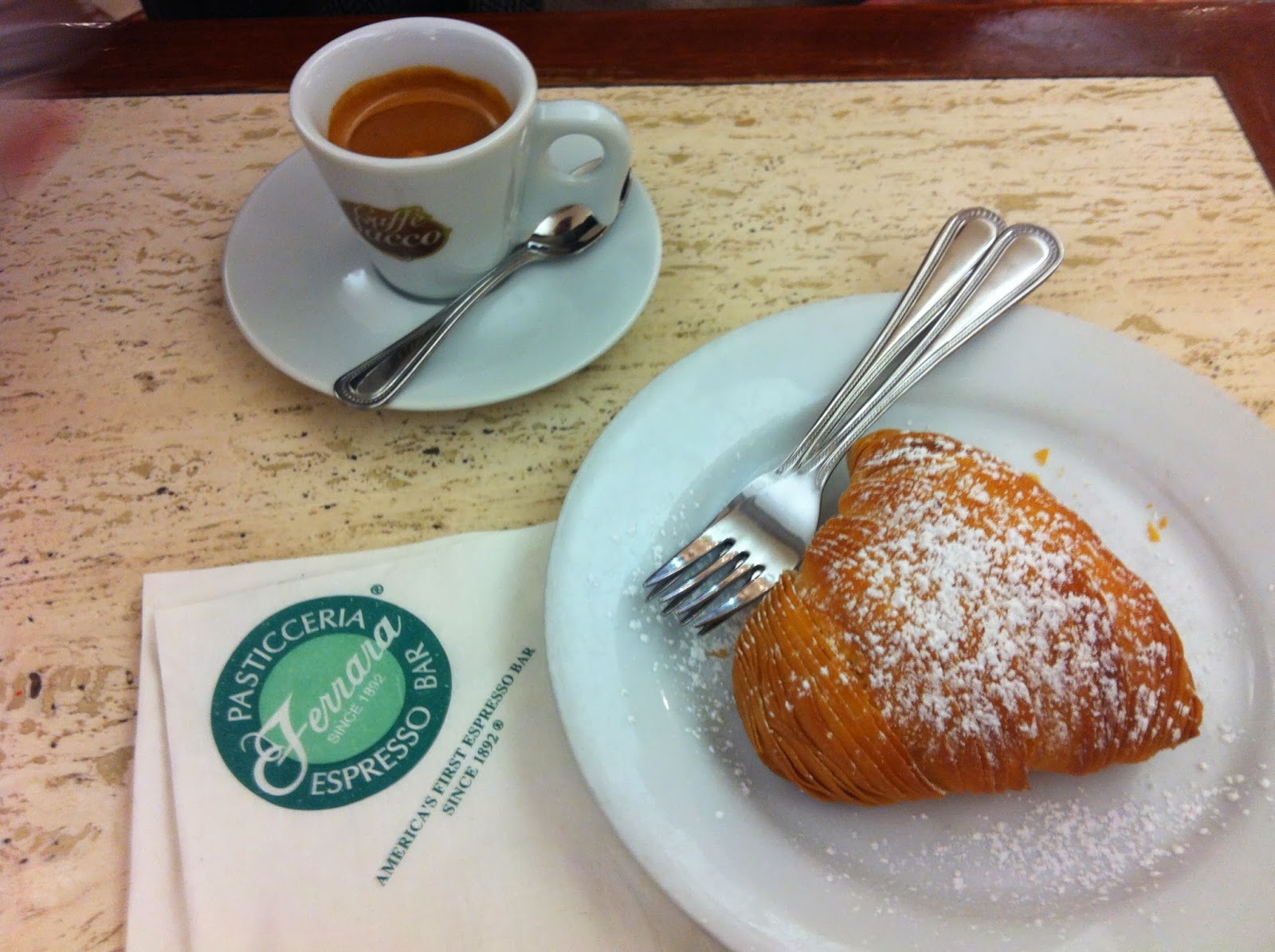
And finally, let's stop for an espresso and sfogliatella at Ferrara Bakery and Café, 195 Grand Street
between Mulberry & Mott St. As they exclaim on their website:

For four generations, the Ferrara family has been delighting Little Italy with its outstanding Italian/French desserts. Cannoli, sfogliatella, gelati and more have been made right here since 1892.
Today, not only can you come in and enjoy the "Ferrara Favorites" along with specialty coffees, lattes and espressos, you can now order for delivery anywhere in the continental USA for a taste of Little Italy at home!

I can report that both the espresso and the sfogliatella were, indeed, like a taste of home.


Saturday, November 23, 2013

Key West: Chickens, Cats & Conch

Sauce with your conch fritters? Key West.
The southernmost of the Florida Keys - in fact, the southernmost point of the USA - is twice the size that it once was. It's a US naval base, and over the years the navy has reclaimed so much land that the key is now divided into Old Town (funky, quirky, interesting) and New Town (boring, full of service companies and cheap hotels). Still, the original Old Town has something about it -- President Harry Truman loved staying here (there's even a 'Little White House'), as did Hemingway, Tennessee Williams and other arty characters with a few secrets and a fondness for the sun.

Truman remembered. Key West
The chickens? In the Old Town they wander about unmolested (there's a law protecting them), the roosters occasionally crowing between the coconut vendors. They're remnants of Cuban cock-fighting birds, set free when the grim 'sport' was outlawed.

Why is that chicken crossing the road?
The cats? Well, over at the Hemingway place there are about 45 of them, all descended from 'Snowball', the household cat when Ernest Hemingway lived there with his second wife Pauline and their two sons. Snowball had six 'toes', and so do about half of his current descendants.

A six-toed cat resting on Hemingway's bed. Key West.
Hemingway had it good in Key West. A boy from Oak Park, Illinois, he'd served and been wounded n WWI ("A Farewell To Arms"); lived his 'Paris years' with his first wife Hadley, making forays into Spain ("The Sun Also Rises", "For Whom The Bell Tolls"); dumped Hadley and married Pauline. From Key West he took big game hunting safaris in Africa ("The Snows of Kilimanjaro") and he kept a custom-built deep-sea fishing boat. He liked to go fishing in Cuba ("The Old Man and the Sea"). Yep, the Key West years were prosperous and the lovely old island-architecture house (with huge swimming pool) attests to that. You can visit 'Papa's' writing studio in the old stable.

The Hemingway place, Key West.
Hemingway's writing studio., Key West Here, 'The Snows of Kilimanjaro' was created.
You can also gawk at Sloppy Joe's Bar (the original site and the later site) where Hemingway drank (a lot), and where he met Martha Gelhorn, his third wife. He dumped Pauline and moved with Martha to Cuba. Pauline got the Key West house. (Martha was later dumped for fourth wife Mary; Cuba had its revolution and the Hemingways moved to Idaho, where Ernest eventually shot himself).

Sloppy Joe's on Duval Street, Key West.
But back to Key West, a quirky haven for writers and artists and 'alternative-lifestylers'. Poets.org says:
Long before the overseas highway connected it to the mainland and cruise ships made it a regular port of call, Key West was a tropical frontier town. Populated in the early twentieth century by an eclectic mix of fishermen, spongers, rum runners, and cigar makers, the tiny island was more Caribbean than American. Over 100 miles from mainland Florida and the southernmost point in the United States, Key West has attracted numerous artists and writers, including Ernest Hemingway, Wallace Stevens, Ralph Ellison, Elizabeth Bishop, Tennessee Williams, Robert Frost, and James Merrill, with its remote location, tropical setting, and wild spirit. 
Tennessee Williams first came to Key West at age thirty, in 1941. After living in a boarding house, he bought a clapboard Bahamian cottage on the outside of town, at 1431 Duncan Street, where he created a compound with a guest cottage, swimming pool, and one-room writing studio he called the "Mad House."
Pretty Key West architecture.
Bisque on the Beach. Key West.

More recently, Calvin Klein had a house in Key West, a lovely wooden confection in an octagonal shape, painted white and pale turquoise. Nearby is a house left by its owner to her cats, a bequest upheld by the courts. Key West lost many of its gay residents to the Aids epidemic, and has its own sombre Aids memorial. Its near the beaches on the Atlantic side of the island. I enjoyed a bowl of excellent seafood bisque on Higgs' Beach (memo to self: look up Clarence S. Higgs; he's probably a relative). The sea doesn't roll up in big surf here - there's a reef about five miles out. The sand is trucked in.
Calvin Klein's (ex) house, Key West.
This reef proved a source of prosperity for Key West in the past - claiming salvage from the shipwrecks was a major industry. Many of the fine old wooden mansions in the town are wreckers' houses. There was also a thriving pineapple industry until a blight wiped out the pineapples. Today tourism rules. Duval Street is full of chi-chi galleries and gay bars at one end, and noisy drinking holes and t-shirt shops at the other. Mallory Square shops will sell you a conch shell or a sea-sponge while you wait for the big cruise ships to get out of the way, so you can see the glorious sunset.

Pauline Hemingway's bedside lamp. Homage to the pineapple.
Conch fritters? Mojito?


On the Gulf side of the Key is the old seaport where the fishing boats, sailing boats, dinghies and runabouts moor, in front of crab shacks and mojito bars. At sunset, tradition has it that a conch shell is sounded - blown through a hole in one end to produce a low hoot which marks the going down of the sun on another day in paradise.


And Key Lime pie for afters?
The conch? It's everywhere, not just the shell, but also the fritters, Bahamian-style (Key West is just 90 miles north of Cuba, closer than it is to Miami). In the 1980s, after the US Government set up a customs post between Key West and the mainland of the USA (there was a bit of trouble with smuggling), the Key briefly declared itself a republic and 'seceded from the Union.' It became "The Conch Republic", with a flag and all. There was a psuedo-battle involving throwing stale bread at the Navy, a backdown by the rebels, a gracious removal of the customs post by the US government, and an excuse for another annual festival was born.

A local member of The Conch Republic.
Speaking of festivals, I was lucky to just miss Key West's 'Fantasy Festival' held around Hallowe'en. They had 75,000 visitors this year, principally because public nudity laws are relaxed for the duration and the main 'costumes' are merely body paint.

That's Key West.

Jimmy Buffett got his start singing in bars in Key West.
Only 90 mies to Cuba! The southernmost point of the USA.
"The Conch Republic."


Saturday, November 9, 2013

Pasta al forno

Italian comfort food.
The other night, the November days quickly growing shorter, seemed like a good time to try pasta al forno, Italian comfort food. Recipes vary. Here's one from David Rocco, in case you want something with formal quantities:

PASTA AL FORNO
1 lb rigatoni pasta (450g)
4 tablespoons extra virgin olive oil (60ml)
2 garlic cloves, chopped
1 large eggplant, cubed
15 infornate olives, pitted and chopped
10 large sun-dried tomatoes, chopped
2 dried chili pepper, crushed (optional)
1 jar of tomato puree (750ml)
0.8lb freshly grated mozzarella (400g)
smoked scamorza cheese, as much as desired, roughly chopped
freshly grated parmigiano cheese for sprinklingsalt to taste

To start your Pasta al Forno: Preheat oven to 400 degrees Fahrenheit.
While the rigatoni cooks in salted boiling water, prepare the sauce. In a saucepan heat up olive oil and sautí garlic, eggplant, olives, sun-dried tomatoes and chili peppers for a few minutes. Add tomato puree and salt. Let cook for approximately 10 minutes on medium heat.
Drain rigatoni, add to the saucepan, sprinkle with some parmigiano and cook for another 30 seconds.
Place half the rigatoni in a baking dish, adding a layer of half of the mozzarella, half of the scamorza and another sprinkle of parmigiano cheese over the pasta. Add the remaining rigatoni, and follow with a final layer of all the cheeses. Bake for 20 to 30 minutes or until golden brown. Per 4 persone.

Or, you could skip the eggplant, garlic and olives, and use your home-made tomato sauce made from local pomodoro, and substitute ricotta for the mozzarella, and a little of whatever local cheese you have for the top. You can also use whatever pasta you have in the cupboard, if there's no rigatoni about.Oh, and make the sauce with a little meat, if you like. And some hard boiled eggs. Hmm...I wonder if that David Rocco guy knows il vero pasta al forno? Ah - further investigation reveals that pasta al forno with eggplant is more Sicilian....to each his own...

For the variety we made, just follow these photos:  buon apetito!


A good onion. A little beef.
Add a little pork sausage if you like.
Onions softened, olive oil added, meat browned. Now add tomato sauce.
Ingredients: rigatoni, ricotto, a little provelone.
Add some sale grosso to the simmering sauce. 45 mins.
Boil your pasta.
Draining pasta, adding a little olive oil.
Sauce in the baking dish.
Pasta on the sauce.
Layer of sliced ricotta.
A few hard-boiled eggs if you like.
Another layer of sauce.
Another layer of pasta - lasagne sheets this time.
More sauce on top.
Slices of provelone cheese.
Ready for 15 mins in the oven.
Done!
Serve!
...with some vital accompaniments.